
I'm going to be honest about something: I almost didn't finish this book. Not because it's bad — it's really, really good — but because I started it during my car-time-in-the-garage ritual and the opening scene hit me so hard I just sat there with the engine off, staring at the garage door, forgetting I had a toddler inside who was definitely awake from her nap by now.
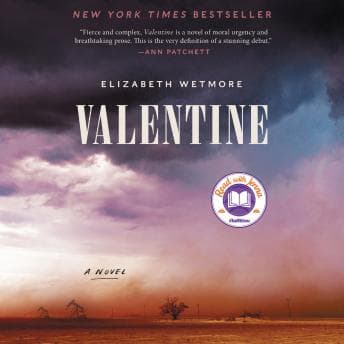
Valentine opens with fourteen-year-old Gloria Ramírez showing up on a stranger's porch in the dark hours after Valentine's Day, beaten and assaulted, barely conscious. And then the book doesn't let you look away from what that violence does — not just to Gloria, but to every woman in this dusty, oil-soaked corner of West Texas. This is not a comfort read. I need to say that upfront because if you're coming to my reviews for cozy recommendations, this ain't it. But sometimes a book grabs you by the collar and you just... let it.
West Texas Wind Gets Into Everything, Including Your Bones
Elizabeth Wetmore writes Odessa, Texas in 1976 like it's a character with a grudge. The dust, the oil rigs, the relentless wind — Cassandra Campbell's narration gives all of it this low, steady West Texas twang that made me feel parched just sitting in my minivan. The town itself is practically hostile, and that hostility seeps into how people treat each other, how they talk about Gloria's assault in church pews and bar stools like they're discussing weather. The casual racism, the way men close ranks around the accused — Wetmore doesn't editorialize it. She just shows you, and it's worse that way.
What surprised me is that the book isn't really Gloria's story, even though her assault is the event everything orbits around. It's told through a rotating cast of women: Mary Rose, who takes Gloria in and then has to live with the consequences in a town that'd rather she hadn't. Corrine, an older woman tending her dying husband and a pecan tree she refuses to let go of. Debra Ann, a ten-year-old girl basically raising herself. Each woman gets her own chapter, her own weight, her own particular way of surviving a place that doesn't much care if they do.
Two Narrators, Zero Missteps
Cassandra Campbell and Jenna Lamia split the narration and — okay, I was worried. Multiple narrators can go sideways fast, especially when you're pausing every six minutes because someone needs a snack or lost a shoe or is crying because their brother looked at them wrong. But these two are so well matched that the transitions between chapters felt natural, not jarring. Campbell handles the older women's perspectives with this weathered steadiness that fits Mary Rose and Corrine perfectly. Lamia brings something rawer and more restless to the younger characters.
The voices are distinct between characters but never cartoonish. No one's doing an exaggerated drawl or a Lifetime movie accent. It's subtle, and it works. The one thing I'll flag: Wetmore writes without quotation marks, which on the page apparently drives some people nuts. In audiobook form? Honestly, you barely notice. The narrators handle the dialogue-to-internal-thought transitions so cleanly that I never got lost, even after Pause #34 when Lucas needed help finding his other sock (it was on his foot).
This Book Will Wreck You at School Pickup
Made me cry at school pickup. Worth it though. Specifically — and I'm not spoiling anything major — there's a scene with Corrine standing in her yard, alone, talking to her dead husband about what Odessa used to be versus what it is now, and something about the way Campbell read that passage just cracked me open. I had to sit in the carpool line with my sunglasses on pretending I was fine.
The ending is... look. Some people find it frustrating. There's no neat resolution. No courtroom triumph. The women in this book don't get cinematic justice, and that felt like the whole devastating point. But I understand why some listeners wanted more closure. If you need a tidy bow, this will leave you unsatisfied. I had a similar reckoning with Surrender, which also refuses to hand you an easy ending and somehow hits harder for it.
At 10 hours, I finished it in about a week and a half — longer than my usual because I couldn't listen during lighter moments. This one needed my focused attention. Not a multitasking book. Not a folding-laundry book. This is a kids-are-asleep-and-I'm-sitting-in-the-dark book.
Who This Is For (And Who Should Steer Clear)
If you loved Where the Crawdads Sing or anything by Elizabeth Strout, this is your territory. If you want something that examines how small towns protect their own — and who gets left outside that protection — this will stay with you for weeks. But if you're in a season where you need lightness, where the world already feels heavy enough, save this one. I mean it kindly. There's a content warning list here that's not messing around: sexual assault, racism, violence. It's handled with care, but it's there.
Stashing This One on the Top Shelf
Not groundbreaking in a flashy way, but quietly devastating in a way that snuck up on me. My book club will love this (if I ever have time for book club again). The kind of debut that makes you want to pre-order whatever Wetmore writes next. Just maybe don't start it at 9 PM when you have to be up at 6. Ask me how I know.