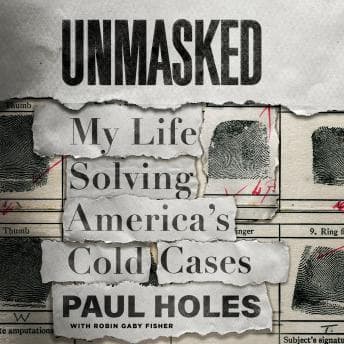

Paul Holes is a textbook case of the wounded healer archetype, and he knows it.
I was making chicken tikka masala at 10 PM—the kind of elaborate cooking I do when my brain needs to process something heavy—when Holes described waking up drenched in sweat from nightmares about decomposing bodies. And I thought: this man is giving me a clinical presentation of secondary traumatic stress, narrated by the patient himself. The research shows that investigators who work violent crimes have PTSD rates comparable to combat veterans. Holes doesn't cite the studies. He doesn't need to. He's living data.
The Investigator as His Own Case Study
What makes this memoir compelling isn't the Golden State Killer takedown—though that's obviously the headline act. It's watching Holes conduct what amounts to a psychological autopsy on himself. He describes ordering bourbon after bourbon, trying to "flip the switch" that will let him stop thinking about victims. He admits he prioritized hunting monsters over being present for his own children.
The protagonist exhibits classic avoidant coping mechanisms, and unlike most true crime content, he's not romanticizing the detective's obsession. He's interrogating it.
The graphic content warnings are earned. Holes doesn't sanitize the violence—the rapes, the murders, the way the Golden State Killer terrorized couples in their own beds. But here's the thing: he's not being gratuitous. He's showing you exactly what lived in his head for twenty years. When he describes standing where a young girl took her last breath, you understand why his sheets are soaked with sweat. The horror isn't entertainment. It's evidence.
When the Witness Is Also the Narrator
Here's where it gets complicated. Holes narrates his own audiobook, and his delivery is... stilted. There's no way around it. The man who can analyze blood spatter patterns and DNA evidence with surgical precision reads his own prose like he's giving testimony. Which, in a way, he is.
But—and this is a significant but—that stiffness works in ways a polished narrator couldn't replicate. When Holes talks about the cases he couldn't solve, the victims whose families he couldn't give closure, you hear the weight in his voice. It's not acting. It's a man who's spent 27 years compartmentalizing trauma finally letting some of it out. That raw vulnerability reminded me of the emotional honesty in Open Book, though Jessica Simpson's trauma manifests completely differently.
My therapist would have thoughts about this character. She'd probably say the stilted delivery is itself a defense mechanism. I'd probably agree.
The intimacy of author-narration creates something strange here. You're not just hearing about Paul Holes. You're sitting across from him at that bar while he orders another bourbon. The production quality is clean, the pacing deliberate. It demands your attention in a way that background listening won't satisfy.
The Cost of Catching Monsters
I kept asking myself: why does Holes really write this book? He claims it's about the cases—Laci Peterson, Jaycee Dugard, the Pittsburg homicides. And yes, those investigations are detailed with the precision you'd expect from a career forensic investigator. But the deeper thread is his attempt to answer whether destroying his personal life was worth it. Did catching killers justify absent fatherhood? Failed relationships? The drinking?
He doesn't give you a clean answer. Which is honest. Which is psychologically accurate. The research on moral injury in first responders suggests there often isn't a clean answer. You do the work because someone has to. You pay the price because the work demands it. Willows explores a different kind of moral injury—the psychological cost of surviving horror rather than investigating it—but the question of whether survival justifies the damage is eerily similar. And you spend the rest of your life wondering if the math adds up.
This is a fascinating case study in what happens when someone who's spent decades analyzing other people's worst moments finally turns that analytical lens on himself. Holes isn't a natural memoirist. His prose can be workmanlike. But the authenticity is undeniable.
Who This Is For (And Who Should Skip It)
If you want true crime that treats you like an adult—that doesn't flinch from violence but also doesn't glorify the investigator—this delivers. If you're specifically interested in the Golden State Killer case, the insider perspective is invaluable. If you study trauma, secondary stress, or the psychology of obsession, you'll find yourself taking mental notes.
Skip this if graphic descriptions of sexual violence will harm you. Skip this if you need your narrators to be polished performers. Skip this if you want easy answers about whether the sacrifices of law enforcement are "worth it."
Case Closed (Sort Of)
Paul Holes gave twenty years of his life to catching a serial rapist and murderer. This audiobook is him trying to figure out what that cost him. The narration is imperfect. The self-reflection is sometimes uncomfortable. But psychologically? This tracks. The man who couldn't stop hunting monsters is now hunting the monster the hunt made him. That's not a story a professional narrator could tell you. That's confession.