
What if the thing destroying your health isn't your lack of willpower — but a system designed, literally engineered, to override every defense mechanism your body has?
I was halfway through making aloo gobi from my mother's recipe — real potatoes, real cauliflower, spices I'd toasted myself — when Chris van Tulleken started describing the industrial process that turns a potato into a Pringle. And I just... stood there, wooden spoon in hand, staring at my kitchen wall like I'd been personally betrayed by snack food. Which, psychologically speaking, I kind of had been.
The Part Where a Doctor Eats Garbage on Purpose (For Science)
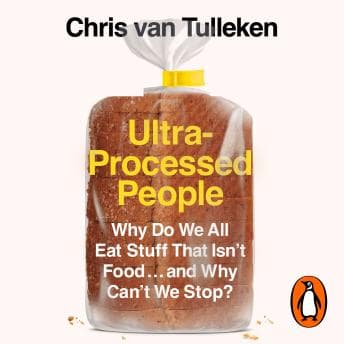
Van Tulleken does something I genuinely respect: he doesn't just lecture. He puts himself on an 80% ultra-processed food diet for a month and documents what happens to his brain and body. This is a fascinating case study in self-experimentation, and the results are disturbing. His brain scans show new neural connections forming between the areas responsible for reward and automatic, repetitive behavior — the same patterns you see in substance addiction research. He gains weight. His sleep deteriorates. He reports feeling hungrier while eating more.
What makes this compelling isn't just the personal experiment — it's how van Tulleken uses it as a scaffold to walk you through decades of food industry science, regulatory capture, and the deliberate engineering of "bliss points" in processed foods. The research actually shows that UPF isn't just "unhealthy food" — it's a fundamentally different category of substance. It's food-shaped product optimized not for nutrition but for overconsumption. He breaks down the NOVA classification system, explains emulsifiers and their effect on gut lining, and traces the economic incentives that make a bag of chips cheaper than an apple.
Psychologically, this tracks perfectly. The food industry has essentially reverse-engineered human motivation — our evolved drive toward calorie-dense foods, our susceptibility to variable reward schedules, our tendency to mistake engineered palatability for genuine hunger. Van Tulleken understands human nature here. He's not wagging his finger at you for eating a frozen pizza. He's showing you the architecture of a system that makes the frozen pizza nearly impossible to refuse. The idea that external systems — not personal weakness — shape our choices is something I kept turning over in my mind while reading Bombshell Effect, which does a similar structural analysis of how beauty industries engineer insecurity.
When the Author Is Also the Narrator (And It Actually Works)
I'll be honest: author-narrated audiobooks make me nervous. Plenty of brilliant writers have the vocal presence of a tired GPS. But van Tulleken is a broadcaster, and you can tell. His delivery is conversational and warm — like sitting across from a very smart friend who happens to have a medical degree and strong opinions about emulsifiers. He doesn't perform the book so much as tell it to you, which suits the material perfectly.
And then there's the bonus content. At the end of each part, Chris and his twin brother Xand (also a doctor) have these loose, unscripted conversations about what you just heard. It's like a built-in debrief podcast. Sometimes they disagree. Sometimes they go on tangents about their own eating habits. It's messy and real and it does something clever: it models the kind of processing (pun intended) you should be doing with this information. I found myself asking: why does this informal format feel more trustworthy than a polished summary would? Because it signals genuine thinking-in-progress rather than rehearsed authority. Smart production choice.
The Psychology of "It's Not Your Fault" (And Why That Framing Matters)
Here's where my brain really lit up. Van Tulleken's central thesis — it's not you, it's the food — is doing serious psychological work. He's essentially reframing the entire obesity and diet conversation from individual moral failure to systemic design. The protagonist (and yes, he is the protagonist of his own narrative here) exhibits classic patterns of someone moving from self-blame to structural analysis. He talks about his own patients, his own family, his own cravings, all with the understanding that shame is not just unhelpful but actively weaponized by an industry that profits from your guilt.
My therapist would have thoughts about this framing, all positive. The research on shame-based health interventions is pretty clear: they don't work. They make people eat more. Van Tulleken knows this, and his book functions almost like a cognitive reappraisal exercise — here's the evidence, here's the system, now you can stop blaming yourself and start getting angry at the right target.
At twelve hours, it's a commitment. Some of the science sections in the middle — particularly around specific chemical compounds and their metabolic pathways — demand real attention. This is not a background-while-doing-dishes listen. I did most of it during morning jogs, which felt appropriately ironic given the subject matter.
Who Gets the Most From This
If you've ever felt confused about why you can't stop eating certain foods despite knowing better — this is your book. If you work in health, psychology, public policy, or you just want to understand why the grocery store is basically a psychological trap — listen to this. If you want a quick list of "good foods" and "bad foods" without context, skip it. Van Tulleken is interested in systems, not simplistic rules.
My Clinical Note
I finished this at 6 AM on a Saturday, standing in my kitchen again, reading the ingredients on a box of cereal I'd owned for weeks. Methylcellulose. Soy lecithin. "Natural flavoring." I put the box in the recycling. Not because van Tulleken told me to — he explicitly avoids prescriptive advice — but because I finally understood what I was actually eating. And that shift, from ignorance to informed choice, is the most psychologically powerful thing a book can do.