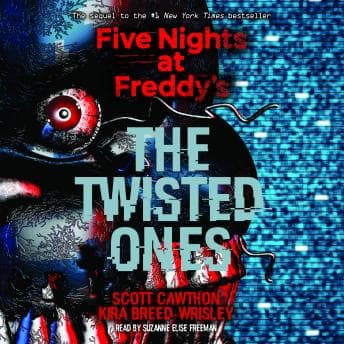

I was sitting in the kitchen at 11:30 on a Tuesday night, halfheartedly circling comma splices on sophomore essays, when I realized I'd been listening to The Twisted Ones for two hours straight and hadn't marked a single paper. That's either a compliment to the book or an indictment of my work ethic. Probably both. The last time a thriller pulled me that far under was Rules of Prey — a book I started on a Sunday afternoon and finished somewhere around 2 AM with no memory of eating dinner.
Look, I need to be upfront about something: I am a 48-year-old man who teaches Fitzgerald and Morrison for a living, and I just voluntarily listened to a Five Nights at Freddy's novel. My students would be thrilled. My podcast listeners — all 47 of them — might stage an intervention. But here's the thing about horror aimed at younger readers: when it works, it taps into something primal that doesn't care about your MFA.
The Story Charlie Deserves vs. The Story Charlie Gets
The setup is genuinely strong. Charlie — our protagonist from The Silver Eyes — is trying to rebuild her life at a new school, a year after surviving the nightmare at Freddy Fazbear's Pizza. And the book does something I appreciate: it doesn't let her off easy. She's haunted. She's processing trauma. That's real, and for a YA horror novel, it's more psychological groundwork than I expected. When bodies start turning up near campus with wounds that echo the animatronic attacks, you feel Charlie's dread because Cawthon and Breed-Wrisley earned it in the first book.
But — and this is where my English teacher brain kicks in — the sequel doesn't hit as hard as The Silver Eyes. The pacing stumbles in the middle stretch. There's a lot of setup and investigation that feels like it's circling the same drain, and the "twisted" versions of the animatronics, while conceptually creepy, don't land with the same claustrophobic terror as the originals. The first book had the advantage of a single, contained setting — that pizza parlor was a pressure cooker. This one opens the world up, and some of the tension leaks out with it.
This reminds me of what Hemingway said about writing: the dignity of movement of an iceberg is due to only one-eighth of it being above water. The first book understood that. This one shows a little too much of the iceberg.
Suzanne Elise Freeman: A Tale of Two Genders
Here's where it gets complicated. Freeman is genuinely good at building suspense through pacing and emphasis. She knows when to slow down, when to let silence do the work. The narrator understands that pause is punctuation. And her female characters — Charlie especially — feel distinct and inhabited. You can hear Charlie's exhaustion, her reluctance to be pulled back into this world.
But the male characters. Oh, the male characters.
Every guy in this book sounds like he just woke up from a nap he didn't want to take. There's this flat, slightly dazed quality to every male voice — whether it's a friend, a love interest, or someone who should be radiating menace. It's like Freeman found one register for "male" and committed to it across the board. When you're trying to build dread around a masked murderer, having him sound vaguely like a guy ordering a sandwich at Subway is... not ideal.
I kept comparing this to the best horror narrators I've encountered — performers who can shift the temperature of a room just by dropping their voice half a register. Freeman can do that with her female characters. With the men, it's like the thermostat is stuck.
Who's Going to Love This (And Who Should Read It Instead)
If you're a FNAF fan — and I now know more about this franchise than any middle-aged English teacher probably should — you'll enjoy spending more time with Charlie and watching the mythology expand. The twisted animatronics are a genuinely unsettling concept, even if the execution doesn't always match the idea. If you loved The Silver Eyes audiobook specifically, you'll get more of the same from Freeman, for better and worse.
But if the male voice issue bothered you in the first book, it's just as present here. And if you're coming in cold without any attachment to the FNAF universe, I'd honestly say start with the first book or just read the print edition. The story deserves it. The audio experience is uneven enough that I can see why some listeners get frustrated.
My students who are FNAF obsessed would devour this in a single bus ride home. And honestly? There's something to be said for a horror series that gets teenagers to consume 8-hour novels voluntarily. I've been trying to get these kids to read for two decades. Scott Cawthon figured it out with haunted animatronics. The irony isn't lost on me.
Mr. Williams's Marginalia
The Twisted Ones is a solid sequel that doesn't quite reach the heights of its predecessor — a common enough problem in trilogies that I should probably do a podcast episode about it. (Episode 87: "The Middle Book Problem, from Towers of Midnight to Twisted Animatronics." My mom would definitely fall asleep.) The story earns its scares when it commits to them, and Charlie remains a protagonist worth following. The audiobook, though, is a mixed bag. Freeman's suspense work and female voices carry it; the male character work drags it back. Worth pausing the faculty meeting for? The scary parts, absolutely. The scenes with three guys talking? That's when I went back to circling comma splices.