
I was making dal makhani at 10 PM on a Tuesday—the kind of elaborate cooking project that happens when you're avoiding revising a manuscript—when Kate Rudd's voice shifted into this sultry 1936 New York accent and I genuinely forgot to stir. The onions survived. Barely.
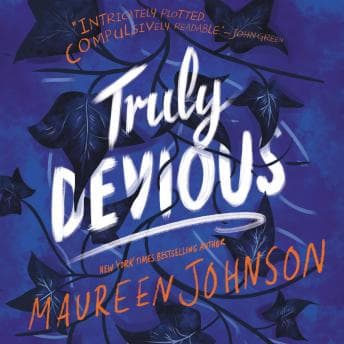
Maureen Johnson's Truly Devious is, at its heart, a case study in obsession. And I don't mean that dismissively. Stevie Bell exhibits classic hyperfixation patterns that any psychology researcher would recognize: the compulsive information gathering, the inability to let go of an unsolved problem, the way her anxiety and her detective work feed into each other in this complicated loop. What makes this character compelling is that Johnson doesn't pathologize it. Stevie's anxiety isn't a quirk or a plot device—it's woven into how she processes the world. My therapist would have thoughts about this character. Specifically, she'd probably say Stevie needs better coping mechanisms than cold case obsession. (She'd be right.)
The Psychology of a Puzzle Box
The research actually shows that mystery readers are essentially seeking cognitive closure—we need the pieces to fit. Johnson weaponizes this by giving us two mysteries that refuse to stay in their separate timelines. The 1936 Ellingham kidnapping and the present-day death at the academy keep bleeding into each other, and Rudd handles the temporal shifts with distinct vocal personalities. Her 1930s flashback work has this noir-worthy quality—think old Hollywood, cigarette smoke, and secrets. Then she snaps back to Stevie's rapid-fire internal monologue, all contemporary anxiety and true-crime podcast energy.
Psychologically, this structure tracks. Memory and investigation work the same way—you can't examine the past without the present contaminating it, and vice versa. Stevie isn't just solving a cold case; she's trying to understand how trauma echoes. Johnson gets human nature, or at least the nature of people who can't stop picking at old wounds.
Kate Rudd Gets Inside Stevie's Head
I found myself asking: why does this narration work so well when the book is essentially a setup for a series? Rudd's performance answers that question. She captures Stevie's thought patterns—the way anxiety makes your brain skip tracks, circle back, catastrophize. The conversational tone matches Stevie's rapid thoughts without becoming exhausting. There's a breathiness to her delivery during panic moments that felt uncomfortably accurate.
The character differentiation extends beyond just Stevie. Ellingham Academy is populated with archetypes—the inventor, the novelist, the actor—but Rudd gives each enough vocal texture that they don't blur together. It's not flashy work. It's the kind of narration where you forget someone is reading to you.
Where It Stumbles (And Why I Didn't Mind)
Look, the pacing in the first third is deliberate. Some would say slow. Johnson is building her puzzle box piece by piece, and if you're the type who needs a body in chapter one, you'll be frustrated. I wasn't—I'm a researcher, I understand the value of methodical setup—but I can see why some listeners bounced.
The cliffhanger ending, though. This is a fascinating case study in reader manipulation. Johnson gives you just enough resolution to feel satisfied while yanking the rug out from under you. It's effective. Copper River pulled a similar move on me, though with higher stakes and more bodies. It's also slightly infuriating if you weren't prepared to commit to a series. I immediately downloaded the next book, which I suppose means the manipulation worked.
Who This Is For (And Who Should Run)
If you grew up on Agatha Christie and now consume true-crime podcasts like they're a food group, this is your book. If you appreciate characters whose mental health is portrayed with actual nuance rather than as dramatic shorthand, Stevie Bell will feel like recognition.
Skip if: you need standalone mysteries, you hate YA voice (though Rudd minimizes the more grating elements), or cliffhangers make you genuinely angry rather than just mildly annoyed.
The 10-hour runtime is perfect for a long weekend of focused listening. I wouldn't recommend this for background audio—you'll miss connections, and the whole point is catching them.
Final Notes from the Margins
This is a smart book pretending to be a fun book. Or maybe a fun book that's accidentally smart. Either way, Johnson has constructed something that rewards close attention and punishes skimming. Kate Rudd's narration elevates what could have been a standard YA mystery into something that lingers—her 1936 accent work alone is worth the credit.
My dal makhani turned out fine, by the way. Though I did have to restart the last chapter because I was too busy theorizing about the kidnapping to notice the audiobook had ended. Classic hyperfixation behavior. Stevie would understand.