
What happens when the most dangerous man in any room decides he doesn't want to be in the room anymore?
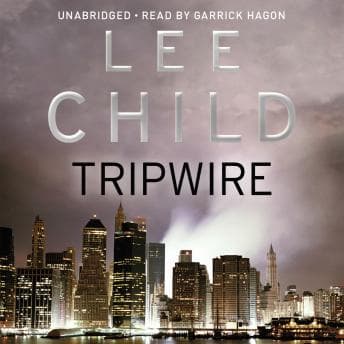
That's the question Lee Child keeps circling in Tripwire, the third Reacher novel, and it's the question I kept turning over during a Saturday walk along the lakefront with Denise. She was talking about her sister's kitchen renovation. I was nodding at appropriate intervals. But my head was somewhere in the Florida Keys, watching a six-foot-five drifter dig swimming pools by hand and bounce drunks at a strip club — which is about as close to "retirement" as Jack Reacher gets.
The Guy Who Doesn't Want to Be Found (But Can't Help Being Interesting)
Here's what Child does better than almost anyone writing thrillers: he makes stillness feel dangerous. The first few hours of this book are Reacher doing manual labor, sleeping in a rented room, existing at the margins. And it works because you know — you know — something is about to shatter that calm. When a private detective named Costello shows up looking for Reacher and then turns up dead with his fingertips sliced off, the shatter arrives on schedule, but it's the buildup that earns it.
This reminds me of what Hemingway said about the iceberg theory — the dignity of movement being due to the seven-eighths beneath the surface. Child isn't Hemingway. Nobody's confusing these sentences for The Sun Also Rises. But Child understands economy. Short declarative sentences. Subject, verb, object. Reacher thinks, Reacher acts. There's a rhythm to it that the audiobook format actually amplifies, because you hear the cadence instead of just scanning it on the page.
The plot pulls Reacher north from Key West to New York, unraveling a conspiracy that reaches back to Vietnam — missing soldiers, a hook-handed villain who's genuinely unsettling, and a love interest in Jodie Jacob (née Garber) who actually feels like a real person with her own career and complications. The hook prosthesis on the antagonist isn't just a character detail — Child weaponizes it in scenes that made me wince on a public jogging path. Denise asked if I was okay. I was not okay. I was thinking about what a sharpened hook does to human tissue.
Garrick Hagon and the Art of Controlled Menace
Let me be honest about what I know and don't know here. Hagon's narration doesn't call attention to itself — and I mean that as a compliment, mostly. He reads Reacher the way Reacher would want to be read: flat, competent, no wasted motion. There's an AudioFile review that nails it — Hagon makes "the edge even sharper." And that's accurate. His pacing during the violence sequences feels clipped and efficient, matching Child's prose style almost beat for beat.
But here's my reservation: at 15 hours and 42 minutes, there are stretches — particularly the middle third where Reacher is doing investigative legwork in New York — where Hagon's evenness becomes a kind of plateau. The narrator understands that pause is punctuation, but I wanted a few more pauses. A bit more dynamic range in the dialogue scenes between Reacher and Jodie, where the emotional stakes are supposed to be different from the physical ones. Hagon gives you professional. I wanted, in places, something closer to intimate.
Compare this to, say, the way Scott Brick handles a Robert Ludlum novel — there's a theatricality to Brick that Hagon deliberately avoids. Whether you prefer Hagon's restraint or Brick's drama is a matter of taste. I lean toward restraint in general, but 15 hours of restraint tested me in the late-night grading sessions where I really needed the voice to carry me.
Who Gets the Assignment (And Who Doesn't)
If you loved Killing Floor or Die Trying and you're working through the Reacher series — and you should be — this is the book where Child figures out his formula. The Vietnam backstory gives the plot weight that the first two books didn't quite earn. The Jodie relationship gives Reacher something to protect besides his own code. And the villain is memorably grotesque without tipping into cartoon territory.
My students would hate this. I love it. Not because the prose is literary — it's not — but because Child knows exactly what he's doing with every sentence, and that kind of craft deserves respect regardless of genre. I teach kids that writing is choices. Child makes ruthlessly efficient choices.
Skip this if you need complex moral ambiguity or unreliable narrators. Reacher is Reacher. He's right, the bad guys are wrong, and the fun is watching the physics of that collision. I had a similar experience with Deception Point — Dan Brown operates in the same moral ZIP code, heroes clearly labeled, villains clearly not, and the whole engine runs on momentum rather than ambiguity, though I walked away from that one considerably less satisfied.
The Grade I'd Put in the Gradebook
Solid thriller, solid narration, solid entry in a series that rewards commitment. Not the Reacher book I'd start someone with — that's still Killing Floor — but it's the one where I started believing the series had legs beyond the premise. Worth pausing the faculty meeting for. Worth the lakefront walk. Worth Denise's mild annoyance at my distracted nodding.
Principal Martinez, if you're reading this: still wasn't listening to your budget presentation. But I was listening to something worthwhile.