
What do you do with a hostage thriller when the hostage negotiator’s real problem is grief?
I started Trapped while standing over a pot of dal at 10:45 p.m., half-listening for the cumin to stop sputtering and half-waiting for the audiobook to prove it wasn’t just doing Die Hard cosplay in the Empire State Building. Then Stana Katic showed up as Christine Travers - Theo Requa’s supposedly dead FBI partner, now speaking for the terrorists - and, okay. Fine. You have my attention.
The building is the trap, but Theo is the case study
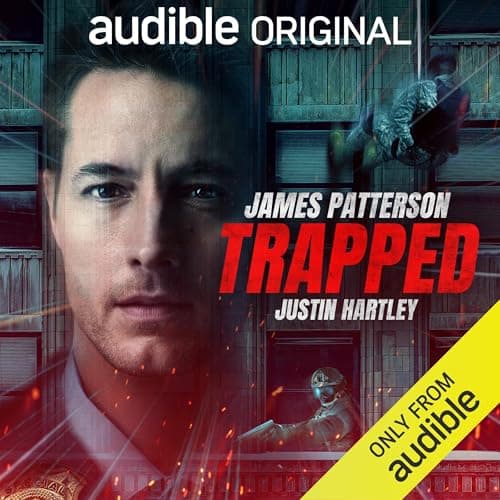
The elevator pitch here is wonderfully shameless: Russian terrorists seize the Empire State Building, around twenty thousand people are trapped inside, and FBI crisis negotiator Theo Requa gets dragged into a nightmare that is both public catastrophe and private psychological ambush. They demand $119 million from a prominent senator, but the setup keeps signaling that the money is not the point. And that was smart.
What makes this character compelling is that Theo isn’t just solving a siege. He’s trying to make reality line up with trauma. He believes he watched Christine die. Now she’s the spokesperson for the people threatening one of New York’s most recognizable buildings. The protagonist exhibits classic unresolved-trauma logic: if he can decode her, maybe he can retroactively make sense of the original loss. My therapist would have thoughts about this character.
That emotional angle is what keeps Trapped from feeling like generic “important building, bad men, ticking clock” nonsense. The author understands human nature enough to know that a negotiator’s worst enemy is not only the armed group on the other end of the line. It’s the story he’s already telling himself.
And because this thing is only 3 hours and 45 minutes, Patterson and DiLallo don’t over-explain. They push. Hard. Sometimes almost too hard, but mostly in a fun way.
Patterson's instinct for relentless forward momentum is genuinely consistent across his catalog — I noticed the same thing when I sat with 20th Victim, which has that same refusal to let you catch your breath even when the emotional stakes are asking for a pause.Full-cast thrillers live or die on pressure
This is an audio drama, not just a straight read with extra people, and that matters. Justin Hartley gives Theo the exact right blend of command and strain - controlled enough to sound credible in a crisis, frayed enough that you hear the dead partner still sitting in the room with him. Stana Katic, meanwhile, gets the juiciest assignment because Christine has to sound familiar, dangerous, and slightly unreadable at the same time. She does.
Elizabeth Rodriguez and Rhenzy Feliz help round out the sense that this is a populated event rather than one man monologuing into federal misery. That’s the real advantage of the production: scale. A story about twenty thousand hostages in the Empire State Building should not sound intimate in the wrong way. It should sound crowded, escalating, and a little claustrophobic even when characters are physically far apart.
The Dolby Atmos presentation - if you have the setup for it - makes the whole thing feel more spatially pressurized. I’m being careful here because I don’t want to invent hyper-specific sound design details that weren’t in front of me, but the production clearly aims for immersion rather than “celebrity voices reading lines in sequence.” And it works.
Also: the stunt-casting concern never really kicked in for me. Sometimes recognizable actors can yank me right out of a thriller because I start hearing publicity decisions instead of characters. Not here. Hartley and Katic, especially, justify their presence.
Fast, twisty, and not pretending to be literature
This is where your trade-off lives.
If you want a densely layered procedural with tons of institutional realism, Trapped is probably too brisk for you. Psychologically, this doesn’t track as a slow-burn negotiation study, and it isn’t trying to. It’s built like a compressed pressure chamber. Big reveal early. Bigger implications after that. Little time for philosophizing.
But if you meet it on its terms, it’s very effective. The short runtime helps more than it hurts because the premise is inherently high adrenaline: the Empire State Building under terrorist control, a demand for $119 million tied to a senator, and the deeply destabilizing reveal that Christine may not be dead after all. Drag this story out to nine hours and I’d start asking rude questions. At under four? Pretty much ideal.
I found myself asking: why does Christine really agree to become the face of this operation, and what version of Theo is she counting on getting? That question kept me listening more than the mechanics of the siege, which is probably the best compliment I can give a thriller. Plot gets you in the door. Character pathology keeps you there.
That's actually the same thing that made Crooked Kingdom so compulsively listenable for me — the plot is genuinely clever, but it's the characters' damage and competing loyalties that do the real psychological work.My one reservation is also a function of the format. Because it moves so quickly, some listeners are going to want more room for the betrayals and loyalties to breathe. I did too, a little. Listener feedback saying “I wish the story was longer” makes complete sense to me. Not because it feels padded or incomplete - it doesn’t - but because the central relationship is interesting enough that you notice how ruthlessly the script keeps sprinting.
You, specifically, should know this before hitting play
This is a focused-listening thriller. Not background wallpaper. If you throw it on while replying to emails, you’ll lose some of the pleasure, because a big part of the hook is tracking shifting allegiance and listening for what Theo hears in Christine’s voice. If you give it a dedicated afternoon, a tense commute, or one very determined workout, it rewards you.
And yes, it’s violent, profane, and built for mature audiences. The setup is not subtle. Neither is the fun.
My 11 p.m. diagnosis
Trapped is basically a panic attack with a negotiation strategy. Short, sharp, and unusually smart about the fact that the real hostage situation is often psychological. I’d spend a credit on it if you love full-cast suspense, though the short runtime makes a sale feel even nicer.