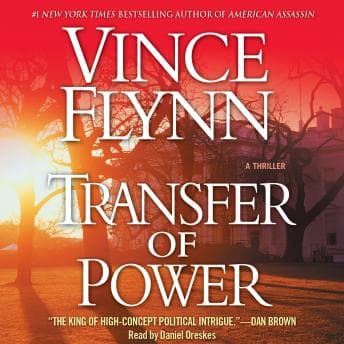

There's a moment early in this book where the politicians are arguing over optics while terrorists are literally securing the White House perimeter. I almost drove my truck off Mopac laughing.
Not because it's funny. But because it's so damn accurate.
I've spent half my life in security briefings where the biggest concern wasn't the threat, but the press release. Vince Flynn got that right. Transfer of Power is basically Die Hard in the White House, but with less quippy one-liners and way more tactical movement.
I listened to this on a quick hop from Austin to Dallas. At just over four hours, this is the abridged version—which usually makes me grind my teeth. (I like the full intel package, not the executive summary.) But honestly? It worked here. It felt like a high-speed extraction. In and out. No wasted movement.
The Operator in the Walls
Mitch Rapp isn't James Bond. He doesn't wear a tux. He's a blunt instrument. I appreciate that. Flynn writes him like a guy who knows that when the shooting starts, the Rules of Engagement usually go out the window.
Watching—well, listening to—Rapp dismantle a terrorist cell from the inside of the White House is satisfying in a primal way. Poisoned Pen had that same methodical precision—different setting, same surgical approach to taking down the bad guys. He's moving through secret corridors, using stealth, taking out tangos quietly. It reminded me of some urban evasion training I did back at Bragg. The geography of the White House feels solid, too. Flynn clearly looked at some blueprints, or at least talked to guys who have.
What really sells it for me is the contrast. You've got the terrified suits in the bunker, and then you've got Rapp in the crawlspace with a knife. It's the ultimate "Boots on the Ground vs. Suits in the Rear" scenario.
Oreskes on the Comms
Let's talk about Daniel Oreskes.
I saw some reviews saying he sounds plodding. Look, if you're listening at 1.0x speed, maybe he is. But I cranked him up to 1.25x (standard operating procedure), and the man sounds like he's been gargling gravel and whiskey. It fits.
He has this deep, commanding delivery that works for the gravity of the situation. When he does the terrorists' voices, it's not cartoonish. When he voices the politicians, he gives them just enough whine to make you hate them. He doesn't get in the way of the story. He just reports it. That's all I ask for.
The "Cliff Notes" Factor
Here's the only snag. Because this is the 4-hour cut, the character development takes a hit. You don't get the slow burn. It's all action, all the time.
Usually, I want to know why the bad guy is the bad guy. Here? They're just targets. If you're looking for a deep geopolitical treatise, this isn't it. This is a tactical exercise.
But sometimes, after a week of dealing with corporate clients who think a phishing email is a crisis, I just want to hear the good guys win. Loudly.
Ranger (my Shepherd) slept through the first half but woke up for the final assault. I think he sensed my heart rate going up.
Who Should Listen (And Who Should Skip)
If you want a fast, violent tactical thriller and don't mind the abridged format, this is your mission. Skip it if you need deep character backstory or nuanced villain motivations—you won't find them here.
SITREP: It's short, it's violent, and it doesn't apologize. Mission accomplished.