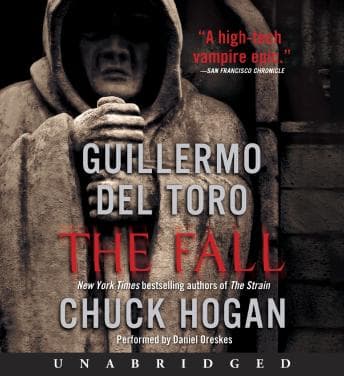
Look, I'm just gonna say it: switching narrators mid-trilogy should be a crime. Or at least a misdemeanor. When I heard Ron Perlman wasn't returning for The Fall, I did that thing where you stare at your phone like it personally betrayed you. Perlman's voice in The Strain was so perfectly gravelly and apocalyptic that I genuinely wondered if anyone else could carry this vampire plague forward without it feeling like a cover band.
So here's my confession: Daniel Oreskes proved me wrong. Not completely—I'm not that easily swayed—but enough that I stopped mourning Perlman somewhere around hour three.
The Ron Perlman Problem (And Why It's Not Really a Problem)
Oreskes sounds like Perlman's slightly younger cousin. There's a similar rumble, a comparable dramatic weight. Is it the same? No. But it's close enough that my brain stopped doing the comparison thing after the first few chapters. The pacing is solid, the character differentiation works, and he commits to the horror in a way that matters. Because here's the thing about vampire fiction—if your narrator sounds like they're reading a grocery list during a feeding scene, you've lost me. Oreskes doesn't do that. He understands that dread requires investment.
The production is clean, professional, no weird audio hiccups. I listened to most of this during late-night walks with Shirley (the cat, not Jackson—though she would've appreciated the vampiric themes). There's something about walking through empty streets at midnight while a narrator describes the systematic collapse of human civilization that just hits different.
Where Del Toro and Hogan Actually Shine
This is where I need to separate the narration from the story itself, because The Fall does something interesting: it goes bigger. The Strain was contained chaos—a vampire virus hitting New York, a small group figuring out what the hell is happening. The Fall expands the scope, and that's both its strength and its stumbling block.
Del Toro's cinematic sensibilities are all over this. You can feel the director's eye in how scenes are constructed—the visual horror, the set pieces, the way tension builds before something terrible happens. Hogan's thriller instincts keep things moving, mostly. There are moments where the pacing drags, especially when new characters get introduced and you're trying to figure out why you should care about them when the world is literally ending. Undone had a similar issue with subplot bloat, though at least there the world wasn't actively ending. (Seriously, we're mid-apocalypse. I don't need another subplot.)
But when it works? It works. There are gut-punch moments that reminded me why I love this genre—horror that's not just about monsters but about what humans become when everything falls apart. Sycamore Row explores that same darkness in human nature, just through a courtroom lens instead of fangs. That's the good stuff. That's Shirley Jackson energy, even if it's wrapped in vampire mythology.
The Slow Burn That Tests Your Patience
I won't pretend this book doesn't drag in places. It does. There are sections where I found myself zoning out, which is a cardinal sin for horror. The first book had urgency from page one—this one takes its time, and not always in a way that builds tension. Sometimes it just... meanders.
But here's my counterpoint: the payoff exists. If you can push through the slower sections, the back half delivers. The mythology deepens in ways that feel earned rather than tacked on. And Oreskes handles the escalation well—his delivery shifts as stakes rise, which is exactly what you need from a narrator in a series like this.
If you're coming from the TV show, the book fills in gaps you didn't know existed. It's more detailed, more brutal, more willing to sit in the uncomfortable moments. The show was good. The books are better. (I said what I said.)
Who's This For (And Who Should Skip It)
If you loved The Strain, you need this. If you're hesitant about the narrator switch, give it three hours before you decide. If you scare easily, maybe don't listen while walking alone at night. Skip it if middle-book pacing frustrates you or if you need constant action—this one earns its scares through slow-building dread, not relentless momentum.
Shirley was unimpressed, as always. I was invested. And honestly, that's the best endorsement I can give a horror sequel.