
Okay, I need to talk about this book because it's been bugging me for three days and I finally figured out why.
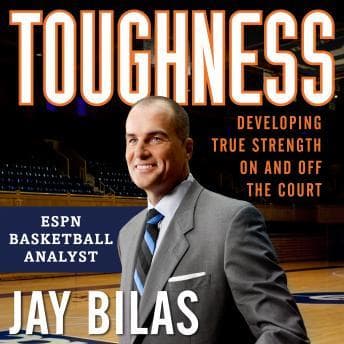
Here's the thing — Jay Bilas spends a LOT of this book telling you what toughness is. And then telling you again. And then one more time, just in case you missed it. I was deep into a rebrand project for a local brewery, headphones in, Frida draped across my keyboard like the tiny dictator she is, and somewhere around hour four I caught myself thinking: Didn't he already say this? Not the exact same words, but the same idea dressed up in a slightly different Duke jersey.
And that's my honest frustration with Toughness. The repetition.
When Jay Gets Out of His Own Way
But here's where it gets complicated — because when Bilas stops circling back to his central thesis for the fifteenth time and just tells a story, this book actually hits. The chapters where he talks about making mistakes, specifically his own screw-ups as a young player and then as a broadcaster, have this raw honesty that I wasn't expecting from an ESPN talking head. There's a modesty in his voice when he's recounting the moments he fell short that feels genuinely earned, not performed. Like he's sitting across from you at a bar and he's on his second beer and he's finally being real.
The sections featuring Coach K and Bob Knight are where I perked up the most. Bilas doesn't just name-drop — he gives you specific moments, specific lessons, the kind of granular detail that makes you understand why these coaches built what they built. The Grant Hill and Mia Hamm stories pull the concept beyond basketball, which the book desperately needs because otherwise it would suffocate inside Cameron Indoor Stadium.
Jay Narrating Jay (It Works Better Than You'd Think)
Author-narrated nonfiction is always a gamble, and I'll be honest — I almost didn't pick this up because I figured it'd sound like a seven-hour halftime segment. But Bilas has this conversational cadence that works. He's not trying to be a Voice Actor with a capital V. He sounds like a guy who knows how to hold a room, which — yeah, he literally does that for a living on television. The humor lands because he's not forcing it. The reflective moments land because he drops his broadcast polish and gets a little quieter, a little slower.
Is it Julia Whelan? No. (Nobody is Julia Whelan.) But for what this book needs — a steady, genuine, occasionally self-deprecating presence — Bilas does the job well. I never once wanted to switch to reading the physical copy, which is my personal litmus test for author narration.
The Repetition Problem (Because I Have to Be Honest)
I can't sugarcoat this. The book would be significantly better at five hours instead of seven and a half. Bilas has maybe four or five truly strong ideas about toughness — mental preparation, accountability, the willingness to do unglamorous work, communication, resilience after failure — and he hammers each one from multiple angles with multiple anecdotes until you're nodding along on autopilot. Mindful Athlete covers some of this same ground — mental preparation, presence, the inner mechanics of performance — but with a tighter structure that trusts you to make the connections yourself. By the back half, I was designing on muscle memory while my brain kind of glazed through sections I felt I'd already absorbed.
And look, I get it. This is a motivational sports book. Repetition is kind of the genre's love language. But when you've got stories from legends like Coach K and Mia Hamm in your back pocket, you don't need to keep restating the thesis. Trust your material, Jay.
The other thing — and this is more of a vibe critique than a content one — there are stretches where it feels like Bilas is building his own highlight reel. Not in a gross, arrogant way, but in a "the whole book orbits my personal journey" way that occasionally made me want a wider lens. The best chapters are the ones where he steps back and lets someone else's toughness be the story.
Who's Going to Love This (And Who Won't)
If you're a college basketball fan, a coach, or someone who genuinely responds to the "mental toughness" framework for life advice, this is a solid listen. Bilas clearly lived this stuff and his credibility is real. My partner — who played basketball through college and still watches every March Madness game like it's a religious obligation — would eat this up. The audience overlap with Benjamin Franklin: Made in America is real too — that one also rewards readers who respond to credibility built through lived experience rather than bullet-pointed frameworks.
But if you're coming in wanting practical, structured takeaways you can apply Monday morning? You might leave frustrated. And if repetition is a dealbreaker for you, maybe bump the speed to 1.25x for the middle chapters. (Yes, I'm saying that as someone who listens to everything at 1.0x. That's how much the pacing drags in spots.)
Abuela wouldn't have touched this one — basketball was never her thing. But she would've respected the parts about accountability and doing the hard work nobody sees. That was her whole life.
Not a Slam Dunk, But Not an Airball Either
This book felt like a really good podcast series that needed a tighter editor. The highs are genuinely engaging — Bilas at his most personal and most generous with other people's stories is worth your time. The lows are just... sameness. A solid listen for the right audience, but not one I'll be replaying.