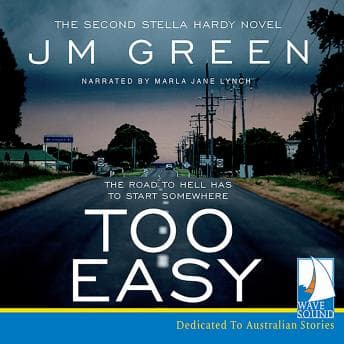

Melbourne cops, corruption, and a protagonist who runs her mouth like a soldier who just got back from leave and forgot how civilians talk. Too Easy by J.M. Green caught me off guard.
I picked this one up on a recommendation from a buddy who knows I'm particular about crime fiction - if the procedural details are garbage, I'm out before chapter three. Started it during a late-night session prepping threat assessments for a client presentation. Ranger was snoring on the couch. Linda was asleep. Just me, coffee that was too strong for midnight, and Stella Hardy's stream-of-consciousness narration pulling me through Melbourne's western suburbs.
Stella Hardy Runs Her Mouth and I'm Here For It
Let me cut to the chase - Stella isn't a cop. She's not military. She's a social worker-turned-investigator with a mouth that won't quit and opinions about everything. Normally that kind of protagonist would annoy me. I've worked with enough civilians who think they know how law enforcement works because they watched The Wire twice. But Green does something smart here: Stella knows she's out of her depth. When her best friend Detective Phuong Nguyen calls during a storm saying her lover's been framed for corruption, Stella doesn't suit up like she's some action hero. She stumbles forward, gets scared, makes questionable decisions, and talks herself through all of it in real time.
That stream-of-consciousness style is the book's biggest strength and its one real limitation. When it works - and it works about 80% of the time - you're right inside Stella's head as she connects dots between dirty cops and a missing witness. The humor lands because it's organic. She's funny the way real people are funny when they're stressed: dark observations, self-deprecating jabs, the kind of gallows humor I recognize from my own career. When it doesn't work, you're wading through internal monologue that could've been trimmed by a good editor. Not a dealbreaker, but at 9 and a half hours, there are stretches where the pacing dips.
The Corruption Angle - Close Enough to Real
Here's where my day job kicked in. Police corruption investigations are a specific beast. I've consulted on internal affairs-adjacent security reviews, and the dynamics Green portrays - the thin blue line closing ranks, the genuine difficulty of getting one honest person to testify against an entire unit, the way institutional loyalty can look a lot like complicity - she clearly did her homework. Or at least she did enough homework that I wasn't grinding my teeth.
The setup is solid: Phuong's lover is the only clean cop in his unit, and the one person who can corroborate that has vanished. Stella has to find this guy and convince him to come forward before the investigation buries the wrong people. It's not a complicated premise, but Green uses it to explore how corruption works from the ground level - not the flashy movie version, but the slow, grinding, "everyone just looks the other way" version that's much closer to reality.
The Melbourne setting is a real asset. Green's a Melbourne local and it shows. This isn't generic-city crime fiction with the serial numbers filed off. The western suburbs feel lived-in, specific, almost like another character. For an American listener, it adds genuine novelty - I'm used to crime fiction set in New York, LA, Chicago. Melbourne's west gives everything a different texture. Woman in Cabin 10 gave me that same jolt of unfamiliar geography doing real narrative work, though the Scandinavian setting there operates more like a trap than a neighborhood.
Marla Jane Lynch Behind the Mic
Lynch is an upgrade over the narrator from the first book in the series - that's the word from people who've listened to both, and I believe it. She handles Stella's running commentary with genuine warmth and energy. The joy in Stella's observations comes through, which matters when you're living inside someone's head for nearly ten hours. She doesn't oversell the humor or underplay the tension. It's a controlled, natural-sounding performance.
Where I'd ding her slightly: character differentiation could be sharper. In a book with multiple cops, a missing witness, and Stella's personal circle, there were moments where I had to rewind to catch who was talking. Not a fatal flaw at all, but something I noticed, especially during dialogue-heavy scenes. I listened at 1.25x and the pacing felt right - Lynch's natural tempo is conversational enough that the speed bump doesn't distort anything.
Who Should Deploy With This One
If you like character-driven crime fiction where the mystery matters but the person solving it matters more, this is worth your time. If you need constant action and body counts, look elsewhere - this is more slow burn investigation than door-kicking. Fans of Australian crime fiction or anyone tired of the same American/British settings will find the Melbourne angle refreshing. And if you've read Green's first Stella Hardy book, the consensus is this one's better.
Worth your time? Here's the debrief: Too Easy is a smart, funny, grounded mystery that doesn't insult your intelligence. Not perfect - it meanders when it should march - but Stella Hardy's voice is the kind you want to spend time with. End Game has that same quality - a protagonist whose interior voice earns the time you invest, even when the plot takes its sweet time getting where it's going. Ranger slept through the whole thing, but he sleeps through everything that doesn't involve the word "treat."