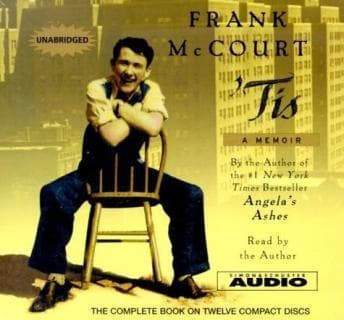

There are exactly two kinds of memoirs in this world: the ones where someone tells you about their life, and the ones where someone sits across from you and lives it again, right there in front of you. Frank McCourt's 'Tis is the second kind.
I started this one on a Saturday morning, walking the lakefront with Denise. She knew within five minutes I was gone — that particular silence I get when something's got me by the collar. She took my arm and let me disappear into 1949 New York while we walked past joggers and tourists and the whole gorgeous indifferent sprawl of Lake Michigan.
The Voice That Won't Let You Look Away
Let's talk about what makes this audiobook singular, maybe even irreplaceable: Frank McCourt reads his own story. Not an actor. Not a trained narrator with a polished demo reel. The man himself. And you can hear everything in that voice — the Limerick childhood that never fully left his vowels, the decades of New York grit layered on top of it, the teacher who learned to hold a room's attention with timing alone. When he does his impersonations — the dock foremen, the university professors, the women who alternately attracted and terrified him — there's this quality of a man at a bar who's been saving this story for exactly the right audience. His timing on the comic beats is extraordinary. The way he pauses before delivering some withering observation about American class hypocrisy, holding the silence like it's punctuation. Because it is. The narrator understands that pause is punctuation.
Now, is it perfect? No. There are stretches — particularly in the middle chapters about his army service in Germany, the dog training and the typing reports — where McCourt's self-deprecating Irish voice starts to feel like a character he's playing rather than a man he's being. That faux-naïf thing, the wide-eyed immigrant bumbling through America, wears a little thin when you know the man went on to teach for thirty years in New York City schools and win a Pulitzer. He's smarter than the voice sometimes lets on, and around hour eight or nine, I wanted him to drop the performance and just talk to me. He does, eventually. But it takes a while.
A Teacher Recognizes Another Teacher
Here's what got me — and this is probably the teacher in me talking, so bear with my professional bias: the final third of this book, when McCourt discovers the classroom, is some of the most honest writing about teaching I've ever encountered. He doesn't romanticize it. He doesn't give you some Dead Poets Society nonsense about standing on desks. He talks about the terror of facing thirty teenagers who can smell your insecurity like blood in the water. He talks about using stories from his own miserable childhood in Limerick not because he had some pedagogical theory, but because he'd run out of lesson plans and the truth was all he had left.
My students would hate this. I love it.
Twenty years I've been standing in front of classrooms, and McCourt captured something I've never been able to articulate to Denise or anyone else: that teaching isn't about having answers. It's about being willing to stand there, exposed, and let the kids see you figuring it out in real time. When McCourt describes his early days at McKee Vocational, stumbling through lessons, getting eaten alive by students who'd been chewing up substitute teachers since birth — I was grading papers at 11 PM and I actually stopped, red pen in hand, and just listened.
Worth pausing the faculty meeting for. (I wasn't at a faculty meeting. But if I had been, it would've been worth it.)
The Shadow of Angela's Ashes
Let me be straight: this isn't Angela's Ashes. That book had the terrible clarity of childhood poverty — everything reduced to hunger and cold and a mother's exhausted face. 'Tis is messier, more sprawling, because adulthood is messier and more sprawling. The narrative drifts sometimes. His time on the docks blurs together. His romantic relationships feel episodic rather than cumulative. If you loved Angela's Ashes for its tight, almost biblical structure, this is its spiritual successor — but it's the kind of successor that's found its own apartment and isn't keeping it as clean.
But the prose deserves to be savored. McCourt has this trick — inherited from the oral tradition, I think, not from any MFA program — of circling back to phrases and images until they accumulate weight. The recurring shame about his eyes, his teeth, his Limerick accent in a room full of Americans who can't quite place him. He keeps returning to these small humiliations until they become something bigger: a portrait of what it costs to remake yourself in a country that invites you in and then asks you to prove you belong.
This is why we still read the classics — and why McCourt, reading his own words in his own battered, beautiful voice, turns a fourteen-hour audiobook into something closer to confession. Jane Austen does something similar in her own way — her narrators hold a kind of quiet, devastating authority over the reader that I keep coming back to in my Complete Novels of Jane Austen Volume 1 review, though the intimacy there is earned through irony rather than confession.
Who Gets the Most Out of This
If you've ever taught, immigrated, felt like a fraud in a room full of people who seemed to know the rules you were never taught — this is your book. If you're an Angela's Ashes devotee, come in knowing it's a different animal. Looser, longer, occasionally repetitive. If you need fast pacing and tight plot, this will test your patience. But if you can surrender to McCourt's rhythm at 1.0x — and I insist you listen at 1.0x, because the author chose those words and that cadence — you'll find something rare: a man telling the truth about his life without asking for your pity or your applause.
The Red Pen Stays Down for This One
Fourteen hours with Frank McCourt's voice in my ears, and I came out the other side feeling like I'd had dinner with the man. Not a perfect dinner — he repeated a few stories, lingered too long on some, rushed through others I wanted more of. But the kind of dinner where you drive home afterward and sit in the car for a minute before going inside, just thinking. Denise asked me if it was good. I told her it was honest, which is harder and rarer than good.