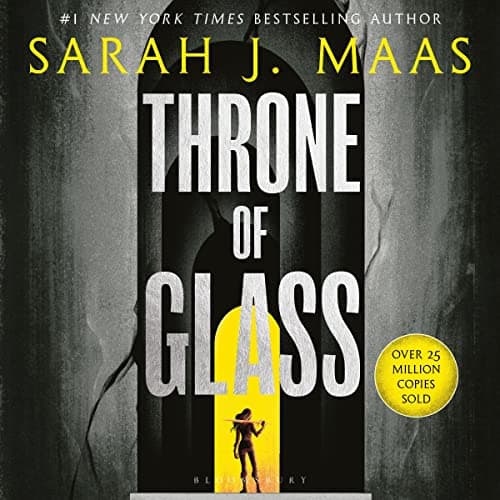

I started this one at 1 a.m. while reorganizing the board game shelf I should not have been reorganizing (my thesis outline sat open on the laptop like a disappointed paladin). Somewhere between stacking Gloomhaven boxes and trying not to drop a copy of The Way of Kings on my foot, I hit the point where Celaena goes from "notorious assassin dragged out of a death camp" to "fine, I guess I'll survive a murder tournament in a glass castle too," and yeah - I was locked in.
The assassin swagger is the whole build
The thing that makes Throne of Glass work, especially in audio, is that Celaena Sardothien is not written like a generic Chosen One with a knife. She's vain, sharp, theatrical, dangerous, and weirdly girly in a way that the book refuses to apologize for. She can be assessing who might kill her in a competition against twenty-three thieves, murderers, and fighters - and still care about dresses, parties, and being underestimated. That combo is fun. It gives the character actual texture instead of just "deadly but damaged."
And the setup is still catnip, honestly: in a land where magic is supposedly gone, the king drags an imprisoned assassin to court and offers freedom if she wins a brutal contest to become his Champion. That's already a good fantasy pitch. Then Maas throws in the rot under the castle - competitors turning up dead, something foul lurking in the halls, and a sense that this court is lying about way more than just politics. It gives the first book a little horror edge that keeps it from being just tournament fantasy with flirting. That particular flavor of political darkness woven with something older and fouler underneath the surface is something The Burning God eventually perfects at series-end, though it earns it through three books of accumulated dread rather than one.
That said, you can absolutely feel this is book one. The world-building is more promise than payoff right now. You get the kingdom, the anti-magic atmosphere, the court dynamics, the hints of old power and buried history - enough to make you curious, not enough to fully feast on yet. If you want Sanderson-level rules and architecture right out of the gate, this isn't doing that. It's more breadcrumb trail than encyclopedia. I was into it, but if you don't like info-dumps, this isn't for you (but you're wrong) - and ironically this book is actually pretty restrained on them.
Castle murder mystery, with bonus feelings
What surprised me most on relisten-via-audio energy was how much the book leans into two lanes at once: competition plot and court romance plot. You've got Celaena trying to survive training, poison, sabotage, and whatever nightmare is killing off champions. And then you've got the very YA-but-effective push and pull between Prince Dorian and Captain Chaol.
Here's the useful warning label: if love triangles make you break out in hives, you may spend chunks of this audiobook muttering at your steering wheel. Dorian is the charming prince option, Chaol is the guarded captain option, and Maas wants you aware of both. I didn't hate it because it says something about Celaena's different masks - who she gets to be with each man matters - but there are definitely moments where the romantic tension slows the forward momentum of the murder plot.
That's the pacing trade-off. When Throne of Glass is moving, it moves: secret passages, late-night discoveries, dead bodies, training, court intrigue. When it slows down, it slows down for banter, longing, and emotional calibration. Some listeners are going to call that tiresome. I get it. I didn't feel bored, exactly, but I did feel the first-book scaffolding. Pieces are being placed. Relationships are being arranged on the board. This is not a pedal-to-the-floor grimdark sprint. It's a character-forward setup campaign with enough creepy castle business to keep the initiative order interesting.
Also, minor but real: Celaena's whole vibe is more entertaining when you accept that she is nineteen and occasionally acts like it. If you need your elite assassin to behave with total hard-bitten realism every second, this may drive you nuts. I found the contradictions kind of charming. My D&D group would absolutely adopt her and then regret it within two sessions.
Elizabeth Evans knows exactly who the main character is
Elizabeth Evans is doing a lot of the heavy lifting here, and for the most part she wins that saving throw. She nails Celaena's voice - the sass, the pride, the exhaustion under the bravado, the flashes of softness she'd rather no one notice. That "weary but still dramatic" energy is hard to hit without making the character sound either brittle or cartoonish. Evans gets the balance right.
That matters because Celaena is in so much of the book. If the central voice is off, the whole thing collapses. Instead, Evans gives her a distinct identity immediately, and it makes even the slower political or romantic sections easy to follow. I can see why listeners say the narration helped them finish the book. It has that clean, propulsive quality where you keep letting one more chapter roll.
The weak spot: the male voices. Not terrible. Not "why is this happening to me" bad. Just flatter and less individually defined than Celaena's. Dorian and Chaol are differentiated enough to track, but they don't pop with the same specificity. If you're the kind of listener who wants every male lead to have a wildly distinct vocal signature, you'll notice the gap. And once or twice, Evans pushes a little hard on the performance choices - some listeners will love that heightened style, some will think it's a touch much. I landed on mostly-charismatic, occasionally extra.
Production-wise, this is straightforward single-narrator fantasy audio. No sound effects, no music, no gimmicks. Clean recording. Easy to settle into for a 13-hour listen.
So who gets the quest marker?
Pick this up if you want a fantasy opener built around a cocky assassin, a deadly court competition, and a castle mystery with romance threaded through it. Pick it up if you're here for seeing a massive series begin in seed form. And pick it up if a strong central performance can carry you through some first-book unevenness.
Skip it if you need relentless pacing or if love triangle energy instantly lowers your HP. Skip it if your ideal fantasy heroine is emotionally austere and never interested in gowns, parties, or chemistry. This one is doing something more melodramatic on purpose.
For me? Worth the credit. Not because it's flawless - it isn't - but because the bones of the series are here, Celaena is a blast when she's allowed to be complicated, and Elizabeth Evans understands the assignment. I read this instead of writing my thesis. Which, tragically, is one of the better endorsements I can give.