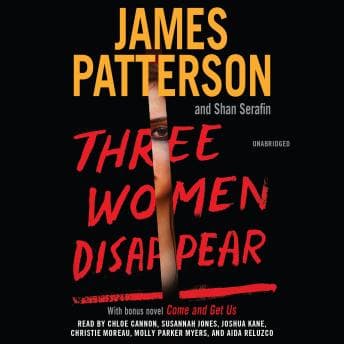

I was making chana masala at 10 PM on a Tuesday — the kind of elaborate, unnecessary cooking I do when my brain won't shut off — and I needed something to occupy the part of my mind that wasn't measuring garam masala. Three Women Disappear seemed like the right speed. A Patterson co-write, six narrators, under ten hours. Quick mystery comfort food. And honestly? That's pretty much exactly what I got. No more, no less.
Three Suspects, One Dead Accountant, and a Detective Who's Too Close
The setup is classic whodunit with a domestic noir twist: Anthony Costello, a manipulative accountant who apparently treated people like balance sheets, turns up dead in his own home. His wife Anna, his personal chef Sarah, and his maid Serena all had motive, all had access, and all three have vanished. The protagonist exhibits classic tortured-detective syndrome — Sean Walsh has a personal connection to the case that the book slow-drips throughout, and his superior officer is breathing down his neck for reasons that go beyond professional rivalry.
What makes the structure interesting — at least in theory — is that you're essentially getting four parallel narratives: Walsh's investigation, plus each woman's perspective on why she ran. The research actually shows that when you split a mystery across this many viewpoints, you either create a kaleidoscope effect where each angle reveals something new, or you dilute the tension until nobody's story has enough weight. Patterson and Serafin land somewhere in between. Each woman gets enough backstory to feel distinct (Sarah's culinary world, Anna's proximity to Costello's financial crimes, Serena's more vulnerable position in the household), but none of them get enough depth for me to really sink my teeth into their psychology.
And that's where I found myself asking: why does Walsh really care this much? The personal connection angle is supposed to be the emotional engine, but it felt more like a plot device than a genuine psychological wound. My therapist would have thoughts about this character — he's got that "I'll sacrifice everything for the case" energy that in real life usually masks something much messier. The book gestures at that messiness but doesn't commit.
Six Narrators Walk Into a Murder Investigation
The full-cast approach with six narrators is — honestly — a smart call for this particular structure. Joshua Kane handles Walsh's investigation chapters, and the women's perspectives each get their own voice actor. This is a fascinating case study in how audio production can paper over structural thinness. When you've got Aida Reluzco, Chloe Cannon, Christie Moreau, Susannah Jones, and Molly Parker Myers rotating through, the perspective shifts that might feel choppy on the page instead land with clarity. You always know whose head you're in. That's not nothing.
But here's the thing — and this is where I get a little frustrated — the narrators are doing competent, professional work with material that doesn't always give them much to chew on. Patterson's co-writes tend to run lean. Short chapters. Clipped prose. Lots of forward momentum, not a lot of interior life. Which means the narrators are primarily serving the plot rather than excavating character. Nobody gets a monologue that reveals something genuinely surprising about who they are. The performances are clean, well-produced, and distinctly voiced. They just don't get those moments where you forget you're listening to a performance.
Psychologically, This Doesn't Quite Track
Look, I study why people do what they do. And the central premise here — three women connected to the same man, all disappearing simultaneously — raises questions the book doesn't fully answer to my satisfaction. The mechanics of how and why each woman vanishes are handled efficiently, but the emotional logic? Costello is described as someone who turns "enemies into allies and vice versa," but we mostly see the aftermath of his manipulation rather than the manipulation itself. I wanted to understand the specific texture of his control over each of these women. What made Sarah stay in his employ? What kept Anna in the marriage? What was Serena's actual breaking point?
The book gives you answers to these questions, but they're surface-level. Functional. The kind of character motivation that checks the plot box without making you feel the weight of the decision. At under ten hours, there simply isn't room for Patterson and Serafin to do both — keep the pages turning AND build the kind of psychological architecture that makes a mystery feel inevitable rather than just surprising.
That said — and this is important — the book knows what it is. It's not trying to be Tana French. It's a fast, competently plotted mystery with a solid structural gimmick and good production values. I finished it before the leftovers made it into the fridge. (The chana masala turned out great, thanks for asking.)
Who Gets the Most Out of This
If you want a weekend listen that moves quickly and doesn't demand you take notes, this works. The multi-narrator format makes it easy to track while you're doing other things — cooking, commuting, folding laundry. If you're the kind of mystery reader who needs airtight character psychology and motivations that hold up under scrutiny? You'll notice the gaps. You won't hate it. But you'll notice.
The Case File, Closed
Three Women Disappear is the audiobook equivalent of a solid procedural episode — you enjoy it while it's on, you mostly forget the details a week later, but you don't regret the time spent. The six-narrator production elevates material that might feel thin on the page, and the under-ten-hour runtime means it doesn't overstay its welcome. Patterson's formula works because it's efficient, and efficiency has its own kind of satisfaction. Chase runs on that same efficient engine — propulsive, lean, and perfectly content to be exactly what it is rather than something weightier. Just don't come to it expecting the characters to haunt you after the last chapter drops. They won't. But they'll keep you company for a Tuesday night.