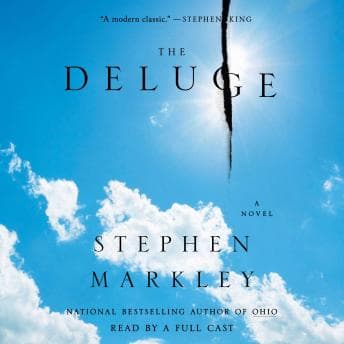

What happens when you throw 14 narrators, 40 hours, and the slow-motion apocalypse into a blender and hit puree?
I started this at 5:47 AM on a Tuesday, half-dead on the Caltrain, coffee not yet hitting my bloodstream. By hour 3, I was genuinely unsure if I was still following the same book or if my Audible had glitched into a different download. By hour 20, somewhere around Palo Alto on a Friday evening, I realized I was completely, hopelessly invested in characters I'd initially forgotten existed. By hour 40, finished during a 2 AM insomnia spiral after a particularly brutal on-call rotation, I sat in the dark of my apartment and just... stared at nothing for a while.
Bottom Line: This is basically The Wire but for climate collapse. Ambitious as hell, occasionally frustrating, ultimately unforgettable.
The Commitment Level Is Not a Joke
Forty. Hours. That's roughly 27 Caltrain commutes. That's three weeks of my life if I'm being honest about how long this actually took me. Markley's Ohio was stunning—NPR wasn't wrong about that—but The Deluge is something else entirely. It's polyphonic in a way that feels almost reckless. You've got a climate scientist getting death threats, an eco-terrorist with a plan, a drug addict spiraling, an advertising strategist who might be the most terrifying character in the whole thing, and Kate Morris, this young activist in Wyoming who becomes the gravitational center everything else orbits around.
The structure is scattershot by design. Markley jumps between timelines, locations, characters—sometimes within the same chapter. It's disorienting. It's also, I think, the point. Climate change doesn't happen in a neat three-act structure. It's everywhere, all at once, and you can't look away from all of it simultaneously.
14 Narrators: The Audio Equivalent of a Distributed System
Okay, so here's where my engineering brain kicked in. Managing 14 narrators across 40 hours is basically like debugging a microservices architecture with 14 different teams who all have slightly different coding styles. Some of them mesh beautifully. Some of them... don't.
The good: Soneela Nankani and Joy Osmanski absolutely killed it. Their characters felt distinct from the first sentence. The full-cast format genuinely helps when you're juggling this many POVs—you start associating voices with storylines, and your brain does the sorting automatically. By hour 10, I could tell who we were following within seconds.
The less good: A couple of the male narrators have this quality that's hard to describe—Kevin said it sounded like they were reading a corporate earnings call. Not bad, exactly, but off-putting enough that I noticed. And there's an adjustment period where you're just trying to figure out who's who. I got confused about two characters for like three hours because their narrators had similar cadences.
No audio glitches, no weird production issues, no sudden volume changes. For a 40-hour production with this many moving parts, that's actually impressive.
The Ending Problem (Or Is It?)
Some listeners found the ending anticlimactic. I get it. After 40 hours, you want catharsis. You want resolution. Dragon Teeth gave me that satisfying wrap-up, which made this one's ambiguity hit harder. You want the climate crisis to be solved or at least for everyone to die dramatically.
But here's the thing—and maybe this is the engineer in me talking—real systems don't have clean endings. Production outages don't resolve with a satisfying click. Climate change definitely doesn't. The ending felt true to what Markley was building. Frustrating? Sure. But the frustration felt earned.
Who This Is (and Isn't) For
This is not a casual listen. Do not start this if you've got commitment issues with audiobooks. Do not start this if you need tight plotting and constant payoffs. Do not start this if you want something you can follow while half-asleep at 6 AM—actually, scratch that, I did follow it at 6 AM, but I also rewound sections multiple times.
Perfect for: road trips, dedicated listening sessions, anyone who's ever doomscrolled climate news and thought "someone should write the novel about this." Skip if: you need gym-friendly background listening, or you hated The Wire because it had too many characters.
Worth the 40-Hour Deploy?
The ROI on this audiobook is weird. It's a massive time investment. Some of it drags. Some characters you'll forget. But the ones that stick—Kate Morris especially—they really stick. And there are moments, scattered across those 40 hours, where Markley captures something about collective action and individual helplessness that I haven't seen anywhere else.
I finished this three days ago. I'm still thinking about it. That has to count for something.