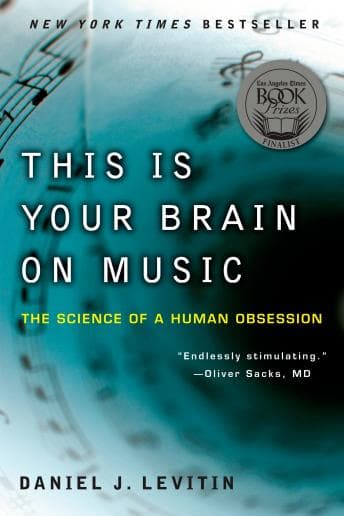

Why do we remember every word to songs from when we were sixteen but can't recall what we had for lunch yesterday?
This question has genuinely haunted me since I started researching autobiographical memory. I was chopping onions for a chana masala I'd eat alone (again, don't pity me) when Daniel Levitin started explaining the neurological basis for why my brain has permanently allocated storage space for the entire Backstreet Boys discography. My therapist would have thoughts about this.
The Protagonist Exhibits Classic Dual-Identity Syndrome
Levitin is a fascinating case study in himself. Here's a guy who worked as a sound engineer and session musician before pivoting to neuroscience—and you feel that duality on every page. He's not some lab coat explaining music from the outside. He's been in the recording booth with Stevie Wonder. He understands why a slightly flat guitar string can make a blues riff feel more authentic.
What makes this compelling is how he bridges two worlds that rarely speak to each other. Musicians talk about "feel" and "groove." Neuroscientists talk about neural oscillation and dopamine release. Levitin speaks both languages fluently. When he explains how composers exploit our brain's pattern-recognition systems to create pleasure—setting up expectations then subverting them—you suddenly understand why that key change in your favorite song gives you chills. It's not magic. It's neuroscience. (Okay, it's still a little bit magic.)
Edward Herrmann Reads Like Your Favorite Professor
The research actually shows that how scientific content is delivered matters almost as much as the content itself. Herrmann—and I mean this as genuine praise—sounds like the professor whose 8 AM lectures you actually attended. His voice has this measured, almost paternal quality that makes dense material feel approachable. He doesn't rush. He lets concepts breathe.
But. Here's the thing. That measured quality cuts both ways. Some listeners find the pacing too slow for audiobook format, and I get it. This isn't a thriller. You're not going to miss your subway stop because you're so gripped by the explanation of the tonotopic map in the auditory cortex. The narration can feel dry when the content gets technical—which it does, frequently. I found myself speeding up to 1.25x during certain sections, then slowing back down when Levitin dropped another fascinating example.
The Earworm Chapter Changed How I Understand My Own Brain
The sections on earworms—those insidious little jingles that hijack your consciousness—hit differently when you're already prone to obsessive thought patterns. (Again, my therapist would have thoughts.) Levitin explains why certain melodic fragments get stuck on repeat, and it's genuinely illuminating. It has to do with how our brains process incomplete patterns. We keep replaying the song trying to "complete" it. The same pattern-completion obsession drives the relationship dynamics in Men Are From Mars, Women Are From Venus—we keep replaying conversations trying to decode what the other person "really meant."
Psychologically, this tracks perfectly with what we know about intrusive thoughts. The brain doesn't like loose ends. It keeps returning to unfinished business. Suddenly that annoying commercial jingle from 1997 that still surfaces randomly makes neurological sense.
I also appreciated his argument against the "music as evolutionary accident" crowd. He makes a compelling case that music is fundamental to our species—possibly more fundamental than language. The evidence he presents about musical processing in infants, about the universality of certain musical structures across cultures, about the deep brain structures involved in musical perception—it all points to something hardwired, not incidental.
Who Should Press Play (And Who Should Skip)
This requires focus. Full stop. If you're looking for something to half-listen to while doom-scrolling, keep moving. But if you're genuinely curious about why music affects you the way it does—why certain songs transport you instantly to specific moments, why you can't help but tap your foot to certain rhythms, why that one chord progression makes you want to cry—this delivers actual answers. Skip it if you want light listening; lean in if you want to understand your own obsessions.
The book is from 2006, so some of the neuroscience has evolved. But the core insights hold up remarkably well. And Levitin's ability to translate complex research into accessible explanations remains impressive.
Case Closed: Patient Shows Healthy Musical Obsession
I found myself asking: why does this book work when so many "science of X" books fail? The answer, I think, is that Levitin never forgets the human element. He's not just explaining mechanisms. He's explaining why those mechanisms matter to our lived experience. He understands that we don't just want to know how music affects the brain—we want to know why it makes us feel alive.
At six hours, it's a reasonable commitment. The production is clean, if sparse—no musical examples, which feels like a missed opportunity. But Herrmann's steady delivery compensates. Worth the credit if you're the kind of person who wants to understand your own obsessions. And honestly? Aren't we all?