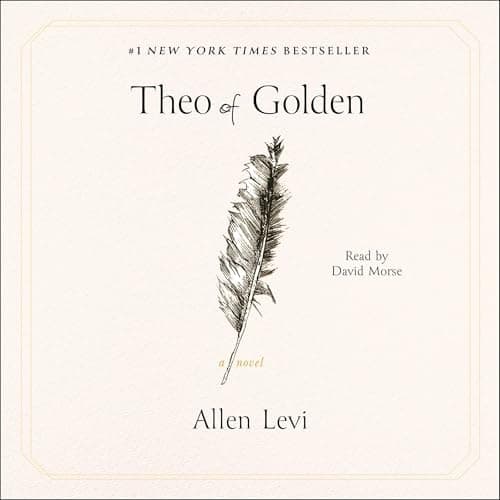

Three AM, warehouse floor, nothing moving but the conveyor belt humming on auto. Jamal's science project is half-glued on the kitchen table, Malik's got a field trip permission slip I still haven't signed, and I'm sitting on a pallet of shrink-wrapped detergent listening to a man buy pencil portraits in a fictional Southern town. That's where Theo of Golden found me.
And look - I almost turned it off.
A Stranger With No Backstory Buying Portraits Off a Coffee Shop Wall
Let me be straight with you. This book has no car chases. No body count. No ticking clock. Theo shows up in Golden, starts buying these pencil portraits off the wall of a coffeehouse, hands them back to the people in the drawings, and asks for their story. That's the whole engine. Portrait by portrait, stranger by stranger, you get these little windows into ordinary lives - marriages gone sideways, kids who moved away and never called, old men carrying guilt like it's a second job.
The criticism that Theo reads like a Mary Sue? I get it. The book never really earns his goodness - he just IS good, and everyone around him opens up like he's got some kind of magic password. In real life, some stranger walks into my warehouse asking for my story, I'm calling security. But here's the thing that kept me listening: the people around Theo felt real. Their problems felt real. The woman who hasn't spoken to her sister in twelve years over something stupid at Thanksgiving - I know that woman. She works second shift.
Allen Levi is an attorney and a judge from middle Georgia, and you can feel that small-town courthouse DNA in every conversation. People talk around their pain before they get to it. That part he nailed.
David Morse Carrying 13 Hours Like It's Nothing
David Morse is the reason this audiobook works at all. The man has this low, unhurried gravity in his voice - like a foreman who's seen everything and doesn't need to raise his voice to get your attention. His Theo sounds like someone you'd actually trust with your secrets, which is half the battle since the book asks you to believe a whole town does exactly that.
He differentiates the characters clearly enough that I never got lost on the forklift, and that matters when you're juggling a cast of small-town folks who could easily blur together. The emotional beats land because Morse doesn't push them - he lets the silences do work. No vocal theatrics, no fake Southern syrup. Just steady, patient delivery.
I bumped it up to 1.6x out of habit and actually dropped it back to 1.25x about two hours in. The pacing is already slow - Morse's deliberate cadence at double speed turns contemplative into rushed, and this book needs its breathing room even if my patience doesn't usually allow for it.
The Saccharine Problem Is Real But Not Fatal
I won't pretend this book doesn't get sweet enough to make your teeth hurt. There are moments where Golden feels less like a real town and more like a Hallmark set - everybody's got a wound that heals just right, every conversation lands exactly where it needs to. Some folks bounced off this hard, calling it contrived, saying nothing really happens. They're not wrong about the plot. If you need narrative propulsion, you will be checking the progress bar by hour four.
But I kept coming back to those individual stories. Working people carrying weight they never asked for, trying to be seen by somebody - anybody - who gives a damn. That part isn't fake. That part is Tuesday night at 2 AM when the orders slow down and you start thinking about whether your kids will remember you being there or just remember you being tired.
(My ex would say I'm going soft. She's probably right.)
The author's afterword at the end, read by Levi himself, is a nice touch - gives you context on why a Georgia judge wrote a book about radical kindness. Short enough that it doesn't overstay.
Who Should Listen (And Who Should Skip)
If you loved A Man Called Ove - quiet character study, grumpy exterior hiding a soft center - this is the same neighborhood. Warmer, less sharp, but the same idea that ordinary people deserve to have their stories heard. When I need the opposite energy, A Good Girl's Guide to Murder is what I reach for - that one's got the propulsion and body count this book deliberately avoids.
If you need tension, if you need stakes, if you listen while doing something that splits your attention - skip it. This demands focus or it turns into pleasant wallpaper.
Clocking Out on This One
Theo of Golden is a 13-hour bet that kindness is interesting enough to carry a novel. Most of the time, thanks to Morse and a handful of genuinely earned emotional moments, it wins that bet. It's soft where I usually want hard, slow where I usually want fast, and optimistic where I'm usually suspicious. But some shifts you don't need another body in a trunk. Some shifts you just need someone to remind you that people are worth paying attention to.
From the warehouse floor straight to you - this one's gentler than my usual, but it got under my skin.