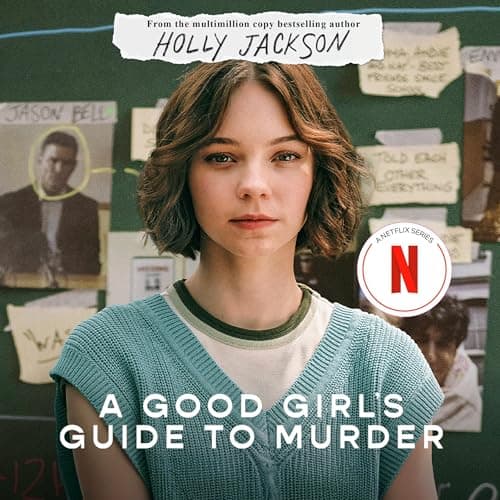

This is not a horror novel. I need to say that upfront because my listeners are going to see my name attached to this review and expect body counts and existential dread. What A Good Girl's Guide to Murder actually is — and I mean this as a genuine compliment — is a YA mystery that understands how real fear works. Not monster fear. Not supernatural fear. The fear that the people around you are lying, that the system already decided who was guilty, and that digging for truth makes you a target.
I was reshelving returns at the library on a Tuesday evening, alone because my coworker called in sick, and I had my earbuds in. The branch was empty except for the fluorescent buzz and Pip Fitz-Amobi's voice walking me through her senior capstone project — a real-time reinvestigation of a five-year-old murder case in her small town. And I'll tell you, there's something genuinely unsettling about standing in a quiet public building at dusk, listening to a teenager methodically prove that everyone around her accepted a convenient lie.
The Full Cast Gamble That Actually Pays Off
Eleven narrators. Eleven. When I saw that cast list, I braced for chaos. Full-cast productions in YA are a coin flip — either they elevate the material or they turn it into a drama club showcase. This one lands. Bailey Carr carries the weight as Pip, and she nails the specific tone Jackson's writing demands: smart but not precocious, driven but increasingly scared. The recorded phone conversations between characters — and this is the production detail that got me — sound genuinely unpolished, like someone actually hit record on their phone during an uncomfortable exchange. That lo-fi quality sells the conceit that Pip is building a case file, not narrating a novel.
The other narrators slot in for interviews and secondary characters, and while none of them get enough real estate to fully inhabit their roles, the sheer variety of voices means you never lose track of who Pip is talking to. Gopal Divan and Shezi Sardar bring weight to the Singh family's grief without leaning into melodrama, which matters because this book is fundamentally about a brown kid being railroaded by a community that found it easier to believe in his guilt than investigate further.
Pip Fitz-Amobi Is Not Your Standard YA Sleuth
Here's where I have to compare, because the comparisons are obvious. If you've listened to One of Us Is Lying, you know the YA-mystery-with-suspects formula. Jackson's working with similar raw material — high school, secrets, a small town that talks — but Pip is a different animal. She's methodical in a way that feels earned rather than precocious. She makes spreadsheets. She tracks timelines. She gets in over her head not because she's reckless but because she's thorough enough to actually find things people buried.
The structure mirrors her process: interview transcripts, production logs, text messages. In audio, this means the format shifts constantly — straight narration gives way to recorded conversations, which give way to Pip's internal notes. At around the midpoint, when Pip realizes someone is actively watching her investigation, the format shifts stop feeling like a gimmick and start feeling like evidence. The kind you'd hand to a detective.
I'll be honest — some of the twists I saw coming. I've consumed enough mystery to recognize when an alibi is too clean or a witness is too helpful. All That Remains gave me that same feeling of watching the pieces arrange themselves just before the floor drops out. But Jackson plants at least two reveals that genuinely surprised me, and one of them recontextualizes an entire character in a way that made me rewind thirty seconds just to sit with it. I won't spoil it, but pay attention to who volunteers information versus who has it pulled from them.
Where It Stumbles
The romance subplot. It's there, it's fine, it doesn't ruin anything, but it also feels like it exists because the genre expects it rather than because the story needs it. Every minute spent on Pip's developing feelings for Ravi is a minute not spent on the investigation, and the investigation is so much more interesting. Carr does what she can to sell the chemistry, but the writing gives her more to work with in the interrogation scenes than the flirting scenes.
And at nearly eleven hours, there's a stretch in the middle — roughly hours five through seven — where the pacing softens. Pip is gathering information, hitting dead ends, regrouping. It's realistic but not exactly propulsive. If you're listening while distracted, you'll lose the thread here.
The Shelving Decision
So look — is this the scariest thing I've ever listened to? No. Shirley (my cat) didn't even twitch during any of it, and she's my unofficial dread barometer. But this book understands that horror isn't about gore — it's about dread. The dread of a community that chose comfort over justice. The dread of a teenager realizing she's the only one willing to ask the right questions. For a YA mystery, that's more than enough.
If you want atmospheric supernatural scares, skip this one — it's playing a different game entirely. But if you want something that respects the mechanics of a real investigation while still delivering genuine surprises, you need this. True crime fans who wish the host would just follow up on the obvious leads? This is your audiobook. My podcast listeners are going to hear about the production design on this one — the recorded conversation trick alone is worth studying.
I finished the last chapter while locking up the library. Walked to my car in the dark parking lot. Checked my rearview mirror twice. Not because I was scared, exactly. But because Pip made me wonder what's buried in every small town that looks peaceful from the outside.