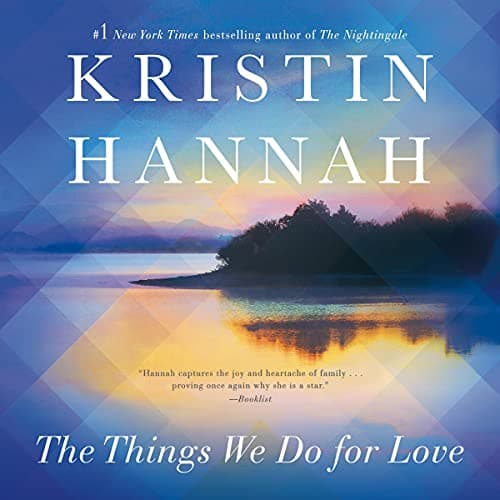

I was folding laundry on a Sunday afternoon when I started this one, expecting something light to pass the time. By hour three, I'd abandoned the laundry basket entirely and was sitting on the floor next to a pile of unfolded towels, completely locked in. That's the thing about Kristin Hannah — she lures you in with what looks like a cozy small-town setup, then quietly rearranges your emotional furniture.
The Things We Do for Love follows Angie DeSaria, a woman gutted by divorce and years of failed attempts to have a child. She retreats to her Pacific Northwest hometown of West End, takes over the family restaurant, and tries to rebuild something from the wreckage. Then Lauren Ribido walks through the door — a seventeen-year-old with a sharp mind, a bruised heart, and a mother who eventually disappears on her entirely. Angie takes Lauren in, and what begins as a generous act of kindness slowly becomes something far more complicated and consequential than either of them could have anticipated.
Here's what caught me off guard: I expected this to be a straightforward story about motherhood and found family, and for a while it is. But Hannah threads in tensions that creep up on you. The relationship between Angie and Lauren is warm and genuine, and you root for both of them so hard that when the story shifts — and it does shift — the emotional fallout hits like a sucker punch. Without spoiling it, the second half of this book asks some genuinely difficult questions about love, sacrifice, and what people are willing to do when those two things collide.
The criticism about predictability isn't entirely unfair, though. If you've read enough women's fiction or Kristin Hannah novels specifically, you might see certain plot mechanics clicking into place before they arrive. The setup is deliberate, and some stretches in the middle feel like they're building toward an inevitable destination rather than surprising you along the way. And the ending? It's abrupt. Not in a way that feels intentionally ambiguous or artful — more like the story runs out of runway. I sat there for a minute after it ended, waiting for more that never came. It's not a deal-breaker, but it's noticeable.
Now, Susan Ericksen's narration is where this audiobook earns real points. Her voice carries genuine emotion without tipping into melodrama, which is harder than it sounds when you're dealing with material this heavy. She shifts between characters with subtle inflection changes — Angie sounds different from Lauren, who sounds different from the supporting cast — and it all feels natural rather than performed. There's a quality to her delivery where the emotion seems to rise from inside the text rather than being layered on top of it. One listener described her voice as "rippling with emotion," and honestly, that's about right. She makes you feel the weight of these women's choices without ever overselling the moment.
Compared to Hannah's biggest works — The Nightingale, The Great Alone — this one operates on a smaller, more intimate scale. It's not an epic wartime saga or a survival story set against Alaskan wilderness. It's two people in a small town trying to figure out what family means when biology and circumstance refuse to cooperate. That smaller scope is both its strength and its limitation. You get deeply attached to Angie and Lauren, but the world around them can feel a bit thin. The DeSaria family provides warmth and texture, but some secondary characters exist primarily as plot devices rather than fully realized people.
What surprised me most in looking at this book's reception is how polarized the responses are — not about quality, but about emotional impact. People who connected with the themes of maternal longing and the complicated ethics of the story's central conflict seem to find it devastating in the best way. People who saw the twists coming found the slow build frustrating rather than rewarding. Your experience is likely going to depend on which camp you fall into.
Who Should Listen (And Who Should Skip)
If you're drawn to emotionally complex stories about motherhood, found family, and impossible choices — and you can forgive a somewhat abrupt ending — this one's worth your thirteen hours. Skip it if predictable plot mechanics in women's fiction tend to pull you out of a story, or if you need a neatly wrapped conclusion to feel satisfied.
At thirteen hours, this is a solid mid-length listen that rewards your attention. It's not background material — you'll want to be present for the emotional turns, especially in the back half. Ericksen's performance elevates material that could feel formulaic in lesser hands, and Hannah's character work with Angie and Lauren is strong enough to carry you through the slower passages. It may not sit alongside Hannah's very best, but it's a genuinely affecting story about how love can simultaneously heal and devastate, often in the same breath. Honestly, the closest I've come to that same bittersweet gut-punch recently was Man Who Would Be King — different world entirely, but that same ache of watching someone reach for something just beyond their grasp.