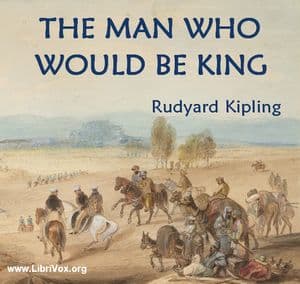

Kipling knew something about empire that we've largely forgotten how to talk about.
I was grading a stack of essays on Heart of Darkness - midnight, kitchen table, Denise already asleep - when I switched this on. Ninety minutes seemed manageable. A palate cleanser before bed. What I got instead was a story that made me set down my red pen and just... listen.
The Con Men Who Believed Their Own Myth
Daniel Dravot and Peachey Carnehan are two of the most audacious characters in Victorian fiction. They're grifters, former soldiers, men who've knocked around British India long enough to develop a very specific kind of delusion: that they can simply decide to become kings. And here's the uncomfortable genius of Kipling - he makes you root for them. You know it's going to end badly. The frame narrative practically screams tragedy. But you're still there, walking with them into Kafiristan, half-hoping they'll pull it off.
The story is based on real figures - James Brooke, who became the "white Raja" of Sarawak, and Josiah Harlan, an American who claimed the title Prince of Ghor. Kipling wasn't inventing this particular brand of imperial madness. He was documenting it. That's what makes the satire cut deeper than you expect.
Philippa's Deliberate Pace
Philippa narrates this LibriVox recording with what I'd call scholarly patience. She reads at a pace that lets Kipling's prose breathe - "slow enough to take in the words easily," as one listener put it. For me, listening at 1.0x (because the author chose those words), this felt exactly right. Kipling's sentences have a rhythm, a cadence borrowed from the oral storytelling traditions he absorbed in India. Rush them and you lose half the music.
Here's the thing about her dialect work for Dravot and Carnehan: it takes about ten minutes to click. The first few exchanges, I'll admit, I rewound twice. The cockney-adjacent accent she gives these two con-artists initially muddles the words. But then something shifts. Your ear adjusts. And suddenly the dialect isn't an obstacle - it's characterization. These aren't educated men. They're chancers. The way they speak tells you everything about who they are before Kipling has to explain it.
Some listeners apparently find her pacing too slow. I suspect those listeners also read SparkNotes in college. (My students would hate this. I love it.)
What Kipling Is Really Saying
This is why we still read the classics. Under the adventure story - and it IS an adventure story, complete with mountain crossings and native battles and a crown made of turquoise - there's a meditation on the lies we tell ourselves about power. Dravot doesn't just want to rule Kafiristan. He starts to believe he has a right to rule it. He convinces himself he's descended from Alexander the Great. The con man becomes the mark.
The narrator - Kipling himself, essentially, as a journalist in India - watches this unfold with the horrified fascination of someone who recognizes the disease. He's an imperial subject too. He knows how easy it is to believe your civilization is destined to lead. The story doesn't preach. It shows. And then it shows the consequences.
Worth Pausing the Faculty Meeting For
At ninety-one minutes, this is the length of a faculty professional development session - and approximately one thousand times more valuable. The production is clean, no audio artifacts or background noise. No music, no sound effects, just Philippa and Kipling's words. It demands focused listening. This isn't a background audiobook. Put it on while doing dishes and you'll miss the frame narrative entirely.
If you loved Heart of Darkness, this is its spiritual predecessor - Kipling doing in 1888 what Conrad would do a decade later, but with more dark humor and less fever-dream prose. For a different take on war and moral complexity, Beneath a Scarlet Sky trades colonial India for WWII Italy—but the questions about what men become under pressure hit just as hard. If you've only seen the 1975 Huston film with Connery and Caine (worth watching, by the way), the source material is leaner, meaner, more explicitly a tragedy.
Who should listen: Anyone who wants to understand the imperial mindset - the self-delusion, the hubris, the way power corrupts even men who started out knowing they were frauds. Who should skip: If you need action every five minutes or if accents throw you off permanently, this isn't your listen.
Class Dismissed
The prose deserves to be savored. Philippa understands that.