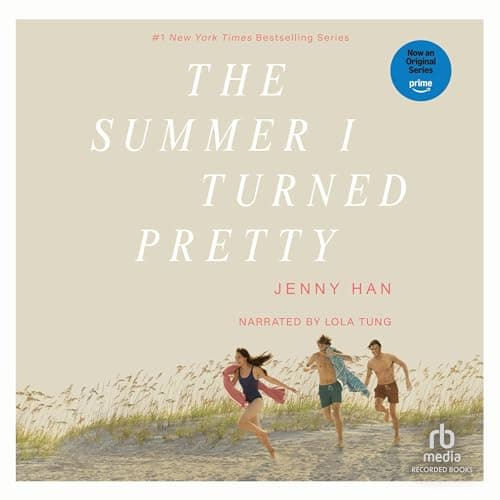

This book is a time machine disguised as a summer romance.
I was walking Luna through the park near my apartment - one of those late June evenings where the light goes golden and the air smells like cut grass and somebody's barbecue - and Belly started talking about Cousins Beach like it was the only real place in the world. And honestly? For six hours, I believed her.
Belly Is Every Kid Who Ever Loved Someone Before They Had the Language For It
Here's the thing about working with teenagers: I know what it sounds like when someone is trying to articulate a feeling they haven't lived long enough to name yet. Belly's internal monologue nails that. The way she catalogues every micro-interaction with Conrad - did he look at me longer than usual, did his hand brush mine on purpose - that's not shallow. That's a kid building her emotional vocabulary in real time. This character feels like one of my kids. The ones who sit in my office and describe a crush like it's a natural disaster happening to them personally.
Jenny Han gets something right that a lot of YA authors fumble: Belly isn't performing maturity. She's messy and jealous and sometimes selfish in that very specific fifteen-year-old way where the whole world revolves around your feelings because you genuinely don't know yet that it doesn't. She's not written to be aspirational. She's written to be recognized.
And the family dynamics - Belly's relationship with her mother, the complicated grief woven through Susannah's warmth, the way the Fisher and Conklin families orbit each other every summer like it's gravitational - the chosen family vibes are immaculate. Not in a dramatic found-family way, but in that quieter, realer way where people just keep showing up for each other year after year until the boundaries between "friend" and "family" dissolve completely.
Lola Tung's Voice Is the Audiobook's Best and Trickiest Feature
So Lola Tung plays Belly in the TV adaptation, and you can hear it. She carries Belly's mannerisms like someone who's lived inside this character's skin - the optimism, the dramatic inner monologue, the way Belly's voice lifts when she's excited about something stupid and small. There's this thing she does on funny lines where you can literally hear her smiling while recording, and it's genuinely charming. It made me grin on my walk more than once, and Luna looked at me like I'd lost it.
But - and this is real - there are moments where the performance gets inconsistent. Some laughs land in weird places, like a giggle dropped into a beat that's supposed to carry weight. Vocal gestures that feel spontaneous in one chapter feel forced in another. It's not a dealbreaker, but if you're listening at 1.25x like I do, you catch every little hiccup. The emotional delivery when it works? Sincere and sweet and exactly right. When it doesn't, it pulls you out just enough to notice the recording booth.
For a single-narrator production with no music or sound effects, the whole thing lives or dies on Tung's voice. And it mostly lives. She doesn't do wildly different voices for every character, but she shifts tone and energy enough that you always know who's talking. Conrad gets this lower, more guarded quality. Jeremiah is lighter, looser. It's subtle differentiation, not theatrical, which fits the intimacy of the story.
The Ache Underneath the Sparkle
What surprised me - and maybe shouldn't have, given Jenny Han's track record - is how much genuine sadness runs under this book. It's marketed as a bright summer romance, and it is that. But it's also about how the people and places we love most are already changing while we're busy memorizing them. Belly is so desperate to freeze these summers because some part of her already knows they won't last. My clients would feel seen by this - that specific anxiety of loving something so hard you're already grieving it.
The ending is abrupt. I'll be honest about that. It stops more than it concludes, clearly setting up the next book. The Final Gambit gave me that same bittersweet finish-line feeling — a series closer that earns its emotional payoff in ways this opener is still building toward. If you need resolution, you're going to feel a little cheated. But the emotional arc - Belly arriving as one version of herself and leaving as another - that part lands.
Representation done right for once isn't quite the phrase here, because this isn't a queer story. But the emotional authenticity? The way Han writes teenage interiority without condescension? That's the standard I wish every YA author held themselves to. Queer joy AND queer pain - both matter, and so does straight-girl-first-love pain when it's written with this much honesty.
Who Should Listen (And Who Should Skip)
If you were ever the kid who spent an entire summer obsessing over whether someone liked you back - this one's yours. It's also great for anyone who wants YA that treats teen emotions as real and worth taking seriously. Skip it if you need a tidy ending or if love triangles make you itch; this is book one of three and it leans hard into both.
Luna and I Give This a Sunset Walk Stamp of Approval
At six hours, this is a perfect weekend listen - light enough to enjoy on a long walk or a commute, emotionally honest enough to stick with you after. It's not trying to be anything other than what it is: a girl, a summer, two boys, and the ache of growing up. Sometimes that's plenty.