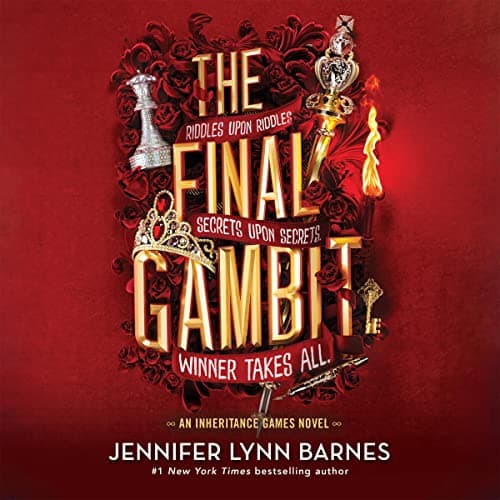

Can we talk about how annoying it is when a series finale tries to juggle a love triangle AND a life-threatening mystery AND four brothers' worth of emotional baggage? Because I spent a solid chunk of The Final Gambit mentally yelling at Avery to stop thinking about boys and focus on the person literally trying to destroy her life. And yet—and this is the frustrating part—I couldn't stop listening. I burned through this entire book on a rainy Sunday, headphones in, phone face-down, completely useless to anyone who needed me.
So here's the deal. A stranger shows up at Hawthorne House, and suddenly the puzzle-box mystery that's been building across three books cracks wide open into something darker and more personal than what came before. Someone from the Hawthorne family's buried past has resurfaced, and the danger feels real this time—not just clever games with ciphers and secret passages, but actual people in actual jeopardy. Jennifer Lynn Barnes has a PhD in psychology and cognitive science, and you can feel it in how she plants clues. She'll bury a critical piece of information inside what sounds like throwaway banter between Jameson and Avery, and twenty minutes later you're rewinding because you realize you missed something that matters. I learned this the hard way when I tried to listen while making pasta and had to scrub back a full chapter.
The emotional weight here is heavier than the first two books. Grayson's arc in particular caught me off guard—Barnes spent two books building him up, and in The Final Gambit she lets him be genuinely vulnerable in a way that doesn't feel manufactured. The ending scene between Avery and Grayson is the moment everyone talks about, and it earns that reputation. Christie Moreau's voice drops into something quieter and rawer during that scene, almost like she's pulling back from performing and just... feeling it. It's the kind of moment where you stop walking and stand still on the sidewalk because the audio demands your full attention.
Moreau has been narrating this series from the start, and by book three she's completely at home with these characters. That comfort level was already clearly building in The Hawthorne Legacy, but something clicked into place between book two and three that made me appreciate her work on this series in a whole new way. Each Hawthorne brother sounds like a distinct person—Jameson's reckless energy, Grayson's controlled tension, Xander's off-kilter warmth, Nash's drawl. She doesn't do wildly different voices for them, but the emotional texture shifts enough that you always know who's talking. Where she really shines is in the high-stakes scenes: there's a confrontation about two-thirds through the book where her pacing speeds up just slightly, tightening the rhythm of the dialogue, and it made my heart rate spike. That's good narration—when the performer's choices make you physically react.
The puzzle structure keeps the plot moving at a clip across 11-plus hours. Barnes doesn't pad her chapters. Every scene either advances the mystery, reveals character, or both. The villain reveal is well-constructed—I had a theory around the 60% mark and I was half right, which is that sweet spot where you feel clever and surprised at the same time. Barnes plays fair with her clues. Nothing materializes from thin air, and when you look back, the breadcrumbs were always sitting right there in the dialogue.
My gripe—and it's a real one—is that the romance sometimes elbows the mystery out of the way. There are stretches where Avery's love life takes up space I wished had gone to puzzle mechanics or family revelations. The love triangle resolution will land beautifully if you've been shipping one pairing since book one, but if you're primarily here for codes and secret rooms and dangerous games, you'll feel those romantic detours.
As a series conclusion, though? This one closes the book properly. Major threads from all three novels get resolved. Characters land in places that feel earned rather than convenient. Barnes doesn't stretch things into sequel bait territory, and that restraint is worth appreciating in a publishing landscape that wants every YA hit to become a six-book franchise.
But I need to be blunt about something: this is not a standalone. If you haven't read The Inheritance Games and The Hawthorne Legacy first, you will be completely lost. I gave The Inheritance Games four stars and still think it's one of the most genuinely fun puzzle-box setups I've listened to in years—do yourself the favor of starting there. The emotional payoffs depend on two books of buildup, and the mystery references events and relationships from earlier installments constantly. Start at book one. You'll want the full ride.
Who Should Listen (And Who Should Skip): If you loved the first two Inheritance Games books and want a finale that honors the emotional buildup and puzzle-box payoffs, this is your listen. If you haven't started the series, do not begin here—you'll be hopelessly lost. And if romance subplots in your mystery make you impatient, know that the love triangle takes up real estate you might wish had gone to ciphers and secret passages.
This is smart, fast YA entertainment with real stakes and a narrator who knows exactly how to deliver it. It rewards listeners who pay attention, it punishes multitaskers, and it left me sitting in my car in the driveway for an extra fifteen minutes because I refused to pause before the final chapter ended.