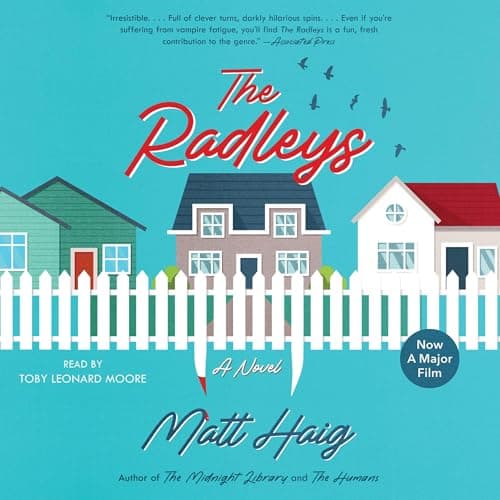

Look, I need to lodge a complaint. I've spent twenty years telling teenagers that vampires are a metaphor — for sexuality, for addiction, for the Other, for whatever thematic lens we're applying that week — and Matt Haig had the audacity to write a book that makes that metaphor work better than most of the ones I assign in class. I was listening to this during a Saturday morning walk along the lakefront with Denise, and she had to physically tap my shoulder twice because I'd stopped responding to her entirely. Not because the plot had me white-knuckling. Because a passage about a vampire father measuring out sunblock for his kids like it was communion wine made me think about every lie I've ever told myself about "choosing" to live a certain way.
That's what The Radleys is really about. Not vampires. Denial.
Suburban Repression With Fangs
The setup is deceptively cozy: the Radleys are a middle-class English family in a village where the biggest scandal should be someone's hedge growing too tall. Peter's a GP. Helen's distant and quietly miserable. Son Rowan gets shoved around at school, and daughter Clara has gone vegan — which, when you're an unaware vampire, is basically your body screaming at you and you interpreting it as a lifestyle choice. Haig plays this for dark comedy, and it lands. Clara's veganism as unconscious vampiric self-denial? My students would hate this. I love it.
But here's what Haig is really saying: the Radleys aren't just abstaining from blood. They're abstaining from themselves. Peter and Helen made this pact seventeen years ago to go "abstaining" — the vampire equivalent of going cold turkey — so their kids could be normal. And the cost of that normalcy is a marriage that's hollowed out, kids who are physically sick from suppressing their nature, and a household held together by routines that feel like rituals of avoidance. If you've ever watched a couple at a dinner party perform their marriage, you know exactly what Haig's doing here.
Then Clara kills someone. And suddenly the book cracks open.
Uncle Will and the Problem of the Fun Villain
When Uncle Will shows up — practicing vampire, unapologetically hedonistic, morally bankrupt in the most entertaining way possible — the book shifts into something thornier. Will is everything Peter gave up. He drinks, he seduces, he doesn't apologize. And Haig is smart enough to make Will genuinely appealing, not just in a bad-boy way but in a "what if you stopped pretending?" way. This reminds me of what Hemingway said about writing — the dignity of movement of an iceberg is due to only one-eighth of it being above water. Will's charm is the visible eighth. The destruction he leaves is the rest.
The tension between Peter and Will isn't really about vampirism. It's about brothers who chose different paths and each resent the other for it. Peter resents Will's freedom. Will resents Peter's moral superiority. Helen, caught between them, starts reconsidering which version of herself she buried. The writing deserves to be savored here — Haig captures the marital strain with a precision that's almost uncomfortable. You feel Helen's seventeen years of self-erasure in small, specific moments, not grand declarations.
Toby Leonard Moore Knows What Silence Is For
The narrator understands that pause is punctuation. Moore's reading is controlled in a way that serves the book's tone perfectly — this is a story about people holding everything in, and Moore's delivery mirrors that restraint. When Will enters, there's a looseness to Moore's voice, a warmth that's just slightly predatory. You feel the temperature change. The AudioFile Earphones Award was earned here.
I wish I could tell you more about specific vocal distinctions between characters — the research is thin on that front, and I'll be honest, Moore doesn't do wildly different voices so much as modulate register and energy. Peter sounds careful. Will sounds like he's enjoying a private joke. Clara's confusion comes through in hesitation rather than vocal gymnastics. It works for this kind of book, where the drama is internal. But if you need each character to sound completely distinct, you might occasionally lose track in dialogue-heavy sections.
I listened at 1.0x, as always, and the pacing felt right. At nine and a half hours, it doesn't overstay. There's a police investigation subplot that could've been tighter — it serves the plot but doesn't generate much real tension — and the final act wraps up a touch too neatly for my taste. But the middle hundred pages? Worth pausing the faculty meeting for.
Who Should Listen (And Who Should Skip)
Pick this up if you want literary domestic fiction wearing a vampire costume. If you loved The Humans — Haig's other genre-as-metaphor novel — this is its spiritual successor, traded from alien to vampire. Skip it if you're looking for genuine horror or vampire mythology with teeth (pun earned). Though if you do want something leaning harder into the atmospheric dread side of things, I spent a few evenings with Six Creepy Stories by Edgar Allan Poe earlier this year — the darkness there is a lot less metaphorical, and Moore's restraint here made me appreciate all over again how much Poe earns his horror by just letting the horror be the thing. The supernatural elements are a delivery mechanism for the family drama, not the main course.
The Lesson Plan
This is why we still read the classics — or in this case, why we still listen to writers who use genre to ask real questions. The Radleys isn't asking "what if vampires lived among us?" It's asking what happens when you spend a lifetime denying what you are to protect the people you love. And whether that protection is really love at all, or just fear wearing a better outfit.
Denise asked me what I was listening to when I finally took my earbuds out. I said it was a vampire novel. She raised an eyebrow. I said, "It's about us. It's about everyone." She raised the other eyebrow. I'm still working on the explanation.