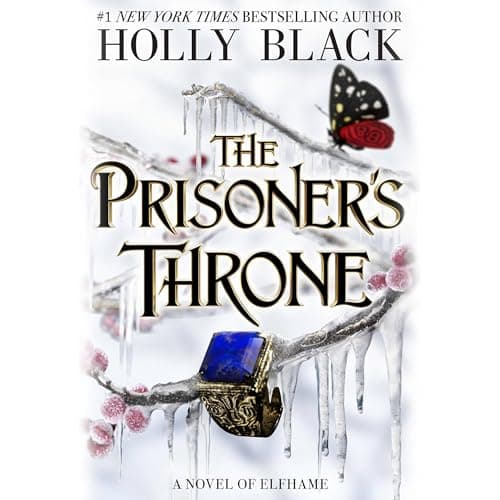

Prince Oak is the most dangerous kind of fae boy: the one who smiles while lying to keep you alive. This whole book lives inside that smile, and Holly Black makes you pay for every inch of it.
I finished it around 1AM, re-shelving my Holly Black row by spine color and moving the same three books back and forth so I'd have an excuse not to stop listening. Earbuds in, 2.0x.
Oak is chained up in the frozen north and still talking his way through it
This is Book 2 of the Stolen Heir duology, so do not start here. Oak is paying for betraying Wren. Start with Stolen Heir: A Novel of Elfhame first, because the whole betrayal hits so much harder when you've watched Oak and Wren fall into it. He's imprisoned in the icy north and bound to her will, and the only weapons he has left are charm and calculation. Meanwhile Jude and Cardan are basically willing to burn the map to get their heir back.
The tension is the choice itself. Oak can try to win back the girl he's always loved, or stay loyal to Elfhame and hand over the thing that ends her reign. Ending her reign might mean ending Wren too. That's a lose-lose for a romance lead, and Black doesn't let him wriggle out cheap. I felt that squeeze in my chest every time the plot pushed him toward the edge.
But real talk: the start is slow. There's an extensive prologue before things really move. At 2.0x I barely noticed, but at 1x I can see people getting antsy. Push past it. Once the war threat is real and everybody in the court is double-dealing, the momentum doesn't let up, and the payoff lands.
Barrett Leddy nails the silver tongue, but some stretches go flat
Quick thing duology listeners should know: The Stolen Heir was told by Wren and read by Saskia Maarleveld. This book flips the point of view to Oak, so the narrator flips too. It's a single-narrator production, and Barrett Leddy's clear, commanding voice works for a book where Oak is the center of everything. Where he wins is Oak's smooth-talking manner. You can hear the performance inside the performance, the desperate conviction under the charm. That's the whole character, and Leddy gets it.
The trade-off of Oak's point of view is that Wren goes quiet. After a whole book inside her head, you now only get her through his eyes, guarded and hard to read. If you fell for her in book one, that's the part you'll miss.
But (and some other listeners agree with me) there were stretches where I wasn't fully hooked. Mostly the quieter, scheming-in-a-room parts. A couple of times I noticed I'd re-sorted three books and couldn't tell you what Oak just said. That's my real test. Great narration makes me forget I'm listening. Leddy pulls that off in the high-stakes scenes, then slips a bit when the energy dips. Solid, not legendary.
Spice check for the romantasy girlies
This is YA from Little, Brown Young Readers, so set your heat expectations to yearning, not explicit. And honestly? The yearning WORKS. The chemistry between Oak and Wren is all trust issues, power imbalance, and "I betrayed you but I'd still die for you" energy. It's a dangerous romance where loving her might literally doom his family. That kind of tension doesn't need open-door scenes to hit.
The Folk of the Air crossover is a huge bonus too. Jude and Cardan being in the mix gives it that old-fandom serotonin, plus actual stakes, because they're not here to be cute. They want their heir back.
Content heads-up: captivity and imprisonment are central, war and danger are constant, and murder comes up. It's blood-soaked, and the violence isn't background dressing.
Who this one's actually for
If you already read The Stolen Heir and you're invested in Oak and Wren, this is your conclusion and you need it. It ties the duology up, and the ending lands as an actual ending, not a setup for more waiting.
If you're a Cruel Prince person who's been side-eyeing this spin-off, the court scheming and the Jude/Cardan appearances should pull you in. Just read book one first, and know Oak's voice is softer and slipperier than Jude's sharp edges.
But if you need spice on the page, or you DNF anything that doesn't grab you in the first stretch, the slow opening and YA heat cap might lose you. And if a narrator who occasionally goes low-energy breaks your focus, bump the speed so the quiet stretches move faster.
Restocked the shelf, Oak's going face-out
When the last chapter ended, I put this one face-out on the top shelf, which is where the books I'll actually reread go. It's a strong close to the duology, with a narrator who's great at the one voice that matters most and fine everywhere else. Spend the credit, crank the speed past the prologue, and let Oak lie to you for the whole 11h 58m.