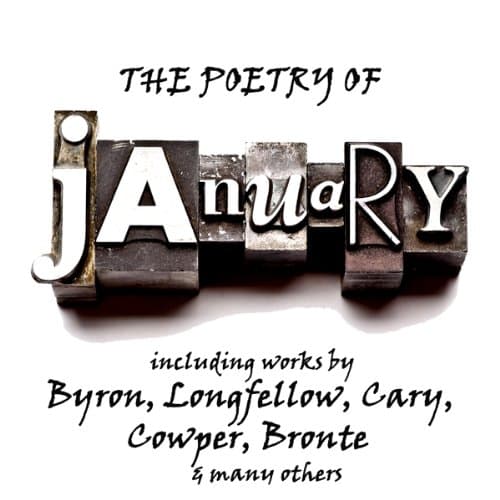

I was up before dawn last Tuesday - couldn't sleep, the way you can't sometimes when January itself feels like it's pressing on the windows. Made my tea in the dark kitchen, wrapped myself in Harold's old cardigan, and settled into the rocking chair by the back door. The peach trees were just black skeletons against a gray sky. I thought: this is the hour for winter poetry. And I pressed play.
Forty-nine minutes. That's all this collection asks of you. Less than an hour. But honey, those forty-nine minutes hold centuries.
Five Centuries of Cold Pressed Into One Hour
What strikes me about this particular anthology is its commitment to the calendar as organizing principle. These aren't just "winter poems" thrown together - they're January poems, many of them dated to specific days, and that specificity matters. Janet Little writing on January 1st, 1792. Byron on his thirty-third birthday, January 22nd, 1821. Joel Barlow on January 14th, 1807, responding to Captain Lewis's discoveries. The effect is almost like reading a diary kept across centuries by different hands, all staring out at the same bleak month and finding wildly different things to say about it.
And the range - Lord. You get Christina Rossetti's playful coyness in "Winter - My Secret" (that poem has always made me smile, the way she teases the reader about what she's hiding under all those wraps and shawls) alongside Thomas Hardy's stark "The Farm Woman's Winter," which sits in your stomach like cold porridge. Emily Dickinson appears twice, and both selections feel well-chosen - "Snow Beneath Whose Chilly Softness" carries that compressed Dickinson electricity where every syllable does the work of a whole sentence. Then you get Coleridge's "Work Without Hope," which I've taught more times than I can count and which still hits me fresh every time: "All Nature seems at work... and I the while, the sole unbusy thing."
My late husband would have loved the inclusion of the lesser-known voices here - Daniel Sheehan, Hilaire Belloc, Amelia Opie. Not every poem is a gem. Some are period curiosities. But that's honest. That's what a real month of verse looks like - not every day is a revelation.
Two Voices Trading the Cold Between Them
Richard Mitchley and Ghizela Rowe alternate through the collection, and the dual-narrator approach works better than I expected for poetry. Rowe takes the women poets - Dickinson, Rossetti, Opie - and Mitchley handles the men, which creates a natural conversation across the collection. It's like sitting between two readers at a gathering, each one picking up the thread.
Now, I'll be straight with you: I listened at my usual 0.85x because poetry demands it, and even at that pace, some of these readings felt like they could have breathed more. Poetry isn't prose. The line breaks are there for a reason. The silences between stanzas are part of the music. Both narrators are competent and clear - good diction, respectful of the material - but I wanted more... dwelling. More willingness to let a line just hang in the air before moving on. When Mitchley reads Coleridge's "Work Without Hope," I wanted him to pause longer at that devastating turn. When Rowe reads Rossetti's teasing lines, I wanted a bit more mischief in her voice.
They're good. They're respectful. But respectful isn't the same as inhabited.
Who Should Sit With This (And Who Shouldn't Bother)
If you're the kind of person who reads a poem a day - or who wants to start - this is a lovely little companion for the month. It's not trying to be a definitive anthology. It's trying to be a friend who says, "Here, listen to this one." And at under an hour, it's the perfect thing to put on while the coffee brews or while you're watching snow fall and feeling some kind of way about it.
But if you want deep critical context, biographical introductions, or the kind of performance that makes you forget you're listening to a recording - this isn't that. The brief spoken introduction is just that: brief. You're mostly on your own with the poems themselves.
Compared to something like the Caedmon recordings of poets reading their own work, or even the longer "Poetry of" series entries that cover more ground, this feels slight. A sampler. But sometimes a sampler is exactly what the season calls for. I remember feeling that same quiet satisfaction with a book that knows exactly what it is and doesn't apologize for it — the way Penderwicks on Gardam Street never once tries to be more than a gentle, companionable story, and is all the better for it.
The Last Sip of Tea
By the time Alice Carey's closing "January" faded out, the sun had come up proper over my backyard. The peach trees had turned from black to brown to something almost warm. Forty-nine minutes of January verse, and the world had shifted. That's what poetry does when you let it - it doesn't change the cold, but it changes your relationship to it. Harold used to say that. I heard him say it again this morning.