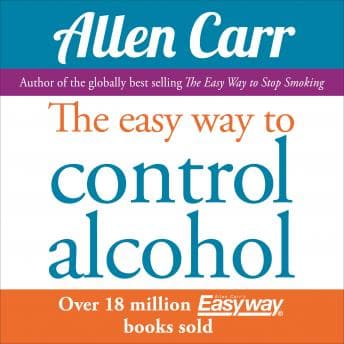

What if the hardest part about quitting drinking isn't actually hard at all - and the entire struggle is something you manufactured in your own head?
That's Allen Carr's pitch. And honestly? It's the same pitch he made with smoking in The Easy Way to Stop Smoking, just swapped out for booze. If you've listened to that one (I have, for a client project on behavioral change frameworks), you already know about 60% of what's in here. The method is identical: don't use willpower, don't feel deprived, reframe the addiction as a trap you've been conned into, and walk away happy. The question is whether the alcohol-specific application earns its 8 hours.
The Dry Cleaning Business Theory of Addiction
Here's what Carr gets right, and it's the thing that kept me listening past the first couple hours: he attacks the cultural mythology around alcohol with genuine precision. The idea that drinking is a reward, that it helps you relax, that social events require it - Carr dismantles these one by one. Not with data or studies (this isn't that kind of book), but with logic puzzles. He keeps asking you to examine why you believe what you believe about drinking. Why do you think your first drink tasted good? It didn't. Why do you think alcohol relieves stress? It created the stress in the first place.
This is what my parents did instinctively. They never drank. Not because of some moral stance - they just didn't see the point. Fourteen hours running a dry cleaner, then you're going to spend money to feel worse the next morning? The economics never made sense to them. Carr basically wrote 8 hours proving my mom's instinct correct.
The repetition is the feature, not the bug. Carr says this explicitly - he's trying to undo years of brainwashing, so he repeats his key arguments over and over from slightly different angles. I get the strategy. I've used similar techniques in change management workshops. But knowing why something is repetitive doesn't make it less repetitive. By hour 5, I was checking my phone during the third explanation of the "pitcher plant" analogy.
Richard Mitchley Does the Job (Barely)
Richard Mitchley narrates with a steady, calm, British tone that's... fine. It's the vocal equivalent of a beige conference room. Nothing distracting, nothing memorable. For a book that's essentially one long persuasion exercise, you'd want either the author's own passionate delivery or a narrator who can inject some urgency into the argument. Mitchley reads it like he's narrating a pamphlet about pension options. Competent. Professional. Flat.
I listened to most of this during a Sunday meal prep session - Jenny was out, I had the kitchen to myself, and the steady drone of Mitchley's voice paired surprisingly well with chopping vegetables. That's either a compliment or an insult depending on how you look at it.
Where the Consulting Brain Gets Twitchy
Here's my problem with the Easyway method as a business framework (because that's how my brain works, sorry): there's no data. Zero. Carr makes sweeping claims about alcohol's effects on the body, on psychology, on social behavior - and backs almost none of it with research. He references "society" and "the trap" constantly but never cites a study, a statistic, a controlled experiment. His evidence is anecdotal: "I drank for 25 years and then I stopped and it was easy."
I've seen this approach fail at three different companies. Charismatic leader says "trust the process," everyone nods along in the room, and six weeks later they're back to old habits because there was no structural framework underneath the inspiration. Now - the counterargument is that millions of people claim Carr's method actually worked for them. Anthony Hopkins. Anjelica Huston. Random people on Audible leaving five-star reviews saying they put down the bottle the same day they finished listening. That's not nothing. But it means this book works more like therapy than like a business case. You either buy in emotionally or you don't. The 4 Disciplines of Execution has the opposite problem—almost too much structural scaffolding, no emotional hook whatsoever—and I'd argue neither extreme actually produces lasting change.
Skip to chapter 5. Thank me later. The first four chapters are throat-clearing about why you shouldn't be scared of the book. If you already bought the audiobook, you're clearly not scared. Get to the actual method.
The key takeaway is worth the listen. The other 7 hours? Not so much. Carr's central insight - that addiction is sustained by the belief that you're giving something up, and freedom comes from realizing there's nothing to give up - is genuinely powerful. It's a clean reframe. But it could've been a 90-minute audiobook instead of an 8-hour one.
Who Gets ROI Here
If you're someone who's been white-knuckling sobriety through willpower and hating every minute? This might actually flip a switch. Carr's whole thing is making quitting feel like liberation, not sacrifice. For that specific audience, it could be the best credit you ever spend.
If you're a casual drinker who's just curious, or a business/psychology nerd looking for a rigorous framework? You'll be bored by hour 3 and annoyed by hour 6. Jenny would say I'm being harsh. Jenny is right. But I'm also right.