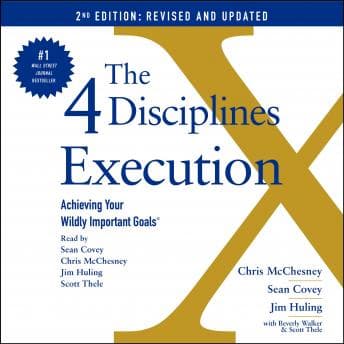

Look, I have a bone to pick with business audiobooks that could've been a TED talk but somehow became 8 hours of my life. The 4 Disciplines of Execution is... not quite that, but it's flirting dangerously close.
Here's the thing though - I actually finished this one. And not just finished it, but found myself mentally mapping the framework onto my team's chaos at work. That's saying something.
The Framework That Actually Stuck
Bottom Line: Focus on the Wildly Important, Act on Lead Measures, Keep a Compelling Scoreboard, Create a Cadence of Accountability. Four things. That's it. The ROI on this audiobook is basically getting a legitimate execution system that I've already started using in our sprint planning.
The lead measures concept hit different for me. We've been tracking lag measures forever - did we ship? did revenue increase? - but the idea of identifying the predictive behaviors you can actually influence daily? That's the kind of actionable stuff I need at 6:47 AM on the Caltrain while my brain is still booting up.
The scoreboard section is where my engineer brain got excited. They talk about making metrics visible and compelling, and while the examples skew corporate (think sales teams, not distributed systems), the principle translates. I'm already thinking about how to gamify our incident response times.
Jim Huling's Enthusiasm Problem
Okay, so this is narrated by all four authors. Which sounds like a feature but is actually... complicated.
Jim Huling is clearly brilliant. The man knows this material inside out. But his voice inflection is cranked to eleven, and I mean ELEVEN. Every sentence sounds like he's announcing a game show winner. By hour three, I was genuinely struggling to focus on the content because my brain kept getting distracted by the sheer ENERGY of his delivery.
It's like having a coworker who's had four espressos explain something important to you. The information is good! You just wish they'd dial it back about 40%.
The other narrators are more measured, which creates this weird tonal whiplash as sections switch. Sean Covey (yes, Stephen Covey's son - the 7 Habits DNA is strong here) has a more conversational delivery that worked better for my half-asleep commute state.
The 30% New Content Question
They advertise 30% new content in this revised edition, covering things like technology for scoreboards and leadership mindsets. Honestly? I can't tell you what's new versus original since I never read the first edition. What I can tell you is that some sections feel distinctly 2020s (remote team accountability, digital dashboards) while others have that timeless corporate consulting energy that could've been written in 2010.
The case studies are... fine. Lots of manufacturing plants and sales organizations. If you're in tech, you'll need to do mental translation work. But the principles are solid enough that the translation isn't hard.
Who Gets Value Here (And Who Doesn't)
This is basically OKRs but with more structure around the HOW. If your team sets goals and then watches them die in the whirlwind of daily firefighting, this framework addresses that specific failure mode.
Perfect for: commute, gym (the enthusiasm actually works when you're on a treadmill). Skip for: bedtime - you'll either be too wired from Huling's energy or too annoyed to sleep.
Individual contributors who don't have team-level influence yet should pass. This is a leadership book through and through. Also skip if you're allergic to corporate case studies or if you've already implemented a solid execution framework.
My Caltrain-Tested Take
I finished this in about 5 commutes at 1.5x speed (highly recommend bumping it up - Huling's enthusiasm becomes more tolerable at higher speeds, weirdly). The framework is legitimate, the examples are adequate, and I've already stolen the lead measures concept for my team. Good to Great covers similar territory on execution discipline, though Collins focuses more on the why than the tactical how.
Is it revolutionary? Nah. Is it useful? Actually yes. The narrator situation is the main thing holding this back from a higher rating - the content deserves better production than "let's have everyone read their own sections regardless of audio performance skills."
Worth a credit if you're a manager struggling with execution. Wait for a sale if you're just curious about productivity frameworks. The ideas here are solid, even if the delivery made me want to slip Jim Huling a chamomile tea.