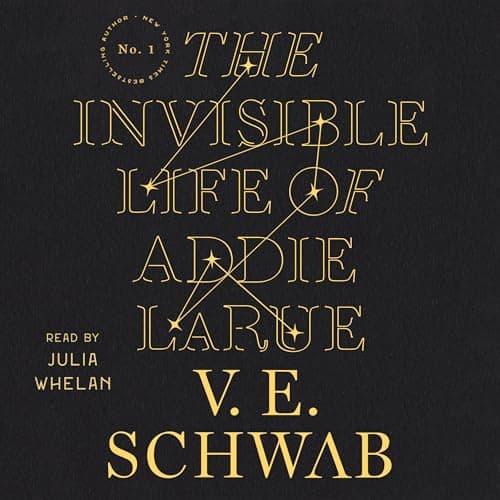

Three hundred years of being forgotten by every person you meet. I was seven hours into Addie LaRue's story when Denise nudged me on the lakefront trail and pointed at the sunset over Lake Michigan, and I genuinely resented her for it. I was in 18th-century France, watching a young woman bargain away her ability to be remembered, and the real world felt like an interruption. That's the kind of book this is.
Schwab has written something that sits in this strange, beautiful space between literary fiction and fantasy — the kind of book that would make half my English department sneer and the other half quietly devour on their lunch breaks. The premise is Faustian in the truest sense: Addie LaRue, desperate to escape an arranged marriage in rural France, calls out to the gods after dark and strikes a deal with a being she comes to call Luc. She gets immortality. The price? No one she meets will ever remember her. Not the innkeeper she speaks to in the morning. Not the lover she holds at night. Every conversation starts from zero. Every relationship erased by the time she walks out the door.
This reminds me of what Hemingway said about prose being architecture — Schwab builds this story like a cathedral with two timelines, and she's patient about it. We toggle between Addie's centuries-long existence and a present-day storyline in New York, where she walks into a used bookstore and a young man named Henry Strauss does the impossible: he says her name. After three hundred years. The moment lands like a gut punch even though you know it's coming — the book's description tells you it's coming — because by then Schwab has spent hours making you feel the weight of all that forgetting.
The Architecture of Forgetting
What makes this more than a clever premise is how Schwab explores the implications. Addie can't write her own name — the words vanish. She can't create art. She can't hold a job. She steals to survive, sleeps in strangers' beds knowing they won't remember her come morning. The historical flashbacks aren't just costume changes — Addie in revolutionary Paris feels different from Addie wandering through World War II Europe, and those tonal shifts carry real emotional texture. But here's the honest criticism: the pacing is uneven. Schwab will spend chapters luxuriating in a single afternoon in 1720s France, then skip forty years in a paragraph. Some decades feel like they matter; others feel like postcards. My students would call this "mid pacing." I'd call it a deliberate rhythm that doesn't always pay off.
And Luc — the darkness she bargained with — keeps showing up across the centuries, and their dynamic is genuinely unsettling in the best way. He's not a mustache-twirling villain. He's charming and cruel and possessive, and their encounters have this push-pull tension that feels almost romantic if you squint, which is exactly the point. Schwab is saying something real about the deals we make with the things that diminish us and how seductive those bargains can feel.
Julia Whelan at 1.0x, As God Intended
The narrator understands that pause is punctuation. Whelan reads Addie LaRue with this low, steady cadence that mirrors the character's patience — a woman who has learned to move through centuries without rushing because rushing gets you nothing when no one remembers you were there. Her delivery during Addie's moments of grief isn't melodramatic; it's contained, controlled, which makes the breaks in that control hit harder.
Now — and I'll be fair here — some listeners have called the narration one-note, and I understand why. Whelan doesn't do wildly different voices for different characters. Henry doesn't sound dramatically different from Luc, and the supporting cast blends together vocally. If you need distinct character voices to track a story, this might frustrate you. But I'd argue Whelan is making a choice: this is Addie's story, told through Addie's perception, and everyone else is slightly blurred at the edges. That's the loneliness of the book made audible. Whether that's brilliant or limiting depends on what you want from a narrator.
At seventeen and a half hours, this is a commitment. The prose deserves to be savored — Schwab writes the kind of sentences that reward 1.0x listening, full of repetition and echoes that you'd miss at higher speeds. There are passages about memory and art and what it means to leave a mark on the world that I genuinely want to assign to my juniors. (They would revolt. I might do it anyway.)
Who Should Listen (And Who Should Skip)
If you loved The Night Circus or The Starless Sea, this is their spiritual successor — atmospheric, slow-burning, more interested in feeling than plot mechanics. Tanglewood Tales scratched a similar itch for me — that same quality of myth-soaked atmosphere where the feeling of a place matters more than what technically happens in it. If you're someone who reads for character interiority rather than action, this will reward you. But if you need tight pacing and a plot that moves like a thriller, you'll spend chunks of this audiobook checking how many hours remain. The Henry-Addie relationship, while sweet, doesn't develop with the urgency some readers want. And the ending — without spoiling it — asks you to sit with ambiguity rather than resolution.
My students would hate this. I love it.
Worth pausing the faculty meeting for? Absolutely. I spent an entire Monday pretending to review the new standardized testing schedule while Addie wandered through 1880s London. Principal Martinez, if you're reading this — that knowing nod I gave during your presentation was really me reacting to a scene where Addie sees her own face in a painting she inspired but can never claim. The things we sacrifice for good literature.
The Annotation in the Margin
Let's talk about what the author is really saying. This is a book about art and memory and whether a life unwitnessed still counts. It's also, quietly, about depression — Henry's storyline makes that clear in ways I won't spoil — and about the difference between being seen and being known. Schwab isn't subtle about these themes, but she's sincere, and sincerity counts for a lot when you've been teaching teenagers to find meaning in texts for twenty years. Sometimes the meaning isn't hidden. Sometimes it's right there on the surface, waiting for someone to remember it.
This is why we still read the classics — and why we should make room for the books that'll become them.