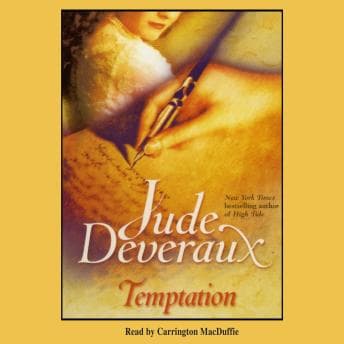

"If she succeeds in matchmaking, she will be allowed to return to New York."
I wrote that down while walking the lakefront because it struck me as such a perfectly 1909 problem. A woman who's built her life around meaningful work—helping single mothers in New York, no less—suddenly held hostage by inheritance laws and a stepfather who thinks he knows better. Temperance O'Neil is essentially being told to sit down and be decorative. And her response? To be as magnificently difficult as humanly possible.
This is why we still read the classics. Or in this case, why we listen to Jude Deveraux.
The Voice in My Head for Four Hours
Alison Fraser does something I genuinely appreciate here—she doesn't try to make Temperance likable in the conventional sense. Temperance is prickly. She's stubborn. She walks into a Scottish manor with pigeons roosting in the kitchen and chickens literally in the bedrooms, and her first instinct isn't charm, it's judgment. Fraser leans into that. Her delivery has this warmth underneath the character's sharp edges that reminds you Temperance is performing her own kind of resistance.
The Scottish accents—okay, look. Some listeners found them over the top. I get it. But honestly? James McCairn is described as a "strapping, rough-mannered giant" who cares more about his sheep than his own living conditions. The man deserves a robust accent. Fraser commits to it. Whether that works for you probably depends on your tolerance for theatrical choices in historical romance. (Mine is apparently quite high. Don't tell my students.)
The pacing is spot-on for a four-and-a-half-hour listen. I finished this during a single week of grading papers at 11PM, which is my personal metric for "engaging enough to keep me awake through sophomore essays about The Great Gatsby." It passed.
When the Premise Outshines the Plot
Here's where I have to be honest. The setup is delicious—independent woman forced into domestic servitude as a secret matchmaking scheme, slowly falling for the very man she's supposed to pair off with someone else. This reminds me of what Austen did with Emma, actually. The confidence that precedes the fall. Road plays with that same dangerous confidence, though in a completely different setting. The assumption that you can orchestrate other people's hearts without risking your own.
But Deveraux doesn't quite stick the landing the way Austen would. The ending feels rushed. You spend hours watching these two circle each other, all that tension building, and then it resolves faster than my students skimming the last chapter before a test. Some listeners called the story predictable, and—yeah. You know where this is going from chapter one. That's not necessarily a flaw in romance (we read for the journey, not the surprise), but when the journey's destination arrives too quickly, it feels like the author got tired.
Temperance herself is a fascinating contradiction. She's ahead of her time in 1909—working with marginalized women, financially independent (in theory), uninterested in marriage. And yet the narrative still bends toward the traditional romance arc. Is that satisfying or disappointing? Depends what you came for, I suppose. If you wanted a proto-feminist heroine who stays proto-feminist, you might feel slightly betrayed. If you wanted to watch a stubborn woman fall in love despite herself, you'll be just fine.
The Deveraux Factor
I've been aware of Jude Deveraux for decades—you can't teach literature and ignore the romance genre's heavy hitters, even if my colleagues pretend otherwise. (The snobbery in English departments about "genre fiction" is exhausting. Deveraux has forty New York Times bestsellers. I had similar thoughts about craft and dismissiveness while listening to Inferno: A Novel—popular doesn't mean poorly written. She won the Romantic Times Pioneer Award. The woman knows what she's doing.)
Her writing here is accessible and funny. The humor lands more often than it misses. There's a scene involving James and his sheep that made me actually laugh out loud during a faculty meeting—which, to be fair, was the most interesting thing that happened in that meeting.
The Lakefront Verdict
Probably wouldn't listen again, but that's not a criticism. This is a perfect commute book. A perfect "I need something engaging but not emotionally devastating" book. A perfect "my brain is tired from grading and I want to be transported to 1909 Scotland" book.
Alison Fraser's narration elevates material that could have felt thin. The production is clean, her character work is solid, and she understands that pause is punctuation—especially in romance, where the silence between two people can say more than dialogue.
If you loved Deveraux's other historical romances, this is absolutely worth your time. If you're new to her work, it's a reasonable entry point, though I'd argue her stronger titles exist. And if you're looking for something that challenges the romance formula rather than embraces it—this isn't that. Know what you're getting.
My students would probably roll their eyes at this one. But my wife Denise, who has excellent taste and zero patience for pretension, would enjoy it. That's the better endorsement anyway.