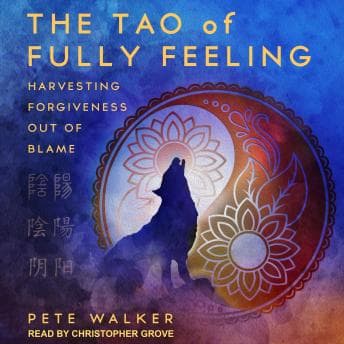

Thirteen hours. Thirteen hours on emotional processing. I almost didn't make it past the description - "sadness easily mellows into solace, anger unfolds into laughter" - because that kind of language usually means someone's about to sell me a crystal subscription. But Pete Walker isn't that guy. He's a therapist with 35+ years in the trenches, and this book caught me off guard at 1 AM on a Tuesday, unable to sleep, scrolling through my Audible library looking for something I could justify as "professional development."
Here's my complaint: this book made me feel things I did not consent to feeling on a work night.
The Business Case for Blame
Walker's core thesis is counterintuitive enough to be interesting: you have to blame before you can forgive. Not performative blame, not rage-posting on social media, but genuinely sitting with the recognition that your parents - or whoever shaped you - did specific, nameable things that hurt you. And that premature forgiveness is basically emotional bankruptcy. You're writing off debts you haven't even inventoried.
As a consultant, I've watched founders implode because they couldn't name what was actually wrong. They'd skip straight to "solutions" without diagnosing the problem. Walker argues most of us do this with our emotional lives. We rush to forgive because sitting in blame feels dangerous, feels ungrateful. And then we wonder why we're running on fumes.
This hit different for me. Growing up Korean-American, the cultural mandate was clear: honor your parents, don't complain, work harder. My parents worked 14-hour days at their dry cleaning business. Complaining about anything felt like spitting on their sacrifice. But Walker makes a distinction I've never heard anyone articulate this cleanly - acknowledging that your parents' behavior hurt you is not the same as saying they were bad people or that their sacrifices didn't matter. It's just... accounting. Emotional accounting. And you can't close the books on what you haven't recorded.
Where the 13 Hours Get Heavy
Let me be straight: this is not a tight book. At 13 hours, Walker repeats concepts in ways that had me reaching for the 2.0x button more than once. There are stretches - particularly in the middle sections on grief work - where the same idea gets repackaged three or four different ways. If this were a McKinsey deck, I'd send it back with "consolidate" written in red.
But here's the thing I kept wrestling with: maybe repetition is the point? Walker's writing about emotional patterns that are deeply grooved into people's nervous systems. You don't unlearn decades of emotional suppression because someone said it cleverly once. The repetition started to feel less like padding and more like the way a good therapist circles back to the same wound from different angles until something finally clicks.
I'm not fully convinced. I still think you could cut 3-4 hours and lose nothing structurally. But I'm less annoyed about it than I expected to be.
Christopher Grove's narration carries a therapeutic warmth that works for this material - steady, compassionate, unhurried. He reads like a therapist who actually likes his clients, which sounds obvious but isn't always how these books land in audio. No vocal fireworks, no dramatic character voices. Just a calm presence guiding you through content that can get genuinely heavy. The sections dealing with childhood abuse and emotional neglect are not easy listening, and Grove handles them with the right weight.
Not Your Typical Self-Help Hustle
Most self-help audiobooks I encounter fall into two camps: the "5 Steps to Everything" crowd (garbage) or the "Let Me Tell You About My Ayahuasca Retreat" crowd (different garbage). Walker sits in neither. He's clinical when he needs to be, personal when it serves, and - this is rare - he doesn't oversell. He's not promising emotional enlightenment. He's describing a practice. Messy, slow, uncomfortable practice. Glennon Doyle covers similar territory in Carry On, Warrior - different context, same refusal to dress up the hard stuff as a tidy five-step program.
The framework for the "negative" emotions is where the real value lives. Walker's argument that anger, jealousy, and fear contain actual useful information - not just noise to be meditated away - felt like validation for every entrepreneur I've coached who was told to "stay positive" while their company was burning. Sometimes anger is data. Sometimes blame is the beginning of understanding.
One listener I came across said they "noticed themselves getting better at feeling each day." That's a weird sentence, but I get it now. This book doesn't give you a framework you implement Monday morning. It gives you permission to stop running from the stuff you've been outrunning since childhood.
Who Gets the ROI
If you're a high-performer who's great at thinking and terrible at feeling - hi, it's me, and probably you too - this is worth the investment. If you grew up in a household where emotions were either forbidden or weaponized, Walker wrote this for you specifically. Skip it if you want tactical productivity advice. This is interior work, and it takes its time.
Jenny would say I'm being harsh about the length. Jenny is right. But I still think you could skip to the sections on blame and forgiveness and get 80% of the value in 60% of the time.
Bottom line: Pete Walker wrote what my parents' generation never had language for - and what my generation keeps trying to optimize away. You can't 2.0x your way through healing. Trust me, I tried.