
How many narrators is too many narrators? Like, is there a point where a full cast production tips from "cinematic experience" into "I need a spreadsheet to track who's talking"? I've been wrestling with that question for the last 18 hours — well, 18 hours of audiobook time spread across about two weeks of coding sessions where my thesis progress bar remained firmly at 0%.
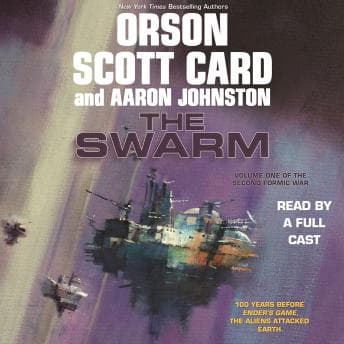
I was debugging a procedural terrain generator at 2 AM (Dr. Patel, if you're reading this, I was absolutely working on my thesis) when I threw this on, and honestly? The opening hours grabbed me harder than I expected. The aftermath of the Scouring of China is genuinely unsettling — Card and Johnston don't flinch from showing what an alien terraforming effort does to an entire civilization, and the geopolitical fallout feels less like space opera hand-waving and more like something out of a really grim UN simulation.
Eight Voices and a Mothership
So here's the thing about having eight narrators for one book: it's ambitious as hell. Stefan Rudnicki has been the voice of the Enderverse for ages, and he anchors the production with that deep, deliberate gravitas that makes military strategy sessions feel weighty instead of dry. Arthur Morey and Vikas Adam handle different POV threads, and the transitions between narrators essentially function like chapter breaks — you always know whose storyline you're in because the voice literally changes. It's the audiobook equivalent of cutting between camera angles in a war film.
But — and this is a real but — Orson Scott Card himself narrates portions, and his delivery is noticeably flatter than the professional voice actors surrounding him. It's not bad exactly, it's just... you can tell the difference between someone who writes stories and someone who performs them for a living. Like when your DM who's amazing at worldbuilding tries to do NPC voices and it's fine but it's not Steven Pacey, you know? (Steven Pacey walked so other narrators could run. I will never stop saying this.)
The Political Engine Under the Alien Invasion
What kept me listening through those late-night coding sessions wasn't the alien threat — it's the human one. The Formics are out past the Kuiper Belt on a mothership that's essentially an extinction-level event on approach, and what does humanity do? Immediately start playing politics. The Hegemon, the Polemarch, the International Fleet — it's all these layers of bureaucratic power struggling to organize while Bingwen, Mazer Rackham, Victor Delgado, and Lem Juke try to actually get stuff done.
This is Sanderson-level world-building in the political arena, but swap hard magic systems for hard military logistics. Card and Johnston are building the institutional scaffolding that becomes the IF we know from Ender's Game, and watching those gears grind into place is genuinely satisfying if you're the kind of person who cares about how a galactic military bureaucracy forms. (I am that kind of person. My D&D group would love this — we once spent an entire session arguing about guild tax structures.)
The progression is satisfying — Bingwen's arc from child survivor to military prodigy-in-training hits different when you've read the First Formic War books, and Mazer's frustration with institutional inertia feels painfully real. But some of the technological leaps the plot takes are... questionable? There are moments where humanity develops capabilities that feel too convenient, like the authors needed the chess pieces in certain positions and moved them there without fully earning it.
The 18-Hour Commitment Question
Yes, it's basically 18 hours. Yes, it's worth it — if you're already invested in the Enderverse. This is not where you start. If you haven't read at least Ender's Game and ideally the First Formic War trilogy, you're going to be swimming in references and character histories that assume prior knowledge.
If you don't like info-dumps, this isn't for you (but you're wrong). There are stretches in the middle — particularly the political maneuvering sections — where the pacing slows to a crawl. I actually found those sections better on audio than I think they'd be on page, because having distinct narrators prevents the talking-heads problem from getting too monotonous.
The production quality itself is clean. No weird audio level jumps between narrators, no background hiss, nothing that pulled me out. For a production this complex with this many voices, that's genuinely impressive engineering.
Who Gets a Seat at This War Table
This is for Enderverse completionists, military SF fans who get excited about fleet organization charts, and anyone who wants their alien invasion stories filtered through political realism rather than just laser fights. If you want pure action — there's some, but it's not the focus. This is a setup book, first in a trilogy, and it knows it. Expect threads laid, not resolved.
Skip it if you want a standalone experience, if you haven't touched the Enderverse before, or if Card's involvement is a dealbreaker for you (I get it, and I'm not going to argue with you on that one).
I read this instead of writing my thesis. Dr. Patel's next email is going to be... pointed. Though to be fair, the last time I lost a week to fiction instead of my thesis it was The Midnight Library, and at least that one had the thematic decency to be about regret. But the Second Formic War isn't going to listen to itself, and honestly? Building out the institutional lore of the IF felt more productive than my actual research. (It was not more productive than my actual research.)