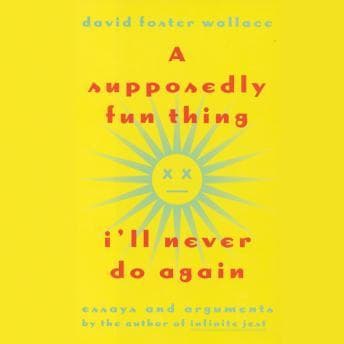

Look, I need to rant about something. David Foster Wallace wrote some of the most brilliantly neurotic, genuinely funny nonfiction of the last thirty years. The title essay alone - the cruise ship piece - is maybe the funniest thing I've ever read about the specific horror of being forced to relax. So when I tell you that Paul Garcia's narration nearly ruined this for me, understand that I'm saying it as someone who desperately wanted to love this audiobook.
I was up at midnight, couldn't sleep, Jenny already out cold, and I figured I'd put on some essays. Low-stakes listening. Wrong.
The Narrator Who Brought Dinner Theater to David Foster Wallace
Here's the thing about Wallace's prose: it's already theatrical. The footnotes-within-footnotes, the 200-word parenthetical asides, the way he'll describe a cruise ship's dessert buffet like he's documenting a war crime - the writing does the heavy lifting. It doesn't need a narrator performing at a volume 11.
Paul Garcia narrates this like he's auditioning for a one-man show in front of a casting director who's hard of hearing. Random inflections on words that don't warrant them. Emphasis patterns that suggest he's reading the sentences for the first time and guessing where the punchlines land. Wallace's humor is deadpan, observational, almost self-lacerating in its precision. Garcia delivers it like a guy doing Shakespeare at a Renaissance faire.
The cruise ship essay - "A Supposedly Fun Thing I'll Never Do Again" - is where this disconnect hurts the most. Wallace's whole bit is that he's an anxious, overthinking mess trapped on a ship full of professionally relaxed people. The comedy comes from his flatness, his resigned despair at being handed another lobster tail. Garcia reads it like it's a rousing adventure. It's like watching someone put jazz hands on a eulogy.
When the Writing Overpowers the Performance
Here's where I have to be honest: even with Garcia's hamming, the content broke through. The Illinois State Fair essay ("Getting Away from Already Being Pretty Much Away from It All") is vintage Wallace - he describes watching a hog judging competition with the same analytical intensity my old McKinsey partners brought to due diligence. That's not a joke. Wallace treats the gravitational pull of a corn dog stand with the same rigor as a market analysis, and it works because he's genuinely curious about everything. That same quality - serious analytical attention turned toward overlooked, ordinary lives - is what made Beautiful Country: A Memoir hit so hard for me, a book that treats the texture of immigrant survival with the same unflinching rigor Wallace brings to a county fair.
The David Lynch essay is where Wallace gets into the weeds of what he calls "Lynchian" - that specific quality where something is simultaneously mundane and terrifying. At 2.0x speed, Garcia's dramatic delivery actually sort of works here because the subject matter is inherently unhinged. Lynch directing Lost Highway while being impossibly polite to everyone on set? That's already dinner theater. So Garcia fits, accidentally.
The tennis essays - particularly on Tracy Austin's autobiography - are where Wallace's consulting-brain energy shows up. He's essentially doing a post-mortem on why athletes can't write interesting memoirs, and his thesis is that the very qualities that make someone great at tennis (an ability to exist purely in the present, without self-analysis) make them terrible at retrospection. I've seen this exact dynamic in founders. The ones who build incredible companies often can't explain how they did it. My parents couldn't have written a business book about dry cleaning. They just did it. Wallace would've understood that.
18 Hours Is a Lot of Garcia
This is an 18-hour audiobook. Eighteen. At 2.0x that's still nine hours of Garcia treating every sentence like it's the climax of King Lear. My 2.0x speed couldn't save this one - it just made the overacting happen faster.
Here's my actual recommendation: read the physical book. I know this is an audiobook review site and that's basically heresy. But Wallace's writing has so much structural complexity - the footnotes, the tangents, the way he embeds jokes inside subordinate clauses three levels deep - that audio flattens it even with a great narrator. With Garcia, it doesn't just flatten. It distorts.
If you absolutely must listen, skip to the cruise ship essay (it's the last one) and the Illinois State Fair piece. Those two alone justify knowing Wallace existed.
Who Gets Value Here and Who Doesn't
If you've never read Wallace, start with the print version. Seriously. If you've read everything and want it as background while you're doing something else, the content is strong enough to survive Garcia's performance - barely. If you're sensitive to narrators who sound like they're explaining the text to you rather than reading it, this will drive you up a wall.
Bottom line: Five-star writing trapped inside a two-star performance. The key takeaway is worth the listen. The other 7 hours? Not so much. Jenny would say I'm being harsh. Jenny is right. But she also hasn't listened to nine hours of a man turning David Foster Wallace into community theater.