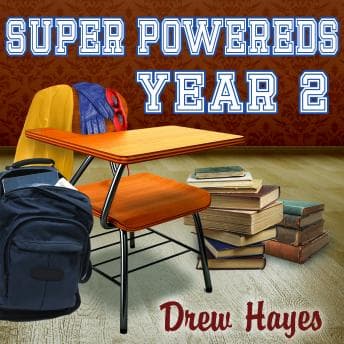

What happens when you take a group of superpowered college kids who were essentially broken - whose abilities were unreliable, dangerous, glitchy - and fix them, then ask them to compete against people who've been training their whole lives?
That's the question Drew Hayes posed in Year 1, and it was good. But Year 2 is where he figured out what he was actually writing.
I started this one during a Saturday lakefront walk with Denise and didn't stop until I was sitting in the car in our driveway three weeks later, engine off, refusing to go inside because McCarley was in the middle of the team battle event and I physically could not press pause. Denise knocked on the window. I held up one finger. She went inside. Thirty-two hours is a commitment, and I gave this book every single one of them.
The Sophomore Novel That Actually Earns the Word "Sophomore"
Here's what Hayes does that so few genre writers bother with: he lets the academic structure matter. Year 2 introduces major specializations - Close Combat, Ranged Combat, Subtlety, Control, Weapons - and instead of treating them as window dressing, they become the engine of the story. The Subtlety professor in particular is this quietly devious presence who reframes what it means to be a hero in ways that genuinely surprised me. This isn't just "X-Men but in college." Hayes is interested in pedagogy. As someone who's spent two decades watching curricula shape young people, I can tell you - he gets the way institutional structure either builds or breaks students. I kept thinking about Orphan's Tale while reading these sections — another book where the institution itself is almost a character, quietly determining who gets to survive inside it.
The Melbrook crew being outed as former Powereds (superpowered people who couldn't control their abilities) creates this social pressure that Hayes handles with real patience. Vince - earnest, almost painfully good Vince - doesn't suddenly become cool. He's still awkward. Still trusting to a fault. And McCarley voices him with this tentative quality, almost timid, that some listeners reportedly struggled with early on. I get it. But here's the thing: the narrator understands that pause is punctuation. Vince should sound uncertain. He's a kid who spent years being treated as defective, and now he's supposed to compete with legacy students who've been groomed for this since birth. McCarley's vocal choice isn't a flaw - it's an interpretation.
McCarley at 32 Hours: A Marathon Performance
Let's talk about what Kyle McCarley is really doing here, because a single narrator carrying 32 hours of a cast this size is genuinely ambitious. He's improved noticeably from Year 1. The voice differentiation is strong - you can tell characters apart without narration tags, which at this length isn't optional, it's survival. His reads of the Little Nick scenes hit differently than anything else in the book. There's a weight to those moments, an emotional gravity that had me gripping my phone during a late-night grading session. One reviewer said those scenes made them cry. I won't say I cried. I will say I stopped grading for a while.
His comedic timing has sharpened too. The banter between characters - particularly anything involving the group dynamics during training - lands with the kind of rhythm that tells me McCarley is performing, not reading. This is why I stay at 1.0x, people. You speed past that timing and you lose half of what makes it work.
One legitimate gripe: he sometimes blows through section breaks without pausing, and in a book with multiple POV shifts and timeline jumps, that can genuinely disorient you. I caught myself rewinding a few times, especially during the conspiracy subplot chapters. If you're listening while multitasking - faculty meeting, hypothetically - you'll miss transitions. This is a focused-listening book.
Who This Is Actually For (And Who Should Back Away Slowly)
If you loved Worm or The Magicians - stories that take superpowers seriously as systems and ask what institutions built around them would actually look like - this is their spiritual successor in audio form. If you want literary prose, beautiful sentences you want to underline... that's not what this is. Hayes writes clean, functional, sometimes workmanlike prose. My students would hate this comparison, but he reminds me of Sanderson in that way: the craft is in the architecture, not the sentence-level beauty.
Skip this if you haven't done Year 1. The emotional payoffs depend entirely on knowing these characters' backstories. And skip the audiobook specifically if you need tight production - there's no music, no sound effects, just McCarley and 32 hours of road.
But if you're in? If you did Year 1 and you're wondering whether to keep going? Keep going.
The Assignment Is Worth Finishing
I started this series skeptical - superhero fiction written by a guy with an English degree from Texas Tech, self-published, 32 hours per installment. My inner literary snob was ready to be condescending. But Hayes understands something I try to teach my juniors every year: character isn't what people say about themselves, it's what they do when the structure around them shifts. Year 2 shifts everything. And these kids - broken, fixed, still figuring out what that means - they rise to it.
Worth pausing the faculty meeting for. Absolutely.