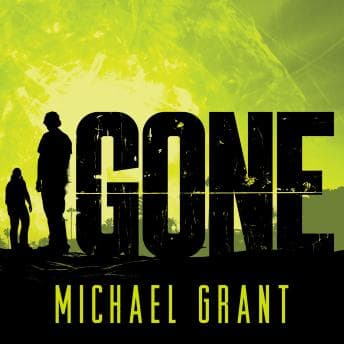

Everyone told me Kyle McCarley's narration would be polarizing. What nobody told me was that I'd spend the first two hours wanting to throw my phone into Lake Michigan—and then somehow finish all seventeen hours in a week.
Here's the thing about Gone that caught me off guard: I expected Lord of the Flies with superpowers. What I got was Lord of the Flies with superpowers, yes, but also with the kind of ensemble cast complexity that Dickens would appreciate. (My students would hate this comparison. I love it.) Michael Grant juggles something like a dozen point-of-view characters, and McCarley has to voice every single one distinctly. He does. Eventually.
That "Said" Problem Everyone Warns You About
I need to address this immediately because it nearly derailed my entire experience. McCarley has this habit—and once you hear it, you cannot unhear it—of emphasizing the word "said" with an upward intonation and slightly louder volume. Like he's asking a question every time someone speaks. "He SAID?" "She SAID?" It's bizarre. It sounds robotic. One review compared him to Sheldon Cooper and I laughed out loud because—accurate.
But here's where I break from the crowd: by hour four, my brain stopped registering it. The way you stop noticing a ticking clock. And underneath that quirk is genuinely solid character work. Sam's voice carries this reluctant-hero weight. Caine sounds exactly like the kind of kid who'd lead a private school coup. Drake—and this is where McCarley earns his paycheck—sounds genuinely unhinged. Not movie-villain unhinged. Damaged-teenager unhinged. The distinction matters.
When Seventeen Hours Flies
I was grading sophomore essays on The Great Gatsby at 11 PM—the ones where every student discovers that the green light symbolizes hope, as if they've cracked some ancient code—when I realized I'd been listening for three hours straight without pausing. That doesn't happen to me anymore. Twenty years of teaching has given me the attention span of a fruit fly.
Grant's pacing is relentless in the best way. The FAYZ (Fallout Alley Youth Zone—yes, it's silly, yes, I got used to it) operates on this constant ticking clock. Every kid knows they'll vanish on their fifteenth birthday. That deadline creates tension that never quite releases. And the mutations—kids developing powers ranging from telekinesis to healing to things much darker—escalate at exactly the right pace to keep you unsettled.
This reminds me of Hemingway's iceberg theory, actually. Grant shows you the violence, the hunger, the bullying, but what he implies about what these kids are becoming psychologically? That's where the real horror lives. Bitten works the same way—the transformation scenes are visceral, but it's the psychological unraveling that stays with you.
The Scene Transition Problem (And a Fix)
McCarley struggles with transitions. I'll be honest—there were moments where I had no idea we'd shifted from one character to another until three sentences in. The production doesn't help; there are no chapter markers, no musical cues, nothing to signal "hey, we're with someone else now." For an audiobook this long with this many POV characters, that's a genuine flaw.
Some listeners recommend 1.25x speed. I listened at 1.0x because the author chose those words and I choose to hear them properly—but I understand the impulse. The narrative sections can drag slightly when McCarley isn't voicing dialogue. Speeding up might actually help smooth the awkward transitions too.
Who Gets an A, Who Gets Excused
If you loved Ender's Game or The Hunger Games, this is their spiritual successor—darker, messier, more willing to let its child characters do genuinely awful things to each other. If you have a teenager who claims they "don't like reading," this might be the gateway drug. (I've recommended it to three students already. Two of them are actually listening.)
Skip it if you need pristine narration to enjoy an audiobook, you're sensitive to violence involving minors, or you want tidy moral lessons. Grant isn't interested in teaching lessons. He's interested in watching kids build—and destroy—a society from scratch.
The content warnings are real. Violence, bullying, starvation, and some genuinely disturbing moments involving a character named Drake and a whip that used to be his arm. It's marketed as young adult, but it reads older. Worth knowing.
Mr. Williams's Final Grade
If Gone were a student in my class, I'd give it a B+. Ambitious, occasionally sloppy, but showing real promise. The narration would dock it points initially, then earn them back through sheer persistence. The story itself? That's A-level work disguised as genre fiction.
I'm already queued up for book two. And I'm definitely listening during Principal Martinez's next budget presentation.