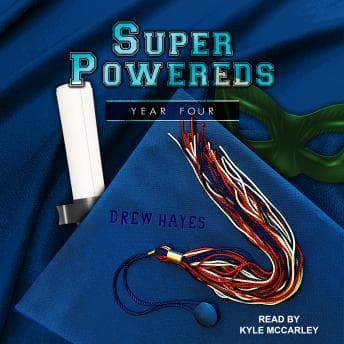
Sixty hours. SIXTY. HOURS.
Let me just sit with that for a second. I committed more time to this audiobook than most people commit to a new relationship. I started this thing during a rainy Tuesday shelving returns at the library, and I finished it - no exaggeration - almost two full weeks later, lying on my couch at 1 AM with Shirley asleep on my chest, staring at the ceiling like I'd just finished a religious experience. Which, for someone who grew up in a house where superheroes were considered borderline idolatry, feels appropriately ironic.
But here's my complaint, and I need to get it out before I say anything nice: Drew Hayes, my guy, you cannot just drop sixty hours of content on people and expect them to function in society. I had patrons asking me if I was okay. I was zoning out during story time with the kids because I was mentally replaying the royal rumble sequence at the end. I am a librarian. I am supposed to be a responsible community figure. This book made that impossible.
The Payoff Four Years in the Making
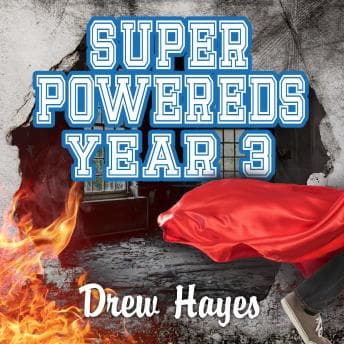
Year 4 is a final exam in every sense. Not just for the Melbrook students grinding through their senior year at Lander, but for the reader - or listener, in my case - who's been tracking dozens of characters across what amounts to roughly 200 hours of audio if you've done the full series. Hayes has been planting seeds since Year 1 that don't bloom until the last quarter of this book, and the satisfaction of watching those threads pull tight is genuinely something I haven't felt since finishing a really good mystery series.
This isn't horror - I know, I know, stay with me - but it understands something horror understands: dread works better than surprise. That slow-pressure dread is exactly what kept me up during my listen of Brimstone: Booktrack Edition - different genre, same creeping inevitability. The long-buried secrets the description teases? They don't explode. They seep. Characters you've spent years with start making choices that feel inevitable in retrospect but gut-punch you in the moment. The tension around who makes the final ten Hero slots is structured almost like a slow-burn thriller, and Hayes earns every bit of it by making you care about characters on opposite sides of that cut line.
The superhero battles are legitimately creative. This isn't just "punch harder" escalation. Powers interact in weird, strategic ways that reward the kind of obsessive attention this series demands. There's a sequence near the end - the big all-out confrontation that fans call the royal rumble - where every favorite character gets a moment to shine, and it works because Hayes spent sixty hours (SIXTY) making sure you understood exactly what each person could do and why it mattered.
Kyle McCarley Carries a Small City on His Back
Let's talk about what it means to voice - conservatively - forty-plus distinct characters across sixty hours of solo narration. Kyle McCarley does this. And he does it while maintaining emotional range, comedic timing, and the kind of tension that had me white-knuckling a book cart at work.
The narrator commits. That's rare.
His male characters are where he's strongest - each one has a specific vocal identity that I could recognize within a few words, even when Hayes doesn't immediately name who's speaking. His Vince is earnest without being saccharine. His Dean Blaine carries weight. Where things get slightly wobbly is with some of the female voices, which start to blur together in the back half. After forty hours, a few of the women sound interchangeable in a way the men don't. It's not a dealbreaker, but in a cast this large, it occasionally had me rewinding to figure out who was talking.
One genuine gripe: McCarley sometimes doesn't pause between section breaks. Scene shifts from, say, an intense combat trial to a quiet dorm room conversation happen with zero breathing room, and it's disorienting. I caught myself confused at least four or five times, thinking a character was still in a scene they'd left. For a book this long, those small navigational hiccups add up.
But when he's locked in? Magic. The emotional peaks of this book - and there are several that genuinely made my throat tight - land hard because McCarley understands pacing. He doesn't rush the quiet moments to get to the action. He lets grief sit. He lets humor breathe. That's an actor's instinct, not just a reader's.
Who Survives This Commitment
If you haven't listened to Years 1-3, do not start here. This is a payoff book. It assumes you know these people, their powers, their relationships, their grudges. Starting here would be like watching the series finale of a show you've never seen.
If you HAVE done the full journey? This is worth every minute. It's the rare series finale that actually honors what came before. My podcast listeners who've been bugging me about superhero fiction are going to love this recommendation, even if it's outside my usual wheelhouse.
Best consumed during long stretches - road trips, marathon cleaning sessions, multi-day projects. The pacing rewards sustained attention. I wouldn't try this in twenty-minute chunks.
Shelve Under: Worth the Obsession
Sixty hours. I regret nothing. Shirley (my cat) was unimpressed by the entire experience. But when that final scene hit and I was lying there in the dark like some kind of superhero-fiction convert, I understood why people have been yelling at me to read this series for years. It's not horror, but it understands something fundamental about storytelling: make them care first, then make it hurt. Shirley Jackson walked so - okay, Drew Hayes is doing something completely different. But the principle holds. Make them care. Then bring the storm.