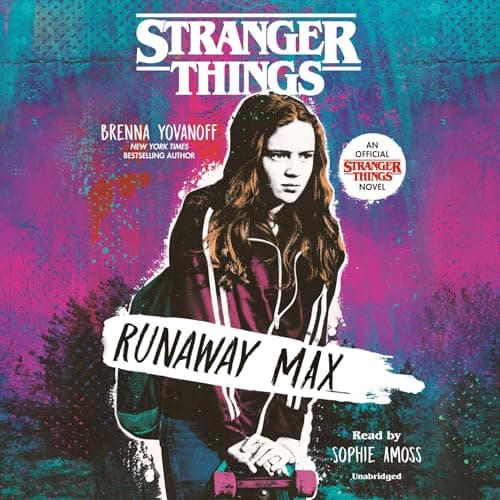

What happens when you take a character everyone already loves and rewind the clock to before she showed up in Hawkins? That's the gamble Brenna Yovanoff takes with Stranger Things: Runaway Max, and whether it pays off depends almost entirely on what you're looking for.
Let's get the narration out of the way first, because Sophie Amoss deserves serious credit here. She captures Max Mayfield's voice with an authenticity that borders on eerie—close enough to Sadie Sink's portrayal that you slip into the Stranger Things world without friction. Her Billy is particularly impressive, carrying the right amount of menace and volatility that fans will immediately recognize. The emotional beats land well, especially during scenes exploring Max's family dysfunction and her complicated, fear-laced relationship with her stepbrother. When Max is angry, Amoss sounds angry. When she's exhausted and beaten down, you hear it. This isn't a narrator reading words on a page; it's a performance that channels the character.
The one legitimate knock against the narration is pacing. Amoss reads slowly—slowly enough that multiple listeners report bumping the speed to 2x or even 2.5x without losing anything. At its natural pace, the five-hour runtime can feel padded. At 1.25x or 1.5x, it hits a sweet spot where the emotional delivery still registers but the momentum doesn't stall.
Now, the story itself. This is where things get complicated. Runaway Max functions as a prequel that covers Max's life in California before the Mayfield-Hargrove family relocated to Indiana, then walks through Season 2 events from her perspective. The California material is genuinely interesting—her skateboarding life, her friendships, the slow deterioration of her home environment as Neil Hargrove's abuse reshapes everything. Yovanoff writes Max's internal world with real care, and hearing her process the chaos around her adds emotional weight that the show, limited by screen time and ensemble storytelling, couldn't fully explore.
But here's the tension: once the story arrives in Hawkins, it becomes a retelling. If you've watched Season 2—and if you're picking up this book, you almost certainly have—you're covering familiar ground. The arcade, the party dynamics, the Snow Ball. Seeing it through Max's eyes offers a different angle, sure, but the plot beats themselves hold no surprises. Some listeners have called this a straight recap, and that's not entirely unfair. It reads like YA fiction filling in margins that were already sketched.
Compared to something like Hawkins Horrors, which at least ventures into new narrative territory within the Stranger Things universe, Runaway Max plays it safe. I ran into a similar wall with The Near Witch, where the atmospheric character work was doing real heavy lifting but the plot kept reminding me I already knew where everything was headed. It's a character study wrapped in a retelling, and how much that appeals to you depends on whether you find Max's inner life sufficient reward for revisiting events you already know the outcome of.
What saves the audiobook from feeling disposable is the abuse storyline. Yovanoff doesn't flinch from the reality of what Max lives with—Neil's violence, Billy's escalating aggression, her mother's inability or unwillingness to protect her. These scenes carry genuine weight, and Amoss delivers them with restraint that makes them hit harder. There's no melodrama, just a kid processing an impossible situation. For younger readers or listeners who connected with Max on the show, this context transforms her from "cool skateboard girl" into someone whose toughness has a cost.
The book works best as a companion piece rather than a standalone experience. If you're deep in the Stranger Things fandom and want to spend more time with Max specifically, the audiobook format is actually the ideal way to consume this—Amoss's performance elevates material that might feel thin on the page. If you're looking for new lore, new monsters, or narrative surprises, this isn't it.
At just over five hours, it's a quick listen even at normal speed. I found it worked well during a long drive—engaging enough to hold attention but not so plot-heavy that a missed minute costs you. The emotional core keeps it from becoming background noise, but it doesn't demand the kind of focused attention a mystery or thriller would.
Who Should Listen (And Who Should Skip)
If you're a Stranger Things fan who specifically wants to understand Max better—her anger, her resilience, the family mess she's carrying—Sophie Amoss makes a strong case for the audio format. Skip it if you're after new mythology, Upside Down lore, or plot twists; this isn't expanding the universe so much as coloring in one corner of it. The story itself is solid if unsurprising—a well-crafted character portrait that happens to retrace steps you've already walked. Whether that's enough comes down to how much you care about the view from Max's skateboard.