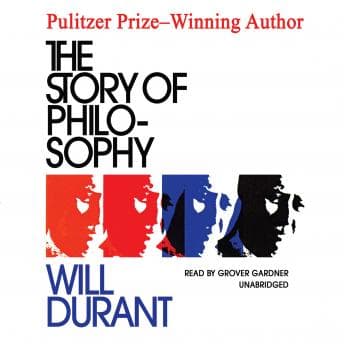

"The mind of Spinoza was one of the most logical that ever existed." Durant drops this line somewhere around hour eight, and I actually stopped chopping onions for a second — knife hovering mid-air over a pile of garlic — because of what came next. Durant doesn't just tell you Spinoza was logical. He walks you through the man's life as a lens-grinder, excommunicated by his own Jewish community at twenty-four, living in near-poverty while constructing one of the most rigorous ethical systems in Western thought. And suddenly you understand the why behind the philosophy. The motivation structure clicks into place.
This is what Durant does better than anyone I've encountered in intellectual history: he treats philosophers as case studies.
Why a Psychologist Fell Hard for a Philosophy Book
I study how narratives shape identity. That's literally my job. And what struck me about Durant's approach is that he understood something most philosophy textbooks get catastrophically wrong — you cannot separate a thinker's ideas from the life that produced them. Nietzsche's will to power reads differently when you know about his chronic illness, his isolation, his unrequited obsession with Lou Salomé. Kant's rigid categories make a strange kind of sense once Durant tells you the man never traveled more than forty miles from Königsberg in his entire life. Forty miles. My therapist would have thoughts about that.
The research actually shows that biographical context changes how people process abstract ideas — Durant was doing narrative psychology decades before we had a name for it. This same principle — that understanding the story behind the mind unlocks everything — is exactly what drew me to Wired for Love, which does something structurally similar: it refuses to hand you abstract frameworks until you understand the attachment histories that made those frameworks necessary. He gives you Plato's aristocratic background, his disillusionment with Athenian democracy, and then the Republic stops being a dry political treatise and becomes what it really is: one man's grief-fueled blueprint for a world that wouldn't execute his teacher.
I found myself asking: why does Durant choose these philosophers? Why Voltaire and not Descartes? Why Schopenhauer at length but Hegel mostly as a foil? The selection reveals Durant's own psychology — he's drawn to thinkers who lived dramatically, who suffered, who were contradictions wrapped in systems. He's a storyteller first, a scholar second, and he's honest about it. That honesty is rare and I respect it enormously.
Grover Gardner's Steady Hand on Nineteen Hours of Dense Material
Let me be real: this is a 19-and-a-half-hour audiobook about Western philosophy. That's a commitment. It's not a beach listen. I spread it across two weeks of morning jogs and late-night cooking sessions, and the pacing worked best when I could give it genuine attention — not background-friendly at all.
Grover Gardner earned that Earphones Award. What makes his narration effective here specifically is restraint. Durant's prose is already rich — sometimes baroque, honestly — with long sentences that build and build toward these devastating little conclusions about human nature. Gardner doesn't compete with that. He reads with warmth and precision, never dropping a line, never overselling Durant's already considerable rhetorical flourishes. When Durant gets sardonic about Schopenhauer's misanthropy (a man who loved his poodle more than any human being), Gardner lets the deadpan do the work. When the prose turns genuinely passionate about Spinoza or Voltaire, there's a slight lift in his delivery that feels earned rather than performed.
No vocal character work here — this isn't that kind of book. It's one man reading another man's ideas clearly, and that's exactly what it needs to be.
The Cracks in the Monument
I'd be lying if I said the whole thing holds up evenly. Durant published this in 1926, and certain passages carry the confident generalizations of that era. His treatment of Eastern philosophy is essentially nonexistent — the title says "Greater Philosophers" but what he means is "Western European philosophers, mostly." The chapter on Spencer has aged poorly because Spencer himself has aged poorly. And Durant's prose style, while gorgeous in stretches, occasionally tips into a kind of breathless reverence that made me want to push back. (Psychologically, this doesn't track — no one is as consistently brilliant as Durant sometimes implies his favorites are.)
But here's the thing. The flaws are the flaws of ambition. Eleven years of research distilled into something a non-specialist can actually enjoy. That's not nothing.
Who Gets the Most From This
If you want rigorous academic philosophy, this isn't it. Go read the primary sources. But if you want to understand why these ideas emerged from these specific human beings at these specific moments in history — if you care about the psychology of thought — this is a fascinating case study in how biography and philosophy are really the same discipline wearing different clothes.
Best for: focused listening, long commutes, anyone who ever wanted to understand Nietzsche but bounced off Thus Spoke Zarathustra (no shame, that book is unhinged). Not best for: multitasking, anyone wanting contemporary or non-Western perspectives.
I started this audiobook because I needed a break from my own research. I finished it with three pages of notes for a paper I didn't know I wanted to write. Durant would probably appreciate that.