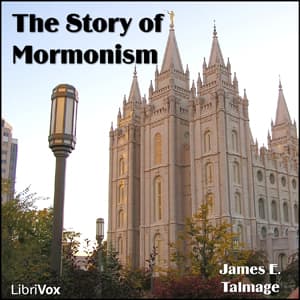

James E. Talmage was a scientist who became an apostle, and that combination makes this little book one of the more unusual religious texts I've encountered in twenty years of teaching rhetoric.
I say "little" because at just under two hours, this is barely longer than a faculty meeting - and considerably more interesting than anything Principal Martinez has put together. I listened to it on a Sunday morning walk along the lakefront with Denise, who raised an eyebrow when I told her I was swapping out our usual Dickens for Mormon theology. But here's the thing: this isn't really theology. It's something rarer. It's an academic standing in front of secular university audiences at Michigan and Cornell in the early 1900s, trying to explain his faith to people who mostly thought his people were strange at best, dangerous at worst.
A Chemist Explains His God
What struck me immediately is Talmage's rhetorical strategy. This is a man trained in geology and chemistry - he was a university president, for crying out loud - and he structures these lectures the way a scientist presents findings. He doesn't plead. He doesn't evangelize in the sweaty, tent-revival sense. He lays out the historical claims of the Latter-day Saint movement with the careful precision of someone writing a lab report, then steps back and lets you draw conclusions. It reminds me of what Hemingway said about the dignity of movement, the iceberg theory - except Talmage's iceberg is Joseph Smith and the entire restoration narrative, and he's showing you just enough above the waterline to make you curious about what's underneath.
Now, does this mean the text is objective? No. Talmage is a believer writing for believers and curious outsiders. He's not pretending otherwise. But there's a formality to his prose, a 19th-century academic register, that gives it a different texture than most religious literature I've encountered. The prose deserves to be savored, even when you disagree with the premises. My students would hate this. I love it.
Nathan Markham and the Challenge of Measured Prose
Markham's narration is... fine. I want to be honest here because the research didn't give me much to work with on his performance specifically, and I'm not going to invent praise or complaints. What I can say is this: the material itself is lecture-based, which means the narrator's job is essentially to deliver academic prose without putting you to sleep. Markham maintains a steady, clear delivery - no dramatic flourishes, no character voices (there aren't really characters to voice), just clean reading of dense expository text. For a LibriVox production, the audio quality is acceptable, though you'll notice it lacks the polish of a studio recording.
The challenge with narrating Talmage is that his sentences are long and architecturally complex - subordinate clauses stacking on subordinate clauses like a Victorian house that keeps adding rooms. A narrator who understands that pause is punctuation could elevate this material significantly. Markham mostly keeps up, but there are stretches where the cadence flattens out and you lose the thread of Talmage's argument. At 1h 50m, it's not a huge commitment, so this never becomes a dealbreaker.
Who This Is Actually For
Let me be direct. If you're looking for a deep dive into LDS doctrine, this isn't it - Talmage wrote other, much longer books for that (Articles of Faith, Jesus the Christ). This is the elevator pitch version, the "here's what we believe and why we're not as strange as you think" presentation, frozen in early 20th-century amber. If you loved reading primary source documents from religious movements - the way you might read Wesley's journals or William James's Varieties of Religious Experience - this is its spiritual successor in miniature.
For me, the value was rhetorical. I teach kids how to construct arguments, how to read for persuasion, how to identify audience awareness. Andy Stanley's Irresistible is doing something structurally similar - a believer making a careful, reasoned case to a skeptical audience - though Stanley's register is far more contemporary and considerably less patient with historical complexity. Talmage at Cornell, standing in front of an audience that probably viewed Mormons the way most Americans did in 1910 - with suspicion and half-formed prejudices - choosing precision over passion? That's a masterclass in knowing your audience. I might actually assign excerpts next semester. (My students will not thank me.)
But if you're coming to this hoping for narrative momentum, for story in the novelistic sense, you'll be disappointed. The title says "Story" but Talmage means it in the archival sense - this is a historical account, not a page-turner. And at under two hours, it doesn't overstay its welcome, which is more than I can say for most things in my life.
The Assignment I'd Give Myself
Worth hearing once if you're curious about early LDS self-presentation, or if you teach rhetoric and want a clean example of academic apologetics aimed at a skeptical audience. It's free, it's short, and Talmage's mind is genuinely interesting even when you're not buying what he's selling. Not every book needs to change your life. Some just need to make your Sunday walk a little more interesting than usual. This one did that. Denise still prefers Dickens, though.