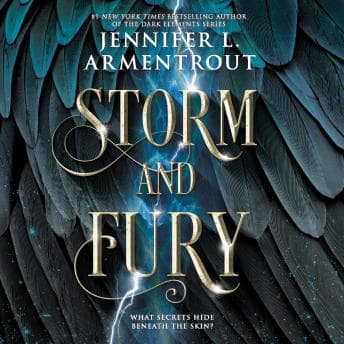
What happens when you grow up in a house where Goosebumps was considered gateway literature to eternal damnation, and then you spend your adult life cataloging the Dewey Decimal section for occult fiction? You develop a finely tuned radar for supernatural stories that actually earn their scares versus ones that just dress up in monster costumes. Storm and Fury lands somewhere in between, and I have feelings about it.
I was shelving returns at the library on a Saturday afternoon — one of those gray Oregon days where the fluorescent lights feel like they're the only thing standing between you and the void — and I had this playing through my earbuds. Which is maybe not the ideal vibe for a paranormal romance that's more romance than paranormal, but honestly? The demon-breach scenes hit different when you're alone in the stacks and the building is making those old-building sounds.
When the Forbidden Fruit Has Fangs and a Six-Pack
Let's get this out in the open: this is a Jennifer L. Armentrout book. If you know, you know. Trinity Marrow is eighteen, going blind, can see ghosts, and is hiding in a Warden compound because demons want to eat her for power-ups. That's a solid horror premise. And Armentrout does something smart — she grounds Trinity's vulnerability in her deteriorating vision, which means the sensory world narrows as the danger widens. That's genuinely unsettling when it works. That narrowing-senses-as-danger-escalates trick reminded me of the mounting claustrophobia in Lord of the Flies, where the island itself seems to shrink as the boys lose their grip — completely different genre, but the same suffocating narrative architecture.
But then Zayne shows up, and suddenly we're spending a lot of hours on banter and tension and the will-they-won't-they that Armentrout does in her sleep. And look — I'm not anti-romance in my horror. Some of the best horror leverages intimacy, uses trust as the thing that gets weaponized. The problem is that Storm and Fury keeps toggling between "demons are literally breaching the walls" and "but have you noticed how his eyes look in this light?" The tonal whiplash over 14 hours is... a lot. There are stretches in the middle where the supernatural war takes a back seat to relationship dynamics that feel more YA contemporary than dark fantasy.
That said — the fight scenes? The daring escapes? Those sequences crackle. When Armentrout commits to the horror elements, she actually commits. The compound breach is genuinely tense, and Trinity's inability to fully see what's coming at her adds a layer of dread that most paranormal romances wouldn't even think to exploit. Shirley Jackson walked so — okay, no. I can't say that here. This isn't that. But it understands that disability in horror isn't just representation — it's a narrative tool that changes how the reader experiences threat. That, I respect.
Lauren Fortgang and the Stuffy Nose Elephant in the Room
Here's where things get complicated. Fortgang's narration is genuinely expressive — her handle on Trinity's sarcastic, raw teenage voice is solid, and she can flip between male and female characters without that awkward pause some narrators need to mentally shift gears. During the suspense sequences, she leans in. The pacing tightens. You can hear her invest in the danger.
But — and I need to be honest because that's what we do here — there's a persistent nasal quality to her delivery that I noticed within the first hour and then couldn't un-notice. It's subtle enough that some listeners probably won't clock it. But for me, someone who listens to audiobooks the way a sommelier drinks wine (obsessively, in the dark, judging every note), it created a low-level distraction. Especially during quieter, emotional scenes where you need the voice to disappear and let the story breathe. Instead, I was aware of the voice as a voice. That's the opposite of what good horror narration should do.
The narrator commits in the action sequences. That's rare. But in the slower romantic beats — which make up a significant chunk of this 14-hour runtime — the delivery sometimes doesn't match the emotional register the scene demands. It's not bad. It's just... inconsistent. Like a flashlight that flickers during the best part of the haunted house.
Who Gets Devoured by This (And Who Walks Away)
If you're an Armentrout fan coming from the Lux or Covenant series, this is going to feel like coming home to a slightly haunted home. You'll love it. If you're a horror-first listener hoping the demons and Wardens and supernatural warfare are the main event — adjust your expectations. The paranormal elements are the skeleton, but the romance is the flesh. And at 14 hours, there's a lot of flesh. Storm Cursed scratches a similar itch — supernatural warfare front and center, with the creature politics dialed way up — but it doesn't pull its punches in favor of slow-burn tension the way this one does.
If you scare easily, this probably won't be the one that gets you. If you're here for the slow-burn romantic tension with a supernatural backdrop, this is your lane. My podcast listeners who want pure dread? I'd point them elsewhere. But the ones who DM me asking for horror-adjacent romance recommendations? This goes on the list.
Speaking of — I speed-listened portions of the middle third at 1.25x, and it actually improved the pacing. The story tightened, the banter moved faster, and I got to the next demon attack sooner. Take that as you will.
The Lights Stay On for This One
I didn't have to turn the lights on at 2 AM. Shirley (my cat) slept through the whole thing. But I finished it, and I'm curious enough about the Harbinger series to keep going — which says something. Storm and Fury isn't horror that respects the genre so much as horror that flirts with the genre while making eyes at romance across the room. And sometimes that flirtation is pretty fun.