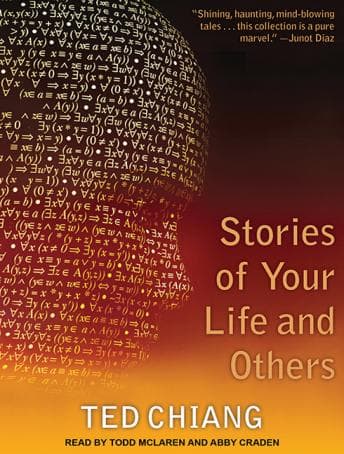

What happens when a writer treats science fiction not as escapism but as philosophy with a lab coat on?
I was walking the lakefront with Denise last Saturday — one of those rare October mornings where Chicago pretends it's not about to betray you with winter — and "Story of Your Life" hit the part where Louise Banks realizes that learning the heptapod language hasn't just changed how she communicates. It's changed how she experiences time itself. I stopped walking. Denise asked if I was okay. I wasn't, really. Not in a bad way. In the way you're not okay when someone hands you an idea so clean and so devastating that your brain needs a minute to catch up with your chest.
Ted Chiang doesn't write stories. He writes premises that unfold with the precision of a mathematical proof and the emotional weight of a eulogy.
The Kind of Smart That Doesn't Show Off
Here's what separates Chiang from ninety percent of science fiction writers I've encountered: he never confuses complexity with difficulty. "Tower of Babylon" imagines miners literally tunneling through the vault of heaven, and the cosmology is bizarre and ancient and specific — but the emotional core is just a man far from home wondering what's on the other side. "Understand" follows a man whose intelligence is chemically enhanced beyond comprehension, and Chiang somehow makes the escalating cognitive arms race feel intimate rather than clinical. The prose is stripped down, almost cold, but there's warmth underneath if you're paying attention. This reminds me of what Hemingway said about the dignity of movement of an iceberg — seven-eighths of it underwater.
My students would hate this. I love it.
The collection is uneven, and I think that's fine — maybe even honest. "Seventy-Two Letters" leans hard into alt-history nomenclature and Victorian automatons, and it's brilliant but demanding. "Division by Zero" is a gut-punch about a mathematician who proves that math is inconsistent, and the parallel story of her marriage collapsing works because Chiang never draws the metaphor for you. He trusts you. "Liking What You See: A Documentary" closes the collection with a fake documentary about a technology that disables our ability to perceive beauty, and it's structured as interviews and news clips — purely textual on the page, but hearing it performed adds a strange verisimilitude. Like you're actually listening to a radio documentary about a campus culture war.
Not every story lands with equal force. "Hell Is the Absence of God" is conceptually wild — angels literally appear and cause collateral damage like natural disasters — but it runs long for what it's doing. And the science in some pieces (thermodynamics in "Exhalation" — wait, that's the other collection) can feel like a lecture if you're not in the mood. But even the weaker entries have this quality of absolute intellectual honesty that I find rare.
Two Narrators, One Temperature
Abby Craden and Todd McLaren split the collection, and they share something important: restraint. These are not showy performances. No dramatic vocal fireworks, no character voices competing for attention. The narration sits at a low simmer, which is exactly right for prose this precise. Chiang's sentences are engineered. The narrator understands that pause is punctuation. I heard Craden bring that same measured calm to Out of the Dark, even when the story demands a chillier edge. Both Craden and McLaren read like they respect the architecture of each sentence — they're not decorating the house, they're showing you how it was built.
That said, if you're someone who needs energy from your narrator to stay engaged, this might test you. I was grading sophomore essays at 11 PM during "Seventy-Two Letters" and had to rewind twice — not because McLaren was doing anything wrong, but because the combination of Victorian naming conventions, passive voice in student papers about The Great Gatsby, and a measured narration pace nearly put me under. This is a focus-listening audiobook. No question.
The prose deserves to be savored. I listened at 1.0x and I'd argue anything faster would flatten the rhythm Chiang is building, especially in "Story of Your Life," where the tense shifts between past and future are doing real structural work that you need to hear unfold.
Who Gets the Most Out of This
If you loved Borges or Lem — writers who treat ideas as characters — this is their spiritual successor in English. If you watched Arrival and thought "that was beautiful but I want the version that trusts me more," the title story will wreck you in the best way. If you're a genre reader tired of world-building bloat, Chiang accomplishes in 30 pages what most authors need 600 for. Then again, The Butcher's Masquerade runs gloriously long and loud, and I loved it for exactly the opposite reasons.
Skip this if you need plot momentum or if cerebral pacing makes you restless. No shame in that. But know what you're passing up.
Worth Pausing the Faculty Meeting For
Ted Chiang writes like someone who believes ideas have feelings. That sounds pretentious. It isn't. "Story of Your Life" alone — with its circular structure, its alien linguistics, its mother who knows everything that will happen and chooses it anyway — that story is why we still read the classics. Or why we'll teach Chiang alongside them someday. My 47 podcast listeners are getting an episode on this. Mom, try to stay awake for this one.