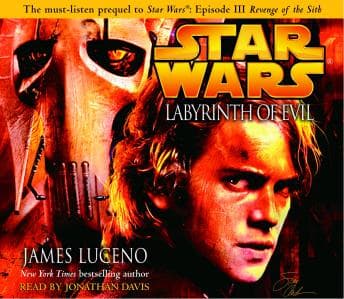

Look, I'll be honest — I came into this one slightly skeptical. Star Wars prequel-era novels have a reputation problem, and I say that as someone who will defend the prequels' world-building until my dying breath. But Labyrinth of Evil kept getting name-dropped in every "best Star Wars Legends" thread I stumbled into while absolutely not writing my thesis at 2 AM, so I figured five hours was a low-risk commitment. And yeah, I was wrong to doubt it.
This book does something I didn't think was possible: it made me care about the political chess game leading into Revenge of the Sith more than the lightsaber fights. Don't get me wrong, the action is there. But James Luceno is playing a different game here.
The Sith Lord Hunt Is Basically a D&D Investigation Arc
The core premise — Obi-Wan and Anakin chasing breadcrumbs from a captured holotransceiver to track down Darth Sidious — reads like the best kind of mystery campaign. You know, the one where your DM has been planting clues for six sessions and you're finally connecting dots on the cork board. Luceno structures it as this galaxy-spanning investigation hopping from Neimoidia to Charros IV to the Outer Rim, and the whole time Sidious is just... ahead of them. Every single time. It's less "action thriller" and more "procedural detective story in space," which honestly? My D&D group would love this. That slow tightening of the noose that never quite closes. It's the same satisfaction I chased in Ready Player One — that feeling of watching someone methodically work a puzzle where the stakes keep quietly escalating under the surface.
What makes it work is that Luceno clearly did his homework on the broader Clone Wars lore. He's connecting threads from the films, from other Legends books, layering in references to the Separatist Council dynamics and Dooku's increasingly uncomfortable position as Sidious's pawn. This is Sanderson-level world-building, except instead of a magic system it's the political machinery of how a Republic collapses from the inside. The info-dumps about Separatist strategy and Jedi Council politics are genuinely interesting because they make Palpatine's eventual victory feel earned and inevitable rather than just "well, the script said so."
If you don't like info-dumps, this isn't for you. (But you're wrong.)
Jonathan Davis vs. Marc Thompson: A Star Wars Narrator Cage Match
So here's the thing — most people talk about Marc Thompson when they talk about Star Wars audiobooks, and rightfully so. But Jonathan Davis is doing something different and arguably just as effective for this particular story. His Yoda doesn't sound like a Yoda impression; it sounds like someone channeling the rhythm of how Yoda speaks and letting the vocal texture follow naturally. His Count Dooku has this aristocratic weariness that Christopher Lee would've approved of. And his Anakin — man, his Anakin walks this line between confident Jedi Knight and someone you can feel the darkness creeping into. There's an impatience in the voice that's subtle but absolutely there.
The sound effects deserve their own mention. This is an abridged production (which, okay, that stings a little — I always want more), but the blaster fire, lightsaber hums, and ship engines are woven in throughout the action sequences in a way that doesn't feel gimmicky. It's closer to an audio drama than a straight narration during the combat scenes, and at five hours the pacing is tight. Davis drives through this thing like he's got somewhere to be, which works for a book that's essentially one long escalating chase.
Steven Pacey walked so other narrators could run, but Davis is sprinting in his own lane here. He's not trying to give you a full theatrical performance — he's giving you a war reporter's urgency, and for a story about the final desperate moves before everything falls apart, that's exactly right.
The Abridged Problem (And Why I'm Still Recommending It)
I need to flag this: it's abridged. Five hours for a full Star Wars novel means stuff got cut, and you can feel it in spots where transitions between planets happen a little too fast, where character moments that probably breathed in the text version get compressed. I read this instead of writing my thesis and I still wanted more, which tells you something. If an unabridged version existed, we'd be having a different conversation about the rating.
But what's here is lean and propulsive. The progression is satisfying — each planet, each clue, each near-miss with Sidious ratchets the tension up. And the final act, where Sidious launches his coordinated campaign to scatter the Jedi across the galaxy (setting up literally everything in Episode III), hits different when you've followed the investigation that almost stopped it.
Who Gets a Seat at This Table
If you're a prequel-era fan who wants the connective tissue between Clone Wars and Revenge of the Sith — this is essential. If you need your Star Wars to be dogfights and Force powers every chapter, you might bounce off the investigative pacing. And if you're allergic to abridged audiobooks on principle, I get it. I really do.
But five hours on a focused afternoon with good headphones? Yeah. Worth it.
Roll for Initiative on This One
This isn't the flashiest Star Wars audiobook out there. It's the smart one. The one that makes you realize Palpatine's endgame was a fifty-move chess problem and the Jedi were playing checkers. Davis's narration matches that energy — controlled, precise, building tension through intelligence rather than spectacle. At five hours it's a quick session, and the abridged format means you're getting the highlight reel rather than the director's cut. But it's a damn good highlight reel.