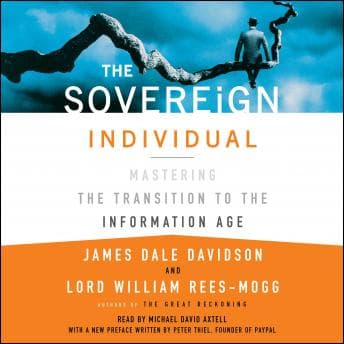

This book predicted Bitcoin, remote work, and the decline of nation-state authority — in 1997.
I need to say that again. Davidson and Rees-Mogg wrote this before Google existed, and they basically described the entire crypto-libertarian thesis that wouldn't become mainstream for another two decades. Reading it now is like finding a git commit from 1997 that contains code for features your team just shipped last quarter. It's eerie. It's also — and I need to be honest here — about 10 hours longer than it needs to be.
When Your 90s Investment Book Becomes a Prophet
The core thesis is genuinely fascinating: as information technology makes violence more expensive and knowledge more portable, the power of traditional governments will erode because their entire business model is based on a monopoly on force within geographic boundaries. When your most valuable assets are in your head (or on a blockchain, though they didn't have that word yet), you can just... leave. And governments can't do much about it.
They draw this out through a framework of what they call "megapolitical" transitions — from hunter-gatherer to agricultural to industrial to information societies. Each transition fundamentally reshapes who holds power and how wealth is created. The agricultural revolution empowered landowners. The industrial revolution empowered factory owners and the nation-states that taxed them. The information revolution, they argue, will empower individuals who can take their productivity anywhere.
The parts where they nail predictions are genuinely thrilling. They describe something that is unmistakably cryptocurrency — digital money outside government control — decades before Satoshi's whitepaper. They predict that high earners will increasingly become "sovereign individuals" who shop for jurisdictions the way you shop for cloud providers. They foresaw the hollowing out of middle-class employment in developed nations.
But here's where it gets complicated. They also predicted the complete collapse of the welfare state by roughly... now. They expected democratic governments to essentially dissolve. They have this very specific aristocratic disdain for democracy that gets uncomfortable — Rees-Mogg was literally a Lord, and you can feel it. There's a recurring implication that the masses are essentially parasites on the productive class, and I kept thinking about how that reads when you're a W-2 employee sitting on Caltrain at 6:15 AM next to other people who are also clearly not parasites.
19 Hours Is a Lot of Hours for a Book That Could've Been a Blog Post. Well, Maybe a Very Long Blog Post.
The ROI on this audiobook is... complicated. The first 6-7 hours are genuinely electric. The historical analysis of how violence economics shaped society is the kind of framework-shifting stuff that makes you pause your audiobook and stare out the train window while your brain reorganizes. But by hour 12, they're repeating their core arguments with slightly different historical examples, and by hour 16, I was at 1.75x and still checking how much was left.
Michael David Axtell does a competent job with the narration — clear, steady, handles the dense economic terminology without stumbling. He's capable of more — his work on Dark Moon, Shallow Sea has actual texture and energy, which makes the flatness here feel like a choice, or a missed opportunity. But it's very much a "reading a textbook aloud" performance. No personality, no rhythm changes when the material gets exciting versus when it's dry. For a 19-hour listen, you really need a narrator who can modulate energy, and Axtell stays pretty flat throughout. I found myself drifting during the middle chapters in a way that wasn't just the 6 AM brain fog.
I actually had to relisten to chunks of chapters 7 through 10 because I'd zone out during what turned out to be important setup for later arguments. This is NOT a half-asleep commute book. It demands genuine attention, and the narration doesn't do enough to pull you back when your mind wanders.
Who Should Commit to This 19-Hour Investment
If you're in tech and you've heard people reference this book — Peter Thiel wrote the new preface, half of crypto Twitter treats it like scripture — just listen to it so you have the primary source instead of secondhand takes. But be strategic about it. The first third is genuinely worth your time. The middle third is where you bump to 1.75x. The last third has some good payoff mixed with repetition.
Skip this if you want actionable advice. Despite the subtitle about "mastering the transition," there's very little practical guidance. It's a macro-level prediction book, not a playbook. Also skip if libertarian economic philosophy makes your eyes roll — the authors' political priors are baked into every chapter, and they don't pretend otherwise.
Perfect for: focus sessions, long flights. Skip for: commute, gym.
The thing is, even when I disagreed with their conclusions or got frustrated with the pacing, I kept thinking about their framework. It's been two weeks since I finished and I'm still applying their "megapolitical" lens to things I read in the news. That's the sign of a book that actually rewires something, even if the listening experience itself was uneven. I just wish someone would release a 6-hour abridged version that cuts the redundancy. The signal-to-noise ratio is roughly what you'd expect from a 90s investment book written by two guys who clearly got paid by the word.