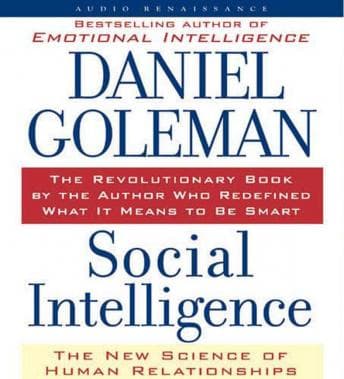

Daniel Goleman wrote the book that launched a thousand corporate training decks with Emotional Intelligence. Now he's back with the sequel nobody asked for but - and I'm a little annoyed to admit this - everybody probably needs.
I finished Social Intelligence during a late Sunday prep session for a Monday client meeting, the kind where you're building a deck about "organizational culture" and wondering if anyone in the room actually understands what that means. Twelve hours of audiobook later, I have a better neurological explanation for why that client's leadership team can't stop sabotaging each other. Whether that helps me fix it is another question entirely.
Your Brain on Other People
The core thesis here is straightforward: we are neurologically wired for connection, and our relationships literally reshape our biology. Goleman walks through mirror neurons, spindle cells, the amygdala's hijack function in social settings - the whole apparatus your brain uses to read a room before your conscious mind even clocks in. He calls it the "low road" versus the "high road" of social processing, and once you understand this framework, you start seeing it everywhere. The boss who kills morale by walking in tense. The parent whose anxiety becomes the kid's anxiety. The doctor whose bedside manner actually affects patient recovery at a cellular level. Viola Davis traces something similar in Finding Me — the way other people's emotional states became load-bearing walls in how she understood herself, long before she had language for any of it.
This is what my parents did instinctively. Now it has a TED talk.
My mom could read a customer walking through the door of the dry cleaners in about two seconds flat - upset about a stain, in a rush, lonely and wanting to chat. She didn't need social neuroscience to tell her that emotional contagion is real. But Goleman does something useful here: he gives you the biological why behind the instinct. And for someone like me who spends half his life trying to explain to founders why their "brilliant jerk" CTO is quietly destroying their company, having the neuroscience in your back pocket is actually worth something.
Where the Padding Lives
Here's the problem. Twelve hours. Twelve hours. The key takeaway is worth the listen. The other 7 hours? Not so much.
Goleman has a habit I've seen in a lot of pop-science authors - he'll introduce a genuinely fascinating concept (like how secure attachment in infancy predicts your ability to handle workplace conflict decades later), then illustrate it with three anecdotes when one would've landed. There's a stretch in the middle about empathy types - cognitive empathy, emotional empathy, empathic concern - that could've been compressed by half. And the section on "social awareness" in educational settings felt like it was written for a specific grant proposal audience, not a general listener.
My 2.0x speed couldn't save this one. Well - it helped. But at 12 hours, even at double speed you're giving six hours of your life. That's a lot for material that could've been a tight four-hour listen.
The thing is, when Goleman is good, he's really good. His explanation of how toxic relationships create chronic stress responses that suppress immune function? That hit different when I thought about a founder I worked with last year who was literally making himself sick trying to maintain a partnership with someone who treated every conversation like a dominance contest. That's not metaphorical damage - it's cortisol doing actual work on your body.
Boutsikaris Earns His Keep
Dennis Boutsikaris narrates with this steady, warm intelligence that's exactly right for the material. He doesn't oversell the science or turn the humanitarian passages into a charity PSA. There's a restraint here I appreciated - he trusts the content to do its work. No dramatic pauses before big revelations, no whispery gravity when Goleman gets into childhood trauma research. Just a clear, competent read that keeps you moving through even the slower sections. For a 12-hour science-heavy book, that's not nothing. A lesser narrator would've had me bailing by hour five.
Who Gets the ROI
If you manage people - and I mean really manage them, not just approve their PTO requests - this book pays for itself. Founders, team leads, anyone who's ever wondered why their "open door policy" isn't working. Also parents, but I'll let Jenny write that review.
If you've already read Emotional Intelligence and found it sufficient, this is going to feel like an expansion pack you didn't need. And if you're allergic to pop-science anecdote structure, your patience will be tested.
Skip to chapter 5. Thank me later. That's where the organizational and relational applications really kick in, and where the science stops being abstract and starts being actionable.
The Consulting Rate for This Advice
Bottom line: Goleman gives you a genuine framework for understanding why relationships aren't just "soft skills" - they're biological infrastructure. The science is solid, the applications are real, and about 60% of this book is genuinely excellent. The other 40% is the tax you pay for bestseller-length publishing norms. At 1.5x or 2.0x, it's a worthwhile investment. At 1.0x, you better really love anecdotes about mirror neurons in Italian monkey labs.