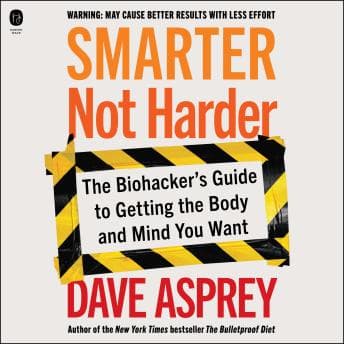

"Your body's operating system is lazy. Not broken—lazy." That line hit me somewhere around hour two, while I was aggressively over-salting a dal makhani at 10 PM on a Tuesday. And I thought: okay, Dave. You have my attention.
Because here's the thing. As someone who studies why humans do what they do—why we self-sabotage, why we resist change, why we'll binge-watch six hours of true crime but can't sustain twenty minutes of exercise—the central premise of Smarter Not Harder is actually psychologically sound. The idea that our bodies evolved to conserve energy, and that we're essentially fighting millions of years of biological programming every time we force ourselves through a grueling workout? The research actually shows this tracks. Asprey calls it "MeatOS," which—look, the branding is a lot, but the underlying concept borrows from legitimate evolutionary biology and metabolic science.
Your Body Is a Lazy Bureaucrat (And That's the Point)
Asprey's core argument is that traditional approaches to fitness and nutrition are essentially trying to brute-force a system designed to resist brute force. Instead, he proposes targeted "biohacks"—short, intense interventions that trick your body into adapting. We're talking about things like specific cold exposure protocols, REHIT (reduced exertion high-intensity training) sessions that last minutes instead of hours, and mineral-targeted eating strategies rather than caloric restriction.
What I found genuinely interesting is how he categorizes people into different "laziness types"—essentially metabolic profiles that determine why your body resists change in specific ways. It's reductive, sure. Any personality typology is. But as a framework for self-experimentation? It gives you something to work with. I found myself asking: why does Asprey frame optimization as a war against your own biology rather than collaboration with it? There's a fascinating case study in here about how Silicon Valley performance culture has repackaged discipline as "hacking," and whether that framing actually helps people or just adds another layer of shame when the hacks don't work.
(My therapist would have thoughts about the whole MeatOS metaphor, honestly. Treating your body like buggy software you need to patch rather than, you know, a body you live in.)
Dave Reads Dave, and It Mostly Works
Asprey narrates his own book, and he sounds exactly like you'd expect—confident, conversational, the kind of guy who corners you at a dinner party to explain why your morning routine is wrong. But he's good at it. His delivery of the technical sections—mitochondrial function, epigenetic signaling, HRV protocols—is clear enough that I didn't need to rewind constantly, which is saying something for a book this dense with acronyms. He has a natural teacher's cadence, slowing down for the complicated bits without being condescending.
The weakness? There's a sameness to his energy across eight and a half hours. Whether he's explaining cold plunge timing or sharing a personal anecdote about his own health journey, it's the same measured enthusiasm. No real peaks or valleys. By hour six, I was craving some emotional variation—a moment of vulnerability, maybe, or genuine frustration. The man has been through significant health struggles; I wanted to hear that in his voice, not just in his words.
Also: the supplemental PDF. If you're listening while jogging or cooking (guilty), you're going to miss the specific protocols and dosage recommendations that really need visual reference. This is a book that wants to be a workbook, and the audio format strains under that weight in places.
The Psychology of "Minimum Effective Dose" (And Who Actually Benefits)
Psychologically, this doesn't track in one important way. Asprey positions this as a book for everyone—the overworked parent, the busy professional, the person who's tried everything. But the biohacks he recommends assume a certain level of access: red light therapy devices, specific supplements, cold plunge setups, particular gym equipment. The "minimum effort" framing obscures the maximum investment required. If you're already in the biohacking ecosystem—you own a Bulletproof coffee setup, you know what BDNF stands for—this is apparently his best and most organized work. Multiple listeners I've seen describe it as the book where Asprey finally puts his scattered ideas into a coherent system.
But if you're coming in cold (pun intended)? The learning curve is steep. And the book doesn't always acknowledge that.
What makes this book genuinely useful, though, is the chapter on stress resilience and nervous system regulation. Asprey connects chronic stress to metabolic dysfunction in a way that's accessible without being dumbed down, and the practical interventions—specific breathing protocols, mineral supplementation for cortisol management—are among the most immediately actionable parts of the book. The nervous system piece especially landed for me—I kept thinking about how Stress Relief Meditations covers some of this same cortisol-and-breath territory, though from a much gentler, less optimization-obsessed angle.
Who Gets the Most Out of This
If you're already biohacking-curious and want a structured framework rather than scattered podcast tips, this is your book. If you're a skeptic who needs every claim triple-sourced with peer-reviewed citations, you'll be frustrated—Asprey references research but doesn't always distinguish between established science and his own extrapolations. And if you're looking for a standard diet-and-exercise plan, you're in the wrong aisle entirely.
The Prescription
I walked away from this one feeling like I'd attended a very thorough lecture by a very smart person who genuinely believes what he's selling—and some of what he's selling is solid. The laziness framework is clever. The targeted interventions are interesting. The narration is competent if monotone. But the gap between "smarter not harder" and "still pretty complicated and expensive" is wider than the book admits. Worth your time if you're already in this world. A steep onramp if you're not.