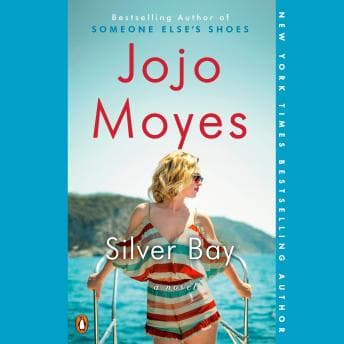

Everyone wants to talk about Me Before You. And look, I get it — that book hit like a freight train and Moyes earned every tear she wrung out of people. But here's the thing that's been bugging me since I finished Silver Bay on a Sunday morning walk along the lakefront with Denise: this earlier, quieter novel might actually be doing something more interesting with its central moral dilemma. It just doesn't announce it with a megaphone.
I'll be honest — the consensus that Silver Bay is somehow lesser Moyes almost kept me from pressing play. People kept saying it starts slow, that it lacks the gut-punch of her later work. And yeah, the first couple of hours take their time. You're settling into this ramshackle Australian hotel run by Aunt Kathleen, meeting whale-watching crews and a little girl named Hannah who's more perceptive than most of my sophomores. It felt like Moyes was building a diorama, placing each figure carefully before she let the story breathe. I almost switched to something else during a faculty meeting. (I didn't. Principal Martinez was talking about parking lot protocols. Liza McCullen's secrets were more pressing.)
But then something clicked around hour four or five, and I realized Moyes had been playing a longer game than I'd given her credit for.
The Con Man Who Doesn't Know He's the Villain
Mike Dormer is a fascinating construction. He shows up in Silver Bay with his pressed shirts and London confidence, scouting locations for a resort development, and Moyes does something I genuinely respect — she makes you like him before you understand what he's there to destroy. The dual narration helps enormously here. Stan Pretty gives Mike this slightly bewildered quality, like a man who keeps bumping into furniture in a house he doesn't understand. When Mike starts rationalizing the development deal, Pretty's delivery has this thinness to it, this almost-too-smooth professionalism that lets you hear the self-deception underneath the words.
Nicolette McKenzie handles Liza with a kind of guarded warmth — you can hear the walls she's built. There's a restraint in McKenzie's voice during the scenes where Liza's past starts leaking through, and the narrator understands that pause is punctuation. She doesn't oversell the tragedy. She lets the silence around Liza's revelations do the heavy lifting, which is exactly right for a woman who's been running from something for years.
The two narrators create this quiet tension just by existing side by side. You're hearing the story from both perspectives and you know — you know — that one of these people is going to wreck the other's life. It's not a question of if, just when and how badly.
Whales, Real Estate, and Why Setting Isn't Just Scenery
This reminds me of what Hemingway said about the dignity of movement — the iceberg theory. Moyes puts so much of her thematic weight into the bay itself, the whales, the water. Silver Bay isn't just a backdrop. It's the whole argument. The whale-watching scenes carry this almost spiritual quality, and listening to them while actually looking at Lake Michigan — different body of water, same principle — made me realize how rarely contemporary fiction trusts nature to do moral work. The bay is Liza's sanctuary. It's Hannah's education. It's Aunt Kathleen's livelihood. And Mike wants to pave over it for jet skis.
Moyes isn't subtle about this, and she doesn't need to be. The environmental thread isn't a metaphor dressed up as a subplot. It's the actual stakes, and when the final third kicks in with its tragedy and its scramble for redemption, the emotional payoff works precisely because you've spent ten hours caring about this place and these creatures.
Where the Seams Show
I won't pretend this is flawless. Some of the secondary characters feel like types rather than people — the crusty fisherman, the protective local community closing ranks. And the romance between Mike and Liza follows a trajectory you can map from about hour three. My students would call it "predictable." I'd call it "traditional," which sounds better but means the same thing. The resolution, too, wraps up a little neatly for my taste. Life doesn't usually offer that kind of clean moral correction, and the novel's willingness to tie its bows so tightly is probably its biggest weakness.
But here's the counterargument I keep making to myself: predictability isn't a crime if the emotional architecture supports it. You know where a sonnet ends. You still read sonnets.
Who Gets the Assignment
If you loved The Bookshop by Penelope Fitzgerald — that same sense of a small community under siege by outside money and indifference — this is its spiritual successor with more emotional warmth and a coastal Australian setting. Sarah's Key scratches a related itch — that same dread of watching something irreplaceable get dismantled by forces that don't understand what they're destroying, though it reaches those stakes through a very different kind of history. It's also a solid entry point if you've only read Moyes's bigger hits and want to see where she was sharpening her instincts. Skip it if you need constant plot acceleration or if you're allergic to romance that takes its time.
The Grade I'd Write in the Margin
This is a B+ novel with A- narration. Moyes was already good here — not yet great, but good in ways that matter. The prose deserves to be savored, the dual narration earns its structure, and by the end I cared about these people and their water and their whales more than I expected to. Worth pausing the faculty meeting for. Not that I had a choice — I was already six hours deep by the time Martinez got to slide fourteen.