
Okay so here's the thing - I expected this to be another relationship self-help book I'd crank to 1.75x and forget by Thursday. The kind that could've been a blog post. Thirteen hours and fifty-three minutes later, I'm genuinely surprised that it... couldn't have been a blog post. Not even close.
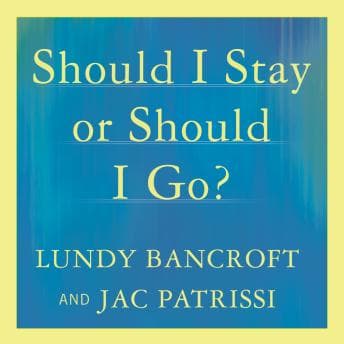
I started this at like 11PM on a Tuesday after Kevin and I had one of those dumb arguments about whose turn it was to clean the bathroom (his, obviously). The late-night-emotional-spiral audiobook pick is genuinely its own genre, and I've gone down that rabbit hole before - Lessons From Lucy was another one I started in exactly that headspace and ended up finishing across three commutes, though for much lighter reasons. I wasn't in crisis mode or anything - I just saw Lundy Bancroft's name and remembered a friend recommending Why Does He Do That? years ago. Figured I'd sample it. Ended up listening through my morning commute, then my evening commute, then another late night. Three full days of train rides plus change.
This Is Basically a Relationship Debugger
And I mean that as a compliment. Bancroft and Patrissi built what is essentially a diagnostic framework for relationships. As someone who literally debugs distributed systems for a living, I respect the architecture here. They don't just say "trust your gut" - they give you actual criteria, actual checklists, actual decision trees for figuring out whether your relationship is a healthy system under load or a fundamentally broken one that keeps throwing the same errors.
The book separates into two major tracks: evaluating whether your partner has what they call a "serious problem" (addiction, abuse patterns, deep-rooted control issues) versus a relationship that's genuinely difficult but still functional. That distinction alone is worth the listen. So many self-help books treat all relationship problems like they're the same severity level. This one doesn't. It triages. It helps you figure out if you're dealing with a P0 incident or just normal operational noise.
What caught me off guard is how much time they spend telling women to prioritize their own growth regardless of what they decide about the relationship. There's an entire section - and it's long - about preparing for life without your partner while still trying to make things work. That's a genuinely useful framework. It's not "leave him" or "stay and fix it." It's "build yourself up so that whatever you choose, you're choosing from a position of strength, not fear."
14 Hours Is A Lot of Self-Help - But Here's Why It Works
Let's address the elephant: nearly 14 hours for a relationship guide is... a commitment. Most books in this category clock in at 6-8 hours. And yeah, there are stretches that feel repetitive - the authors circle back to the same core principles multiple times, which I think is intentional (reinforcement for listeners who are in emotional fog) but can feel like padding if you're tracking the logic clearly.
Stephen R. Thorne narrates, and he's solid. Not Ray Porter (nobody is Ray Porter), but he's got this calm, steady delivery that works well for material that's essentially asking you to sit with uncomfortable truths. He's won multiple AudioFile Earphones Awards and you can hear why - the man reads like a therapist who actually likes you. No dramatic inflections where they don't belong, no condescension. For a book aimed at women in potentially abusive situations, that tone matters more than vocal fireworks.
At 1.5x, the pacing felt right. I wouldn't go higher - there are sections where you need to actually sit with what's being said, especially the parts about recognizing patterns of control versus normal conflict. Cranking it to 1.75x would've had me missing things I needed to catch.
Who Needs This (And Who Doesn't)
This is specifically for women in relationships where something feels off but they can't articulate what. If you're in that weird liminal space of "is this normal hard or is this actually broken?" - this is your book. It's also useful if you have a friend going through it and you want to understand the dynamics without giving bad advice.
If you're in a healthy relationship and just curious about relationship psychology, this will feel like reading documentation for a system you're not running. Informative but not actionable. And if you're looking for couples communication tips - wrong book. This is diagnostic, not prescriptive in that way.
Kevin asked what I was listening to and I told him it was "a relationship debugging manual" and he got very quiet for about thirty seconds before I explained I picked it up out of professional curiosity about decision frameworks. (Which is... mostly true.)
The ROI Calculation
The ROI on this audiobook is hard to quantify because it depends entirely on where you are in life. If you need it, really need it, it's priceless - one listener said it finally helped her "take the leap she long knew she needed to take," and that tracks with the book's energy. It's not pushing you toward any specific answer. It's giving you the tools to find your own.
If you don't need it right now, it's still a well-constructed framework for thinking about relationship health that's more rigorous than 90% of what's out there. Just know you're committing to nearly 14 hours.
Perfect for: commute, housework, walks. Skip for: gym (too much to process while doing deadlifts), falling asleep (you'll miss critical framework pieces).
TL;DR: Worth your commute if you're in the target audience. Bancroft and Patrissi built a genuine decision framework, not just feelings-validation dressed up as advice. Thorne's narration keeps it grounded. Just budget the time - this one earns its length, mostly.