
"The art of war is simple enough. Find out where your enemy is. Get at him as soon as you can. Strike him as hard as you can, and keep moving on."
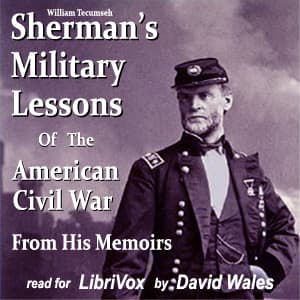
That's Sherman. No ornamentation, no hedging, no academic throat-clearing. Just a man who burned his way through Georgia telling you exactly how and why he did it. I came across this LibriVox recording - just 72 minutes of Sherman's concluding chapter from his 1875 Memoirs - while looking for something short to fill a Sunday morning walk along the lakefront with Denise. She was three steps ahead of me, pointing at the frozen lake and the dogs running on the beach, and I was nodding along while Sherman explained why cavalry should never be trusted with independent operations.
Sherman Talks Like He Fights
What struck me first - and what I kept turning over in my head for the rest of the walk - is how Sherman's prose mirrors his military philosophy. There's no wasted movement. He doesn't build elegant arguments the way Grant does in his own memoirs. Sherman enumerates. He categorizes. He lays out his thoughts on infantry versus cavalry, on the proper ratio of artillery to troops, on the logistics of feeding an army on the march, with the directness of a man writing a field manual disguised as autobiography.
This is why Liddell Hart called him the first modern general. You can hear it in sentences that feel less like 1875 and more like a twentieth-century staff college lecture. He talks about "moral effect" the way we'd now talk about psychological warfare. He discusses the railroad not as background detail but as the central nervous system of modern combat. There's a passage where he breaks down exactly how many pounds of supplies a single soldier needs per day, how many wagons that requires per division, and how that math determines everything about campaign planning. My students would hate this. I love it.
And here's the thing - this is just one chapter. Chapter 25. The conclusion. You're getting Sherman's distilled wisdom without the 30-hour commitment of the full memoirs. It's the man looking back at everything he did and saying: here's what I learned, here's what worked, here's where we got lucky.
David Wales and the Ghost of Uncle Billy
David Wales narrates this with a steady, unhurried authority that works surprisingly well for primary source material. There's no dramatic performance here - no attempt to "do" Sherman as a character. Instead, Wales reads Sherman's words the way a thoughtful professor might read them aloud to a seminar. The narrator understands that pause is punctuation. When Sherman shifts from discussing logistics to making a broader philosophical point about the nature of democratic armies, Wales lets the transition breathe.
One listener said Wales made them feel like they were listening to Sherman himself, and I get that. It's not impersonation - it's inhabitation. Wales trusts the text enough to stay out of its way, which is exactly what this kind of material needs. The pacing is measured, almost conversational, which matches Sherman's own writing voice.
That said - it's a LibriVox production. Single narrator, no production bells, no sound effects, no music. Clean audio, but you're getting volunteer-level recording, not Audible studio polish. For 72 minutes of a Civil War general's strategic analysis, that's perfectly fine. You're not here for atmosphere. You're here for the ideas.
Who Needs This (And Who Doesn't)
If you're a Civil War enthusiast who's read about Sherman but never read Sherman, this is your entry point. Seventy-two minutes. Free. No excuses. If you teach American history - and I say this as someone who watches colleagues across the hall do exactly that - play excerpts of this for your students. Let them hear a general explain why he made the choices he made, in his own words, without a textbook sanitizing the edges.
But if you want narrative, if you want the March to the Sea described in vivid detail, if you want battle scenes - this isn't that chapter. This is Sherman the analyst, not Sherman the storyteller. It's strategic reflection, not memoir in the dramatic sense. Go in expecting a lecture from the smartest, most dangerous man in the room, and you'll be fine. I will say this much - the older I get, the more I find myself drawn to texts that ask something of the reader, which is part of why I spent a few weeks earlier this year sitting with The New Testament, another collection of voices that trusts you to do the interpretive work yourself.
This reminds me of what Hemingway said about prose - that the dignity of movement of an iceberg is due to only one-eighth of it being above water. Sherman's military lessons are the visible eighth. Below the surface is everything he saw, everything he lost, every town he watched burn. He doesn't need to describe it here. He's already lived it.
The Lesson After the Last Bell
I finished this before Denise and I made it back to the car. She asked what I was listening to and I said "a war criminal explaining supply chain management," which is reductive but not entirely wrong. Sherman is complicated. His strategic brilliance is inseparable from the devastation he inflicted. This chapter doesn't grapple with that tension - it's pure military analysis - but knowing the context makes every calm, rational sentence land differently.
Worth pausing the faculty meeting for. Actually, worth pausing almost anything for, if you've got 72 minutes and any interest in how America's bloodiest war shaped modern military thinking. It's free, it's short, and Sherman's prose deserves to be savored - even when what he's describing is the most efficient way to destroy a railroad.








![Steve Jobs [unabridged audiobook] audiobook cover](/_next/image?url=https%3A%2F%2Fcovers.audiobooks.com%2Fimages%2Fcovers%2Ffull%2F9788499923406.jpg&w=1920&q=75)