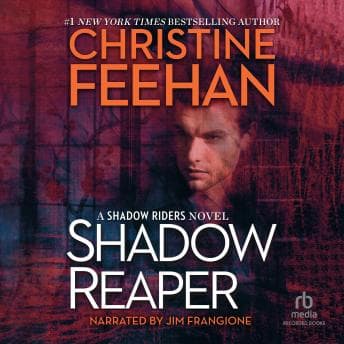

Look, I need to be upfront about something: this isn't really horror. I know it's tagged that way, and yes, the Shadow Riders series has paranormal elements - riders who can travel through shadows, a crime family with supernatural abilities - but let's be honest with each other. This is paranormal romance with some dark dressing. And that's fine. But if you're coming in expecting dread, you're going to get something very different.
I picked this up because the shadow-riding concept genuinely intrigued me. Supernatural abilities tied to literal darkness? People who move through shadows as a means of enforcement and justice? That's a horror premise waiting to happen. Feehan doesn't take it there, but the worldbuilding around the shadow rider mythology is legitimately interesting, and it's the thing that kept me listening through nearly fourteen hours.
The Rope and the Rider
Here's where Shadow Reaper does something I wasn't expecting: it integrates Shibari - Japanese rope bondage - as both a character trait and a plot mechanism. Ricco Ferraro isn't just a billionaire with a dark past (though he is absolutely that, in the most romance-novel way possible). He's a practitioner of Shibari, and the scenes involving it are treated with genuine care and cultural specificity. Feehan did her research, or at least enough of it to make those sequences feel intentional rather than exploitative. The way the rope work parallels the shadow riding - both requiring trust, precision, control - actually works as thematic connective tissue. I didn't expect that from a book where the male lead is described as a "billionaire playboy" in the synopsis.
Mariko, the female lead, has a backstory involving real danger and stalking that gives her agency in seeking out Ricco's protection - though I'll admit the execution sometimes tips into the kind of repetitive internal monologue where characters re-explain their trauma every few chapters. You'll hear Ricco's self-destructive guilt cycle at least four or five times. You'll hear Mariko's fear and determination restated with only slight variation. The writing has a looping quality that, over thirteen-plus hours, starts to feel like a GPS recalculating the same route.
Frangione in the Shadows
Jim Frangione does solid work here. Not spectacular, but solid - and in a book with this many Ferraro siblings, "solid" sometimes means you're squinting with your ears trying to figure out which brother is talking. The family scenes blur together vocally. When it's just Ricco and Mariko, though, Frangione finds something. The intimate scenes have genuine tension in his delivery, a kind of restrained heat that makes it feel like you're overhearing something private rather than being performed at. His handling of Japanese vocabulary is competent - not perfect, but respectful enough that it didn't pull me out of the world.
Where he really earns it is in the quieter moments of psychological weight. Ricco's self-loathing has this barely-controlled undercurrent in Frangione's voice, like a man trying very hard to sound fine. That restraint is more effective than any dramatic vocal performance would've been.
But - and I need to say this - when you've got six or seven Ferraro siblings in a room, you need more vocal differentiation than subtle inflection shifts. I lost track of who was speaking more than once, especially during the family meeting scenes. A little more vocal variety wouldn't have hurt.
Growing Up Forbidden
Here's my personal bias, and I'm owning it: I grew up in a household where this kind of book would've caused a full-scale spiritual intervention. The BDSM content, the paranormal elements, the explicit sexuality - all of it would've been confiscated and prayed over. So there's a part of me that finds genuine pleasure in listening to something like this at 11 PM, in the dark, in my apartment full of horror memorabilia, with Shirley curled up on the couch judging me. (She was, in fact, unimpressed. I was... moderately entertained.)
But my podcast listeners know I hold everything to the same standard: does it earn its darkness? Shadow Reaper earns some of it. The shadow rider mythology is genuinely cool. The Shibari integration is smarter than it needs to be. The threat against Mariko has real stakes. But the repetitive writing patterns dilute the tension, and the romance-genre scaffolding sometimes prevents the darker elements from breathing the way they could.
Who Gets Pulled Into This Shadow
If you're deep into paranormal romance and want worldbuilding that's more inventive than the standard vampire-werewolf rotation, this delivers. Fake It Till You Make It sits in that same paranormal-romance space and is worth stacking against this one if you're building out a playlist. If you're looking for horror with romantic elements, recalibrate your expectations. And if you need distinct character voices in your audiobooks to track a large ensemble cast, Frangione's subtlety might frustrate you during the family scenes.
I didn't regret the thirteen hours. But I didn't lose sleep over it either - and for me, that's always the measuring stick.