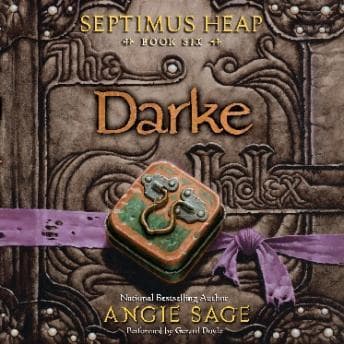

What happens when a kids' fantasy series decides to go full dark side six books in?
I was up way too late reorganizing my board game shelf — which is really just me pulling out Gloomhaven, staring at it, putting it back, and repeating — when I figured I'd throw on the next Septimus Heap book. I'd been working through the series as palate cleansers between heavier listens, and Darke had been sitting in my queue for weeks. Thirteen and a half hours later (okay, spread across a few days of thesis-adjacent procrastination), I have thoughts.
The Darke Domaine Is Basically a Dungeon Crawl
Here's what Angie Sage does that I genuinely respect in this installment: she commits. The Darke Domaine swallowing the Castle is essentially a zone-wide environmental hazard, and if you've ever run a session where a creeping darkness mechanic slowly shrinks the safe area on a map, you know exactly the vibe. Septimus entering the Darke feels like a mid-level character walking into a CR-way-too-high dungeon because the plot demands it. The tension is real — the stakes are bigger than anything the series has attempted before.
But here's where I side with some of the criticism I've seen floating around: book six doesn't quite have the charm of the earlier installments. Sage's humor is still there, but it gets crowded out by drawn-out arguments between characters that feel like they exist to pad runtime rather than advance anything meaningful. There are stretches — particularly some of the sibling conflicts — where I found myself thinking "okay, we get it, Simon Heap has issues, can we move on?" The bickering feels contrived in places where the earlier books would've handled the same interpersonal tension with a lighter, funnier touch.
That said, the payoff when everyone actually starts working together — Septimus, Jenna, Marcia Overstrand, even the estranged Simon — hits pretty well. There's something satisfying about watching characters who've been at odds pool their abilities like a properly balanced adventuring party. My D&D group would love the dynamic of Marcellus Pye and Alther Mella being pulled into the fight alongside the core crew. It's got that "unlikely alliance" energy that makes for the best sessions.
Gerard Doyle Carries the Weight
Look, I'm a Steven Pacey devotee. That's my north star. But Gerard Doyle has been quietly doing excellent work across this series, and by book six he's settled into these characters like they're old friends. His Marcia Overstrand is imperious in exactly the right way — you can hear the ExtraOrdinary Wizard authority dripping off every syllable. And he nails the tonal shift when the Darke stuff kicks in; there's a genuine menace in his delivery during the darker sequences that elevates what could be standard middle-grade spookiness into something that actually makes you sit up.
The consistency across six books is no joke either. Doyle doesn't reinvent anyone — you pick up right where the last book left off, voice-wise — and for a series this deep, that continuity matters. He's not flashy about it, but the comedic timing on Sage's humor beats still lands, and when he needs to shift into something more urgent or emotional, the transition feels earned.
No audio production bells and whistles here. No sound effects, no music, just Doyle and the text. For a kids' fantasy series, that's fine — the narration does the heavy lifting without needing support.
Where the Spell Weakens
My honest issue with Darke is pacing. At 13.5 hours, it's not unreasonably long for a fantasy book — I read this instead of writing my thesis, so clearly I had the time — but the middle section drags. The character conflicts that are supposed to create internal tension before the big Darke confrontation just... go on too long. Previous Septimus Heap books balanced the humor, the Magyk, and the adventure more deftly. This one leans heavier on the "Darke" side (fitting the title, I guess) but loses some of the whimsy that made the series special in the first place.
It's still a solid entry. The world-building remains strong — the way Magyk and Darke function as opposing systems with actual rules is satisfying in a way that reminds me why I loved these books to begin with. This is Sanderson-level world-building... for kids. And I mean that as a genuine compliment. Sage built something internally consistent and interesting. The closest thing I've encountered to that same internally-consistent, rules-have-consequences magic in a younger-audience package is Hans Christian Andersen's work in Fairy Tales and Stories — the logic of consequences in those old stories holds up in a way a lot of modern fantasy doesn't.
Roll for Initiative (Or Just Press Play)
If you've listened to the first five, you're obviously going to listen to this one. And you should — Doyle's narration is the best it's been, and the Darke Domaine stuff is genuinely cool. But if you're new to the series, absolutely do not start here. Go back to Magyk. This is a book that rewards investment in the world and characters, not a standalone.
Kids who like fantasy with real stakes will dig it. Adults who've been following along will notice the pacing issues but still enjoy the ride. If you don't like info-dumps, this isn't for you (but you're wrong). The progression is satisfying even when the journey there gets a little bumpy.