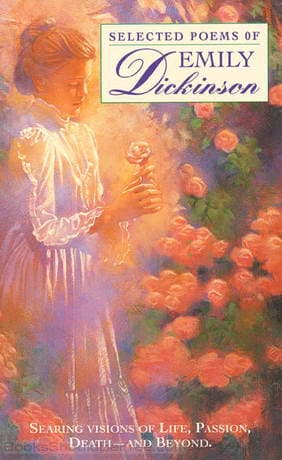

So here's the thing — everyone talks about Emily Dickinson like she's this fragile little recluse pressed between the pages of a high school lit textbook. Quiet. Delicate. Safe. And I bought that story for years. But listening to these poems read aloud, at night, with Diego curled on my chest and the glow of my monitor the only light in the room? Emily Dickinson is not safe. She's furious. She's aching. She's staring straight into the void and daring it to blink first. That same confrontational energy — the kind that refuses to look away from darkness — is something I've only found in a handful of other places, and one of them was Moby Dick, which I did not expect to wreck me the way it did.
I wasn't expecting to feel much from a 69-minute poetry collection. I figured it'd be nice background while I finished a logo set for a client. But by the third poem I'd stopped working entirely. My cursor was just sitting there, blinking, while Emily Dickinson dismantled me.
She Wrote Like Someone Pressing a Bruise on Purpose
What hits different in audio is how physical Dickinson's language becomes when it enters through your ears instead of your eyes. On the page, those dashes feel like quirky punctuation. Heard aloud, they become actual pauses — little held breaths — where you sit in the silence and feel the weight of what she just said. The poems about death aren't morbid. They're tender. Almost intimate, like she's sitting with death at a kitchen table, pouring it tea, asking it personal questions. And the ones about confinement — about a woman suffocating inside the "behavioral confines of her times," as the description puts it — those hit me somewhere I wasn't ready for.
Abuela never read Dickinson. She would've said it was too sad, too dark, waved her hand and turned on her novela. But the thing is, Abuela knew what it felt like to live inside walls someone else built for you. To smile when you wanted to scream. Dickinson knew that too. She just wrote it down in dashes and slant rhyme instead of living it out loud.
My heart. MY HEART.
Becky Miller Reads Like She's Sitting in the Same Room as Emily
Becky Miller's narration is — okay, let me be honest. It's not Julia Whelan. It's not going to wrap you in cashmere and whisper secrets. But there's a quietness to her delivery that actually works for Dickinson. She reads contemplatively, not performatively. She doesn't try to dramatize poems that are already doing all the emotional work on their own. It feels like someone reading to you from a book they genuinely love, in a room with good light, no rush.
Now. The annoying part. Before every single poem, there's this little announcement — narrator name, publisher credit. Every. Single. Poem. In a 69-minute collection. It's like someone tapping you on the shoulder right as you're about to cry. "Excuse me, just wanted to remind you who's reading this." I KNOW who's reading it, I've been here for the last forty minutes. This is a LibriVox production, so I get it — it's part of the format — but it genuinely disrupts the flow. You're sinking into the rhythm of Dickinson's language and then boop, commercial break. It knocked me out of the moment more than once, and in a collection this short, every interruption costs you.
If this were a longer audiobook, I'd adjust. But at just over an hour, those repeated intros eat up real emotional real estate.
A Rainy Sunday Book (That Lasts About Half a Sunday)
This is a rainy Sunday book. Full stop. It's not a commute listen. It's not background. It's the kind of thing you put on when you want to feel small in the best way — when you want to remember that someone 150 years ago felt the exact same impossible things you feel now and found words for them that still land like a fist to the sternum.
The brevity is both a gift and a limitation. At 69 minutes, it's a single sitting, which means you can experience it as one unbroken emotional arc. But it also means you're barely warmed up before it's over. I wanted more. I wanted to live in that space longer.
Listen at 1.0x. Obviously. You don't speed-run poetry. That's a crime.
Who This Is For (and Who Should Scroll Past)
If you've never really listened to Dickinson — like, heard her work spoken into your ears — this is a solid place to start. It's curated toward her darker, more rebellious work, which I personally love. If you're expecting the greatest-hits-only sunshine version, this isn't that.
If you're a stickler about audio production and repeated credits drive you up the wall, know what you're getting into. It's free-tier audio with a free-tier format.
But if you want to feel something real for an hour? If you want to sit with a woman who understood loneliness and rage and the terrifying beauty of not knowing what comes after? Pull up a chair.
The Dash Between the Words Is Where She Lives
I added three crying sessions to my spreadsheet. For a 69-minute poetry collection. Emily Dickinson remains undefeated. Abuela would have pretended not to like this one. But she would've listened twice.